Buying a Used Tesla Out of State: Shipping, Taxes & Registration Guide
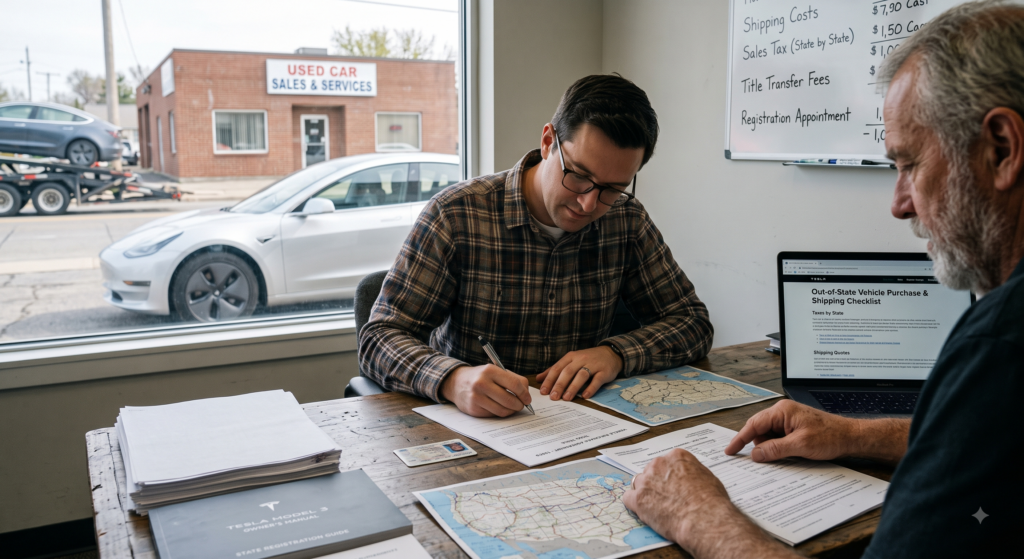
The used Tesla market in 2026 is no longer a local affair. The best deal on the exact Model Y Long Range with the precise paint color, interior, and Autopilot configuration you want is rarely sitting on a lot in your own zip code. It is more likely listed by a private seller in Austin, a small dealership in Phoenix, or a Tesla enthusiast in Seattle who just took delivery of a Cybertruck and is finally parting with their pristine 2021 Model 3 Performance. Expanding your search radius from fifty miles to five hundred—or five thousand—unlocks inventory that local buyers never see, often at prices that reflect regional depreciation patterns rather than your local market’s inflated demand.
But buying a used Tesla out of state introduces a parallel universe of logistical complexity that local transactions simply do not have. You cannot kick the tires in person before committing. You must navigate a patchwork of sales tax laws that vary wildly between states, some of which will attempt to tax you twice if you misunderstand the rules. You need to arrange vehicle transport across deserts and mountain ranges, trusting a stranger to load your new $35,000 electric vehicle onto a trailer without scraping the aero wheels or leaving the key fob in the cupholder. And when the truck finally arrives, you face a registration bureaucracy that demands specific documents, emissions exemptions, and sometimes a physical inspection that your Tesla may or may not pass depending on how strictly your state interprets “safety check” for a vehicle with no exhaust system.
This comprehensive guide walks you through every stage of the out-of-state purchase process. We explain how to evaluate distant listings with the same confidence as local ones, how to arrange transport without destroying your budget or your paint, how to calculate the true total cost including taxes and fees, and how to register your Tesla in your home state without making three trips to the DMV. Done correctly, an out-of-state purchase saves thousands and delivers exactly the vehicle you want. Done incorrectly, it becomes a multi-week nightmare of paperwork, surprise tax bills, and a Tesla that arrives with a cracked windshield and a dead 12-volt battery.
Why Buy Out of State? The Market Reality
The primary reason to look beyond your state borders is simple economics. Tesla prices are not uniform across the United States. Markets with high EV adoption rates, abundant Supercharger infrastructure, and strong environmental incentives—California, Washington, Oregon—have saturated used inventories that drive prices down. A 2020 Model 3 Standard Range Plus with 40,000 miles might list for $28,000 in Los Angeles while commanding $32,000 in rural Ohio, simply because supply is tighter in the Midwest and local buyers have fewer alternatives.
Conversely, states with harsh winters and road salt exposure—Minnesota, Michigan, upstate New York—often have lower prices for a different reason: buyers fear hidden corrosion, battery degradation from extreme cold, and the general wear that snow tires and gravel roads inflict. A savvy shopper in Florida can sometimes acquire a northern Tesla that was garage-kept and meticulously maintained for less than an equivalent local car, because the market stigmatizes all cold-climate vehicles equally.
Rare configurations also drive interstate searches. If you are hunting for a Model S Plaid with the Cream interior, 22-inch Turbine wheels, and Full Self-Driving, your local market may have zero examples while three sit in Denver, Atlanta, and Portland. The internet has transformed used car buying from a geographic lottery into a national marketplace, and Tesla’s standardized factory builds make long-distance purchasing more predictable than with legacy brands where regional option packages vary.
The risk, of course, is that you are buying a vehicle you cannot physically inspect before money changes hands. This risk is manageable, but it requires a different verification protocol than kicking tires in a parking lot.
Remote Verification: Inspecting a Tesla You Cannot Touch
Before you arrange transport or send a deposit, you must replicate the in-person inspection process remotely. This begins with demanding a video walkaround from the seller, not a series of carefully curated photographs. Ask for a 10-minute unedited video shot in daylight that shows every body panel, the panel gaps, the glass condition, the tire tread depth, the interior wear, and the touchscreen boot sequence. A legitimate seller will comply without complaint. A seller who refuses, offers only photos, or sends a video that suspiciously skips the passenger side rear quarter panel is hiding something.
Request an underbody photograph if possible, or ask the seller to visit a local Tesla Service Center or independent EV shop for a pre-purchase inspection (PPI). Many buyers balk at spending $150 to $300 on a distant vehicle they have not yet committed to, but this is the cheapest insurance you will ever buy. A professional technician can identify battery casing damage, suspension leaks, and door seal issues that no video will reveal. The inspection report becomes a negotiating tool: if the rear brake pads are at 10%, you deduct $400 from your offer. If the battery health scan shows 88% State of Health instead of the advertised 95%, you have grounds for a significant price reduction or a walkaway.
For private party sales, verify the seller’s identity through video call. Scammers operating out-of-state listings frequently use stolen photographs from other ads. A live video call where the seller shows you the vehicle in real time, starts it, opens the frunk, and displays the VIN plate on the dashboard proves they actually possess the car. Ask them to write your name on a piece of paper and place it on the windshield during the call—a simple anti-fraud measure that eliminates 90% of listing scams.
Use the Tesla App verification process remotely. The seller can add you as a temporary driver or share screenshots of the vehicle’s software version, remaining warranty dates, and service history. If they claim the battery shows 290 miles at 100% charge, ask for a timestamped photo of the energy graph. If they advertise Full Self-Driving, confirm the FSD badge appears in the software menu via screen share. Remote buying demands paranoid verification; every claim must be documented because you cannot physically challenge it until the vehicle arrives.
The Transport Decision: Drive, Fly, or Ship?
Once you have negotiated the purchase, you must get the Tesla to your driveway. You have three options, each with distinct costs, risks, and timeframes.
Option 1: Fly and Drive The most romantic option, and sometimes the most practical for shorter distances. You book a one-way flight, inspect the vehicle in person upon arrival, complete the transaction, and drive home. This works beautifully for purchases within 500 to 800 miles, where a single day of driving saves transport fees and gives you immediate possession. The downside is exposure: if the vehicle has hidden issues that the remote inspection missed, you are now committed and must either proceed with a compromised deal or absorb the cost of a wasted flight and a frustrated seller.
For longer distances, flying and driving consumes multiple days, requires hotel stays, and places hundreds of highway miles on your new purchase before you have had a chance to establish a baseline. It also complicates the title and registration handoff if your home state requires specific notarization or temporary permit procedures that differ from the seller’s state.
Option 2: Enclosed Auto Transport The gold standard for protecting your investment, particularly for higher-end Model S and Model X vehicles or Teslas with pristine paint and expensive wheel upgrades. Enclosed carriers shield the vehicle from road debris, weather, and prying eyes. They typically cost $1.00 to $1.50 per mile, meaning a cross-country shipment from California to New York runs $2,500 to $3,500. For a $45,000 Model X, this premium is justified. For a $22,000 Model 3, it may consume your entire purchase savings.
Enclosed transport also takes longer. Carriers wait to fill their trailers before departing, and cross-country routes can take 10 to 14 days from pickup to delivery. Ensure the transport company provides gap insurance and photographs the vehicle’s condition during loading. Reputable carriers specializing in EVs understand that Teslas cannot be towed with two wheels on the ground without damaging the drive units; they use flatbeds or specialized dollies. Verify this explicitly. A standard tow truck operator who drags your Model Y onto a hook lift without disconnecting the drivetrain can cause $5,000 in damage before the journey even begins.
Option 3: Open Auto Transport The economy option, costing roughly $0.60 to $0.90 per mile. Your Tesla rides on an open trailer alongside ten other vehicles, exposed to dust, gravel, and weather. Modern Teslas have robust paint, but open transport inevitably introduces minor paint chips, especially on the front bumper and hood. For budget buyers purchasing a higher-mileage daily driver, this is an acceptable trade-off. For perfectionists buying a low-mileage garage queen, it is a recipe for immediate paint correction expenses.
Open transport is faster and more widely available than enclosed. Major brokers like Montway, Sherpa, and AmeriFreight offer instant quotes and carrier networks that cover virtually every US city. When booking, specify that the vehicle is an inoperable electric vehicle if it cannot be driven onto the trailer under its own power—this changes the equipment required and the price. Also confirm that the driver knows how to operate Tesla door handles, charge port access, and the neutral tow mode if the vehicle must be winched.
Don’t risk buying a used Tesla from across the country without verified transport and remote inspection support. At Tesla.tl, we coordinate nationwide vehicle transport, pre-purchase inspections at partner service centers, and secure escrow payment so you can buy from any state with complete confidence. Browse interstate-ready listings at https://tesla.tl/.
The Tax Labyrinth: What You Actually Owe
Taxation is where out-of-state buyers most frequently stumble into expensive mistakes. The United States has no unified national vehicle sales tax system. Instead, you face a maze of sales tax, use tax, reciprocity agreements, and local county surcharges that can add thousands to your purchase or, in rare cases, result in double taxation if you handle the paperwork incorrectly.
Sales Tax vs. Use Tax When you buy a vehicle, you owe tax to the state where you intend to register and garage the vehicle, not necessarily where you purchased it. If you live in Colorado and buy a Tesla from a dealer in Texas, you do not owe Texas sales tax if the vehicle is immediately transported out of state. You owe Colorado use tax when you register the vehicle at your local DMV. The dealer may collect Colorado tax on your behalf if they have a business nexus there, or they may collect no tax at all, leaving you to pay the full amount at registration.
Private party sales add another layer. Most states require the buyer to report and pay use tax directly to their home state DMV during registration. The seller has no obligation to collect anything. If you assume that because you bought from a private seller in Oregon—a state with no sales tax—you owe nothing, you will be shocked when your home state in Nevada demands 8.25% of the purchase price before issuing plates.
The Credit for Tax Paid If you purchase from a dealer in a state with sales tax and that dealer collects tax at the point of sale, your home state will usually grant you a credit for taxes already paid, up to the amount you would have owed locally. Example: you live in Arizona (5.6% state tax) and buy from a California dealer who charges you 7.25% California sales tax. Arizona credits you the full 5.6% you owe them, and you do not pay Arizona anything additional. The extra 1.65% you paid to California is lost unless California offers a refund for out-of-state buyers, which they generally do not.
However, if you buy in a low-tax state and register in a high-tax state, you pay the difference. Buy in Montana (0% tax) and register in Louisiana (9.45% combined rate), and you owe Louisiana the full 9.45% at registration. There is no escape through interstate arbitrage; your home state always wins.
Temporary Permits and Transit Most states offer temporary transit permits or trip permits that allow you to drive or transport an unregistered vehicle for a limited period—typically 3 to 30 days. These cost $10 to $50 and are essential if you are flying to pick up the car and driving it home. Never assume you can simply slap your old plates on the new Tesla or drive without documentation. Law enforcement in every state treats unregistered vehicles harshly, and Tesla’s conspicuous profile makes it a magnet for traffic stops.
If you use a transport company, the vehicle does not need to be registered during transit. The carrier’s insurance and bill of lading serve as legal documentation. But the moment the truck drops the Tesla in your driveway, the clock starts ticking on your obligation to register and pay taxes in your home state. Most states allow 30 days before penalties accrue, but some are as short as 10 days.
Documentary Fees and Dealer Add-Ons Out-of-state dealers love to pad invoices with “documentary fees,”“dealer preparation charges,” and “transportation fees.” These are negotiable. A $499 doc fee is simply profit dressed as bureaucracy. When buying from out of state, insist on an itemized invoice before sending payment. Some states cap doc fees by law; others do not. If a dealer in Florida tries to charge you $1,200 in processing fees on a $30,000 used Tesla, that fee alone may erase the price advantage that drove you to their state in the first place.
Registration: Bringing Your Tesla Home Legally
Registration procedures vary by state, but the core requirements for an out-of-state used Tesla purchase are consistent enough to outline a universal protocol.
Step 1: Secure the Title The seller must provide a signed certificate of title. For dealer sales, this may be a reassigned title or a new title issued by the dealer’s state. For private sales, the seller signs the “Seller” field, you sign the “Buyer” field, and the odometer reading is recorded. Do not let the seller mail the title separately after payment. The title and the vehicle must travel together, or you have no proof of ownership.
If there is a lien on the vehicle, the process becomes more complex. The seller’s lender holds the title. You must either pay the lender directly to release the lien, or use an escrow service that holds your funds until the lien is cleared and the clean title is mailed to you. Never pay a private seller the full amount and trust them to pay off their loan. This is the most common scam in interstate private party sales: the seller takes your money, pays off the loan eventually (or not), and you wait weeks for a title that may never arrive because they had a second lien you did not know about.
Step 2: Obtain Insurance Before you can register the vehicle, you need proof of insurance with your new VIN listed. Contact your insurance agent during the purchase negotiation, not after the vehicle arrives. Most insurers can activate a policy effective the pickup or delivery date based on the VIN and purchase price. Tesla’s aluminum body construction and proprietary repair network mean that insurance rates vary significantly by state and carrier. A carrier that offers cheap rates in Ohio may charge a premium in California for the same vehicle. Shop quotes before you commit to the purchase.
Step 3: Emissions and Safety Inspections Here is where Tesla owners catch a break. Because Teslas are fully electric, they are universally exempt from emissions testing in all 50 states. No smog check, no tailpipe inspection, no OBD-II scan. However, some states still require a safety inspection for all vehicles regardless of powertrain. Texas, Pennsylvania, Missouri, and New York are among the states that mandate periodic safety inspections checking brakes, lights, tires, and horn. When registering an out-of-state Tesla in these states, you may need to present a current safety inspection certificate or obtain one within days of registration.
Other states, like Florida and California, have no safety inspection requirements at all. Research your specific state’s DMV website before the vehicle arrives so you know whether to schedule an inspection appointment immediately or simply proceed to the registration counter.
Step 4: Pay Taxes and Fees At the DMV or through your state’s online registration portal, you will submit the signed title, bill of sale, proof of insurance, odometer disclosure, and payment for taxes and registration fees. The bill of sale is critical: it documents the exact purchase price that your state will use to calculate use tax. If you paid $34,500 but the bill of sale says $25,000 because the seller agreed to underreport the price, you are committing tax fraud. States increasingly use market value databases to challenge suspiciously low declared prices, and the penalties include back taxes plus interest.
Registration fees for Teslas vary by state methodology. Some states charge a flat fee. Others charge by vehicle value, weight, or age. Electric vehicle surcharges are increasingly common: states that lose gasoline tax revenue from EVs impose annual registration fees ranging from $50 to $225 to compensate. Illinois, Georgia, and West Virginia are notable examples. Factor this recurring cost into your ownership budget.
Step 5: Receive Plates and Enjoy Once processed, you receive your license plates, registration card, and stickers. Some states issue temporary paper permits immediately while metal plates are manufactured and mailed. Others hand over plates on the spot. With your Tesla legally registered, you can finally add it to your Tesla Account, activate Premium Connectivity, and begin enjoying the vehicle.
The Tesla-Specific Interstate Complications
Beyond generic used car logistics, Teslas introduce unique wrinkles to out-of-state purchases that legacy vehicles do not face.
Software and Supercharger Access A Tesla sold out of state may have been configured for a different climate or charging environment. If you buy a Texas Tesla and register it in Minnesota, ensure that the vehicle receives an over-the-air update soon after delivery. Tesla’s battery thermal management and preconditioning algorithms adapt to local conditions, and a vehicle that spent its life in heat may need a software cycle to optimize for subzero winters.
Supercharger access is generally universal, but verify that the vehicle has no outstanding idle fees, Supercharger network bans, or account holds from the previous owner. These issues are rare but can strand you if you discover them during your first road trip. Have the seller remove the vehicle from their Tesla Account before transport, and add it to yours immediately upon receipt.
Charging Infrastructure During Pickup If you are flying to pick up the Tesla and driving it home, map your route using A Better Routeplanner or the Tesla navigation system before you land. Verify that the vehicle is charged to at least 90% when you arrive. A seller who hands over a Tesla at 12% charge with the nearest Supercharger 40 miles away has created an unnecessary stress test for your first ownership experience. Confirm the charge level in writing before you book your flight.
Mobile Service Limitations If you discover a minor issue after delivery—say, a squeaky door seal or a misaligned trim piece—Tesla’s Mobile Ranger service may not be available in your area if you bought from a rural location and transported to another. Urban buyers generally have robust mobile service coverage, but buyers in remote or newly serviced regions may need to drive to the nearest Service Center for even trivial adjustments. This is not a dealbreaker, but it is a convenience factor that local buyers take for granted.
The Escrow Imperative for Interstate Private Sales
If you are buying from a private seller in another state, escrow is not optional—it is mandatory. The risk profile of sending a $30,000 wire transfer to a stranger who promises to ship a car is unacceptable. A proper vehicle escrow service holds your funds until you confirm receipt of the vehicle, verify the title is clean and properly signed, and accept the condition. Only then does the escrow release payment to the seller.
Escrow fees typically run $100 to $300, split between buyer and seller or paid by one party. Services like Escrow.com offer specific vehicle transaction workflows that include title verification and lien release checks. The cost is negligible compared to the protection it provides. If a seller refuses to use escrow and demands direct payment, walk away. No legitimate seller in 2026 refuses escrow for an interstate transaction.
Final Verdict
Buying a used Tesla out of state in 2026 is not merely possible; for discerning buyers, it is often preferable. The national marketplace offers better selection, sharper pricing, and access to configurations that local inventory cannot match. But the savings evaporate quickly if you botch the transport, miscalculate the taxes, or trust the wrong seller.
Success requires treating the transaction as a logistics project, not an impulse purchase. Verify remotely with paranoid thoroughness. Use enclosed transport for high-value vehicles and reputable open carriers for budget buys. Calculate the true total cost including transport, taxes, registration fees, and EV surcharges before you negotiate. Handle the title and lien release with legal precision. And always, always use escrow when dealing with private sellers across state lines.
The Tesla you want exists somewhere in America. With the right preparation, it can exist in your driveway without the nightmares of double taxation, registration delays, or transport damage. Buy smart, ship safe, and register clean.
Ready to buy a used Tesla from any state without the logistical headaches? Tesla.tl handles nationwide inventory search, verified remote inspections, secure escrow payment, and door-to-door transport coordination. Find your perfect Tesla across state lines and complete the entire transaction from your couch. Visit https://tesla.tl/ and expand your search today.
