Used Tesla Model 3 from China vs USA: Specs, Quality & Price Differences
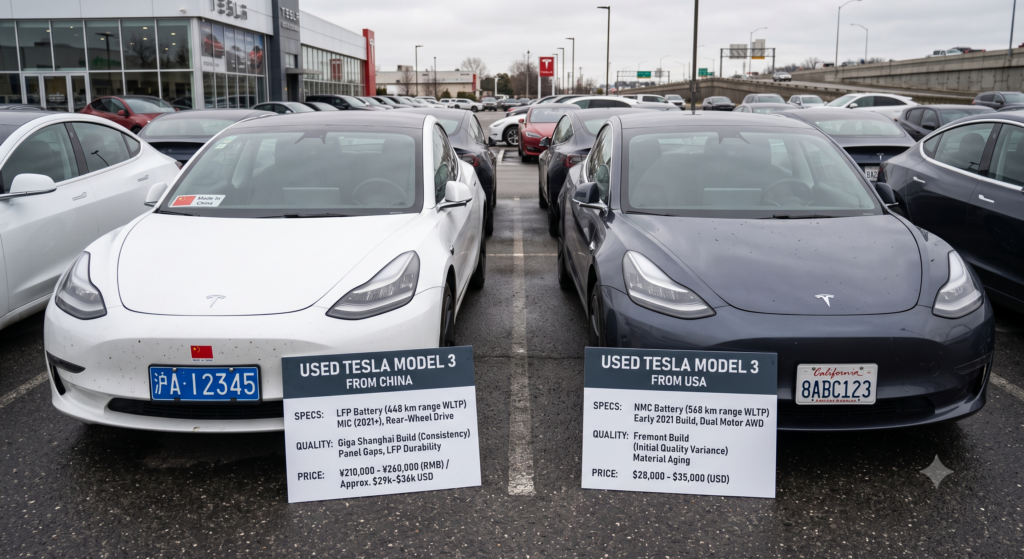
The global used Tesla Model 3 market in 2026 is no longer a simple landscape of American-made sedans shipped from Fremont, California. Since late 2019, when Gigafactory Shanghai began delivering vehicles to Chinese customers and subsequently exporting to Europe, Australia, and beyond, buyers have faced a fundamental choice: purchase a Fremont-built Model 3 from the United States, or acquire a Shanghai-built Model 3 originally produced for the Chinese domestic market or European export. This distinction is not merely a matter of geographic origin stamped on a door jamb. The two production streams diverge in battery chemistry, interior material sourcing, assembly tolerances, software configuration, regional certification, and—critically—secondary market pricing that can swing by thousands of dollars depending on where you are shopping and what you prioritize.
For buyers navigating cross-border listings, import opportunities, or simply comparing locally available inventory, understanding the exact differences between a Chinese-made Model 3 and a USA-made Model 3 is essential to avoiding costly mistakes. This comprehensive guide breaks down every meaningful distinction across specifications, real-world quality perceptions, and pricing dynamics to help you determine which origin story best fits your needs.
The Origin Story: Fremont vs. Shanghai Production Timelines
Tesla’s Fremont, California facility has produced the Model 3 since mid-2017, serving as the primary manufacturing hub for North America and select export markets during the early years. These American-built vehicles established the baseline for what the world expected from Tesla: revolutionary electric drivetrains wrapped in occasionally inconsistent panel alignment and paint application that improved gradually but never fully matched German or Japanese luxury standards during the initial ramp-up.
Gigafactory Shanghai began trial production in late 2019 and started mass deliveries in early 2020. Initially serving the Chinese domestic market, Shanghai quickly became Tesla’s primary export hub for Europe, Australia, New Zealand, and parts of Southeast Asia. By 2021, Shanghai was producing Model 3 vehicles not only for local consumption but also for shipment to dozens of countries, often with specifications tailored to regional regulations and consumer preferences.
This dual-factory reality means that the used Model 3 market in 2026 contains vehicles with identical exterior styling but fundamentally different supply chains. A 2021 Standard Range Plus built in Shanghai may contain a CATL lithium-iron-phosphate (LFP) battery, while a 2021 Standard Range Plus built in Fremont likely retains a Panasonic nickel-cobalt-aluminum (NCA) pack. The seats may come from different textile suppliers. The glass may be sourced from different manufacturers. Even the software loadout at the time of manufacture reflects regional regulatory requirements that persist throughout the vehicle’s life unless manually modified.
Battery Chemistry: The Most Critical Difference
Perhaps no single distinction matters more to long-term ownership than the battery pack inside the floor. While both factories eventually produced vehicles with multiple battery options, the sourcing and chemistry trends diverged significantly.
USA-Made (Fremont) Model 3: For the North American market, Tesla historically relied on Panasonic 2170 cylindrical cells manufactured at Gigafactory Nevada. These cells use NCA (nickel-cobalt-aluminum) chemistry, which offers high energy density and excellent cold-weather performance but is more sensitive to 100% charging habits and generally exhibits slightly faster degradation if not carefully managed. Fremont-built Long Range and Performance variants universally used NCA packs, while Standard Range Plus vehicles also relied on NCA chemistry until the LFP transition began in 2021 for certain markets.
China-Made (Shanghai) Model 3: Shanghai initially used LG Chem NCA cells for early production before rapidly transitioning to CATL prismatic LFP (lithium-iron-phosphate) cells for the Standard Range Plus and later base Rear-Wheel Drive variants. The LFP chemistry offers distinct advantages: it is more tolerant of routine 100% charging, exhibits slower calendar degradation over time, uses no cobalt (reducing ethical sourcing concerns), and generally maintains stable capacity for more charge cycles. However, LFP packs are heavier, slightly less energy-dense, and historically performed worse in extreme cold until Tesla improved the thermal management software.
For used buyers in 2026, this means that a Shanghai-built Standard Range Plus with an LFP battery may show better long-term capacity retention than a comparable Fremont-built NCA example with identical mileage, provided both were maintained properly. Conversely, buyers in cold climates may find that Fremont NCA packs deliver better winter range and faster DC charging speeds in freezing temperatures. The Long Range and Performance variants from Shanghai, particularly those exported to Europe, often continued using LG Chem or Panasonic NCA cells rather than LFP, so origin alone does not dictate chemistry—you must verify the specific battery type for each individual listing.
Build Quality, Panel Gaps, and Assembly Precision
The internet is filled with anecdotal debates about whether Shanghai-built Teslas are better assembled than their Fremont counterparts. In 2026, with years of production data and owner experiences accumulated, a nuanced picture emerges.
Fremont Model 3 (2017–2023): Early Fremont vehicles, particularly 2018 and 2019 examples, suffered from well-documented inconsistencies: uneven panel gaps around the trunk and headlights, paint runs, and interior trim pieces that did not quite align. By 2020 and 2021, Tesla had dramatically improved Fremont quality, and late pre-Highland American builds are generally quite good. However, Fremont operates as a legacy facility converted from a former Toyota-GM joint venture plant, with production lines that have been reconfigured multiple times. This history occasionally manifests in minor inconsistencies that persist even in later model years.
Shanghai Model 3 (2020–Present): Gigafactory Shanghai was purpose-built for Tesla from the ground up, incorporating lessons learned from Fremont’s painful ramp-up. Early Shanghai exports to Europe in 2020 and 2021 were met with widespread praise for tighter panel gaps, more consistent paint application, and interior trim alignment that exceeded contemporary Fremont standards. Chinese-market vehicles also received double-pane front door glass earlier than many Fremont equivalents, improving cabin quietness.
However, Shanghai production is not universally superior. Some export batches to certain markets saw cost-cutting measures in seat materials, carpet underlayment, or trunk seal designs that owners later criticized. Additionally, vehicles built during periods of intense production pressure—such as end-of-quarter pushes—occasionally exhibit rushed assembly regardless of the factory location.
For used buyers in 2026, the practical advice is to judge each vehicle individually rather than relying solely on country of origin. A well-maintained 2021 Fremont Long Range may easily outperform a poorly treated 2021 Shanghai export in daily satisfaction. That said, if you are comparing two vehicles of similar condition and price, Shanghai-built examples from 2021–2023 often demonstrate marginally better assembly consistency in areas like door alignment, paint uniformity, and glass sealing.
Interior Materials and Regional Specifications
Beyond assembly precision, the two factories sourced interior materials from different regional suppliers, creating subtle but noticeable differences in touch and durability.
Seats and Upholstery: Shanghai-built vehicles for the Chinese domestic market often used textile and synthetic leather suppliers based in Asia, with slightly different foam density and stitching patterns compared to Fremont-built cars. European-export Shanghai vehicles generally adhered to EU material standards, which sometimes meant different flame-retardant treatments and odor profiles. Fremont vehicles used North American suppliers with specifications tailored to US regulations. In 2026, these differences are largely academic unless you are sensitive to specific chemical odors or live in a climate where certain foam formulations degrade faster.
Glass and Acoustic Treatment: As mentioned, Shanghai began fitting double-pane acoustic front door glass earlier and more consistently than Fremont on standard trims. This reduces wind noise at highway speeds—a persistent weakness of the Model 3 platform. If cabin quietness is a priority, a Shanghai-built vehicle with verified double-pane glass may offer a tangible advantage over an equivalent Fremont car with single-pane windows.
Climate Control and Air Filtration: Chinese-market Model 3 vehicles shipped with HEPA filtration and Bioweapon Defense Mode hardware earlier and more widely than American equivalents, reflecting consumer expectations in heavily polluted urban environments. Some export vehicles retained this hardware, while others did not. For buyers in 2026, a used Shanghai export with verified HEPA hardware provides superior cabin air quality, particularly valuable for allergy sufferers or drivers in wildfire-prone regions.
Software, Connectivity, and Regional Lock-In
One of the most underappreciated differences between Chinese and American Model 3 vehicles is the software ecosystem and connectivity hardware baked in at the factory.
Chinese Domestic Market Vehicles: Cars built for sale within China originally shipped with Chinese-specific navigation data, Mandarin language interfaces, and domestic 4G/5G modems tuned for Chinese cellular networks. The map database uses Chinese mapping providers rather than Google or regional equivalents. While the core Tesla operating system is identical, the localized software stack can create headaches for buyers attempting to import these vehicles to other countries. The navigation may lack detail for European or North American roads, the voice command system may default to Mandarin, and the modem may not support the cellular bands required for Premium Connectivity in your region.
Export Shanghai Vehicles (Europe, Australia, etc.): Vehicles produced in Shanghai but destined for export markets were configured with regional software loads, appropriate navigation databases, and modems compatible with local carriers. These vehicles function essentially identically to Fremont-built cars in the same region, with the primary differences being hardware sourcing rather than software configuration.
USA Fremont Vehicles: American-built Model 3 vehicles run software configured for North American regulations, with navigation powered by regional providers, English-default voice commands, and modems supporting US and Canadian cellular bands. Importing a US-spec vehicle to Europe or Asia may require software updates, speedometer changes from mph to km/h as default, and potential modem compatibility issues.
For used buyers in 2026, the critical lesson is to verify not just where the car was built, but for which market it was originally configured. A Shanghai-built car is not automatically a “Chinese Tesla” if it was an export model destined for Germany or the UK. Conversely, a Shanghai-built car originally sold in Beijing may require expensive software reconfiguration or aftermarket solutions to function optimally in Los Angeles or London.
Regulatory Certification, Homologation, and Import Feasibility
Attempting to import a Chinese-built Model 3 to the United States, or a US-built Model 3 to China, introduces significant regulatory hurdles that can render the purchase financially disastrous.
Chinese Import to USA: The United States has not certified Shanghai-built Model 3 vehicles for domestic sale. Importing one requires meeting EPA, NHTSA, and DOT standards that may necessitate costly modifications to lighting, bumpers, glass labeling, and crashworthiness documentation. Additionally, Tesla may refuse to provide service, warranty support, or Supercharger access to gray-market imports. The 25-year import exemption for non-compliant vehicles does not apply to 2020–2023 Teslas, making this route effectively impossible for daily drivers.
USA Import to China: China imposes steep import duties on foreign-built vehicles, and US-spec Teslas may not meet Chinese CCC certification requirements without modification. The process is bureaucratic, expensive, and generally impractical for individual buyers.
Cross-Regional Within Export Markets: Importing a Shanghai-built Model 3 from Europe to Australia, or from the UK to New Zealand, is generally feasible because these vehicles share similar regulatory frameworks. However, even within export zones, differences in charging port standards (Type 2 vs. CCS2 vs. local variants), cellular modem bands, and warranty coverage can create friction.
For most buyers, the practical rule is simple: purchase a vehicle built for and originally sold in your target market. Do not assume that a lower-priced Chinese domestic model can be easily converted for US or European use.
Pricing Dynamics on the Used Market in 2026
The price differences between Chinese-built and USA-built used Model 3 vehicles vary dramatically depending on where you are shopping and which specific variant you are comparing.
In North America: Fremont-built vehicles dominate the market and command standard pricing. Occasionally, a Shanghai-built export that was privately imported appears on the market, often at a discount due to uncertainty about service history, software compatibility, and buyer hesitation. These vehicles can represent genuine bargains for informed buyers who have verified regional compatibility, but they also carry resale risk since many North American buyers actively avoid non-Fremont cars.
In Europe: Shanghai-built Model 3 vehicles are extremely common, having served as the primary supply source for years. They trade at prices essentially identical to Fremont-built examples of similar age and specification, provided both are EU-certified exports. European buyers generally do not discriminate against Shanghai origin because the quality reputation is strong and the warranty/service infrastructure is fully supported.
In China: Domestic Shanghai-built vehicles benefit from local familiarity, readily available service, and no import duties. Fremont-built Teslas imported to China carry significant price premiums due to rarity and perceived American origin status, though this is largely a cultural preference rather than a technical advantage. On the Chinese used market, a Fremont-built Model 3 may cost 10% to 20% more than an equivalent Shanghai car despite being older or higher mileage.
In Emerging Markets (Middle East, Southeast Asia, Eastern Europe): Gray-market importers often source the cheapest available Model 3 vehicles globally, which frequently means Shanghai-built Chinese domestic models or US salvage-title cars. These vehicles list at temptingly low prices but may lack proper regional certification, software support, or warranty coverage. Buyers in these markets must exercise extreme diligence.
Don’t risk buying an imported Tesla with incompatible software or locked Supercharger access. At Tesla.tl, every listing includes verified manufacturing origin, target market certification, and regional software compatibility so you know exactly what you are getting. Browse inspected global inventory with full transparency at https://tesla.tl/.
What to Inspect: China-Built vs. USA-Built Checklist
Regardless of origin, your pre-purchase inspection should cover the standard Model 3 weaknesses. However, origin-specific checks are essential:
For Shanghai-Built Vehicles:
- Verify the vehicle was originally configured for your regional market (export vs. domestic Chinese).
- Confirm the modem supports your local cellular bands for Premium Connectivity.
- Check navigation database coverage for your country.
- Verify charging port type matches your local infrastructure.
- Inspect underbody rust protection if the vehicle spent time in humid or coastal Chinese climates.
- Confirm Supercharger network access is active in your region.
For Fremont-Built Vehicles:
- Inspect for early-production panel gap issues if the vehicle is a 2018–2019 build.
- Verify the battery supplier (Panasonic vs. LG Chem) and chemistry (NCA vs. LFP).
- Check for heat pump inclusion on 2021+ models.
- Confirm HW3 or HW4 hardware status for Autopilot features.
- Assess paint thickness consistency, particularly on 2018–2020 examples.
Final Verdict: Which Should You Buy?
The choice between a Chinese-built and USA-built used Model 3 is less about inherent superiority and more about context, compatibility, and certification.
If you are shopping in Europe, Australia, or New Zealand, a Shanghai-built export Model 3 is an excellent choice. The build quality is consistently strong, the battery options are diverse, and the service infrastructure fully supports these vehicles. You should not pay more or less based solely on Shanghai origin—judge each car on its individual condition, battery health, and specification.
If you are shopping in North America, a Fremont-built Model 3 is the safer default choice. It guarantees full Tesla service compatibility, correct software configuration, and stronger resale demand. A Shanghai-built vehicle can work if it is a verified export model originally destined for a compatible market, but expect lower resale value and potential service hesitancy from some buyers.
If you are considering a gray-market import from China to the USA, or from the USA to China, the answer is almost certainly no. The regulatory, software, and warranty barriers outweigh any potential savings unless you are a specialist importer with deep technical and legal resources.
Ultimately, the best used Model 3 is the one with the cleanest history, healthiest battery, correct regional certification, and fairest price—regardless of whether it rolled off the line in California or Shanghai.
Ready to find the perfect used Tesla Model 3, no matter where it was built? Search Tesla.tl for verified listings with full origin disclosure, battery health reports, and regional compatibility checks. Filter by manufacturing location, export market, and specification to find the exact vehicle that fits your region and your budget. Visit https://tesla.tl/ and drive with confidence today.
