Buying a Used Model 3 with FSD: Is It Worth the Extra Cost?
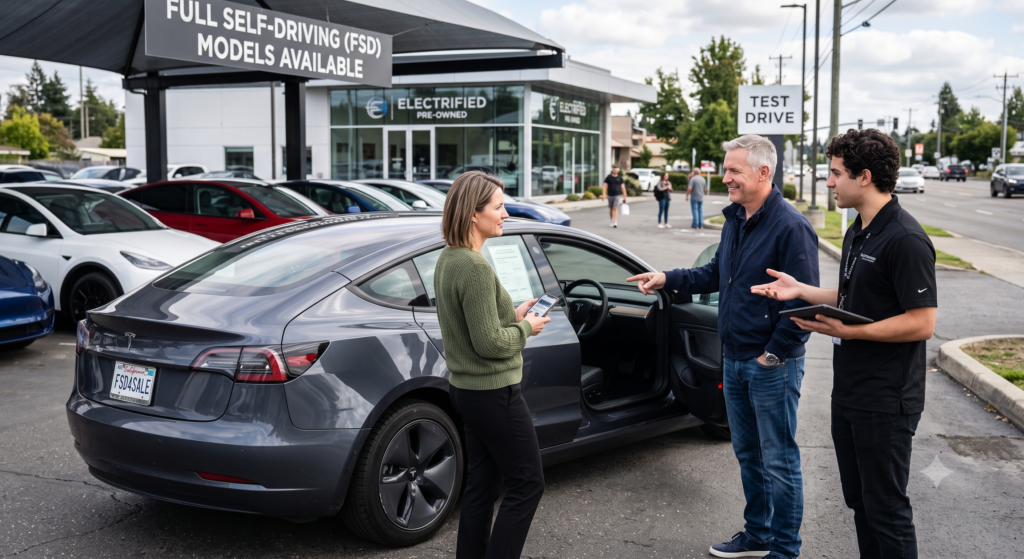
The used Tesla Model 3 market in 2026 is flooded with listings that proudly advertise Full Self-Driving (FSD) as a premium feature justifying an inflated asking price. Scroll through any marketplace and you will see sellers demanding an extra $5,000, $8,000, or even $10,000 above comparable vehicles simply because they clicked the FSD upgrade button years ago. But here is the uncomfortable truth that many buyers discover too late: FSD on a used Tesla is not always what it appears to be. Between hardware limitations, software license transferability nightmares, subscription models, and the ever-evolving reality of what “Full Self-Driving” actually delivers in day-to-day traffic, the decision to pay a premium for FSD requires far more scrutiny than a simple checkmark on a spec sheet.
This comprehensive guide examines whether purchasing a used Model 3 with FSD is genuinely worth the extra cost in 2026. We break down the critical differences between permanent licenses and subscriptions, the hardware generations that determine whether FSD even functions, the real-world capabilities you are actually buying, and the specific verification steps that can save you from paying thousands of dollars for software that either does not transfer to your account or runs on obsolete hardware incapable of supporting modern autonomous features.
Understanding What FSD Actually Means in 2026
Before evaluating whether FSD is worth a premium, you must understand what the term actually represents today. Full Self-Driving is not a single product but rather an evolving suite of driver-assistance features that has changed dramatically since its initial release. In 2026, FSD encompasses capabilities including Navigate on Autopilot for highway interchanges, Auto Lane Change, Autopark for perpendicular and parallel spaces, Summon and Smart Summon for parking lot maneuvering, Traffic Light and Stop Sign Control, and the increasingly capable FSD Beta (Supervised) urban driving stack that handles city streets, unprotected left turns, and complex intersections.
However, the critical distinction that eludes many used buyers is that FSD is not fully autonomous driving. Despite its ambitious name, FSD Beta still requires constant driver supervision, hands on the wheel, and eyes on the road. It makes mistakes, hesitates in ambiguous situations, and occasionally requires intervention. Paying a premium for FSD does not mean you are buying a car that drives itself while you sleep or work. You are purchasing an advanced assistance system that reduces driving fatigue on compatible roads but demands your full attention at all times. Understanding this reality is essential before assigning any monetary value to the feature.
The Hardware Trap: HW2.5, HW3, and HW4
The most expensive mistake a used Model 3 buyer can make is paying an FSD premium for a vehicle that lacks the hardware to run modern software. Tesla has released three major hardware generations for Autopilot and FSD, and not all are created equal.
Hardware 2.5 (HW2.5) was installed in early Model 3 vehicles from 2018 through early 2019. It features a less powerful processor and fewer camera inputs than subsequent generations. HW2.5 cannot run FSD Beta or modern visualization software. If you purchase a used 2018 or early 2019 Model 3 with HW2.5, even if the seller claims it has FSD, the vehicle is permanently capped at basic Autopilot features unless the previous owner paid for and completed the Hardware 3 retrofit. Many did not. Never pay an FSD premium for an HW2.5 vehicle unless the retrofit has been definitively completed and verified.
Hardware 3 (HW3) debuted in mid-2019 and became standard across all Model 3 vehicles by 2020. It uses Tesla’s custom-designed FSD computer with significantly greater processing power and supports all current FSD features including the Beta stack. A used Model 3 with HW3 and a transferable FSD license is genuinely capable of modern autonomous assistance, though future capabilities beyond 2026 may eventually require more advanced hardware.
Hardware 4 (HW4) arrived with the Highland refresh in late 2023 and features higher-resolution cameras, wider fields of view, and an upgraded processing unit. HW4 represents the most future-proof hardware available on the used market, though as of 2026, the practical difference between HW3 and HW4 for FSD functionality remains modest. Over the next five years, however, HW4 is likely to receive software updates that HW3 cannot process.
When evaluating a used Model 3 with FSD, your first question must always be: what hardware generation is installed? A $10,000 FSD license on an HW2.5 vehicle is worth essentially nothing. An identical license on an HW3 or HW4 vehicle is a legitimate asset.
Transferability: The Dealbreaker That Destroys Value
Perhaps no issue creates more post-purchase regret than FSD transferability. Tesla’s software licenses are historically tied to specific vehicles and Tesla accounts, not to individuals. When a private seller advertises their used Model 3 as having FSD, they are describing software that is currently active on their account. Whether that software successfully transfers to your account after purchase is far from guaranteed.
In private party sales conducted outside Tesla’s official channels, FSD does not always transfer automatically. The seller must properly remove the vehicle from their Tesla account, and you must add it to yours. In many cases, the FSD license remains associated with the seller’s account or requires manual intervention by Tesla support to migrate. Some sellers have purchased FSD through subscription models rather than permanent licenses, meaning the feature vanishes the moment the subscription lapses or the vehicle changes hands. Others purchased FSD under promotional programs with specific transfer restrictions.
Before paying any premium for FSD, you must verify:
- Whether the FSD license is permanent or a subscription.
- Whether the license is locked to the vehicle or tied to the seller’s account.
- Whether Tesla support has confirmed in writing that the FSD license will transfer to your account upon purchase.
- Whether the vehicle’s VIN is registered in Tesla’s system with FSD permanently enabled.
If the seller cannot provide definitive documentation, refuses to contact Tesla support before the sale, or becomes evasive when asked about transferability, do not pay a single dollar extra for FSD. Treat the vehicle as having basic Autopilot and negotiate accordingly.
The Real-World Value of FSD in Daily Driving
Assuming you find a used Model 3 with verifiable, transferable FSD on compatible hardware, the next question is whether the feature justifies its cost in your actual daily life. The honest answer depends entirely on your driving patterns and tolerance for supervising an imperfect system.
For highway commuters who spend significant time on interstates and well-marked arterial roads, FSD delivers genuine value. Navigate on Autopilot handles lane changes, highway interchanges, and exit ramps with impressive competence. It reduces the cognitive load of long-distance driving and can make a 200-mile journey feel noticeably less fatiguing. If your weekly routine involves substantial highway mileage, the convenience is tangible and repeatable.
For urban drivers navigating dense city centers, construction zones, and unpredictable pedestrian traffic, FSD Beta is more of a novelty than a convenience. It hesitates at complex intersections, occasionally misreads temporary traffic signage, and requires frequent intervention in environments with erratic driver behavior. Many owners in major metropolitan areas report using FSD Beta for only a fraction of their driving and reverting to manual control in challenging conditions.
For suburban and rural drivers on quiet, predictable roads, FSD offers limited additional value over basic Autopilot. The lane-keeping and adaptive cruise control included with every Model 3 already handles these environments competently. Paying thousands extra for FSD features you will rarely activate is difficult to justify financially.
Subscription vs. License: The Math That Changes Everything
In 2026, Tesla offers FSD through two distinct pricing models, and understanding the difference is critical when evaluating used vehicles.
A permanent FSD license is a one-time purchase tied to the vehicle that does not require ongoing payments. On the used market, this is the only form of FSD that legitimately adds resale value. If you purchase a used Model 3 with a permanent, transferable FSD license, you inherit the feature indefinitely without future subscription fees.
An FSD subscription, by contrast, is a monthly or annual recurring payment that provides temporary access to the feature suite. If the previous owner maintained an active subscription, it may or may not continue under your ownership depending on Tesla’s current policies. More importantly, a vehicle with subscription-based FSD carries zero intrinsic FSD value on the used market because the new owner must begin paying subscription fees immediately. Never pay a premium for “FSD” on a used vehicle unless you have confirmed it is a permanent license.
As of 2026, Tesla’s direct subscription pricing for FSD typically runs between $99 and $199 per month depending on region and promotional status. When evaluating a used Model 3 with a permanent FSD license, compare the asking price premium against approximately 24 to 36 months of subscription costs. If the premium exceeds three years of subscription payments, you are likely overpaying unless you plan to own the vehicle for a very long time.
Don’t risk paying thousands extra for FSD that doesn’t transfer or runs on obsolete hardware. At Tesla.tl, every listing clearly identifies the Autopilot hardware generation, FSD license type, and transfer status before you ever contact the seller. Browse verified FSD-equipped inventory with full transparency at https://tesla.tl/.
How FSD Affects Resale Value and Depreciation
One of the strongest arguments for paying an FSD premium is the assumption that the feature protects resale value. The reality is more nuanced. While FSD does add value for certain buyer segments, it does not always translate to proportionally higher sale prices when you eventually resell the vehicle.
Buyers shopping for affordable used Teslas often prioritize battery health, low mileage, and clean title history over software features. They may view your FSD premium as an unnecessary luxury and choose a cheaper Long Range without FSD instead. Conversely, tech-forward buyers specifically seeking FSD will pay a premium, but this audience is narrower and may take longer to find.
Additionally, as Tesla continues improving its subscription offerings and potentially lowering permanent license prices, the value of older FSD licenses may depreciate faster than the vehicle itself. A 2019 Model 3 with FSD purchased at full price in 2019 may command only a modest premium in 2026 if buyers can simply subscribe to FSD on a cheaper non-FSD vehicle instead.
The hardware generation also affects future resale. An HW3 FSD license will likely hold value longer than an HW2.5 vehicle with any FSD claim, as the latter is effectively obsolete for modern autonomous features.
When Paying the FSD Premium Is Justified
Despite the caveats, there are specific scenarios where purchasing a used Model 3 with FSD is genuinely a smart financial and practical decision.
If you are a long-distance highway commuter who will keep the vehicle for five or more years, the cumulative convenience of Navigate on Autopilot and Auto Lane Change justifies a reasonable premium. The fatigue reduction alone can improve your quality of life during daily drives.
If you are a technology enthusiast who actively follows FSD development and enjoys participating in the Beta program, owning a vehicle with a permanent license ensures you always have access to the latest capabilities without recurring subscription fees.
If you find a late-2020 or newer Model 3 with HW3, clean history, and a verified transferable FSD license priced only $3,000 to $5,000 above an equivalent non-FSD vehicle, the premium is likely fair. The feature adds genuine utility, and you avoid the psychological burden of monthly subscription payments.
When You Should Walk Away from the FSD Premium
Conversely, there are clear red flags that should cause you to reject any FSD markup.
If the vehicle is equipped with HW2.5 and has not received the HW3 retrofit, the FSD license is functionally worthless for modern features. Do not pay extra.
If the seller cannot provide written confirmation from Tesla that the FSD license is permanent and transferable, assume it is not. Vague promises and screenshots of the touchscreen showing “Full Self-Driving” are insufficient proof.
If the FSD premium pushes the total vehicle price close to the cost of a newer Highland or a 2021+ Model 3 without FSD, you are likely better off buying the newer hardware and subscribing to FSD later. Newer vehicles offer better efficiency, improved build quality, and longer remaining warranty coverage.
If you are a low-mileage urban driver who rarely uses highways, the FSD features you are paying for will sit dormant most of the time. Basic Autopilot handles stop-and-go traffic competently, and the subscription model makes more sense for your usage pattern.
Verification Checklist Before You Pay
Before agreeing to any FSD premium on a used Model 3, demand verification of the following:
- [ ] Hardware Version: Confirmed as HW3 or HW4 through the vehicle’s software menu.
- [ ] License Type: Confirmed as permanent, not subscription-based, through Tesla account records.
- [ ] Transferability: Written confirmation from Tesla support that the FSD license transfers to the new owner.
- [ ] Feature Functionality: Live demonstration of FSD Beta or Navigate on Autopilot during your test drive.
- [ ] Software Version: Current software update status confirming the vehicle receives modern FSD releases.
- [ ] Price Justification: The premium does not exceed 24–36 months of equivalent subscription costs.
If any item on this checklist cannot be verified, reset your offer to the non-FSD market value of the vehicle and negotiate from there.
Final Verdict
Buying a used Tesla Model 3 with FSD can be a genuinely worthwhile investment, but only under strict conditions. The feature must run on HW3 or HW4 hardware, the license must be permanent and verifiably transferable, and your driving habits must actually utilize the capabilities you are paying for. For highway commuters and tech enthusiasts who plan long-term ownership, a moderate FSD premium delivers tangible value and eliminates future subscription costs. For urban drivers, short-term owners, or buyers considering older HW2.5 vehicles, the FSD premium is often wasted money that would be better spent on a newer battery, lower mileage, or extended warranty coverage.
The key is treating FSD not as a magical self-driving upgrade but as a specific software package with defined hardware requirements and real-world limitations. Verify everything, trust documentation over promises, and never let a seller’s emotional attachment to their FSD purchase price dictate your financial decision.
Ready to find a used Model 3 with verified, transferable FSD? Search our curated inventory where every FSD listing includes confirmed hardware generation, license type, and transfer status. No surprises, no obsolete hardware, no subscription bait-and-switch. Find your FSD-equipped Tesla today at https://tesla.tl/.
