
Used Tesla Model Y Buying Guide: Every Trim Explained for 2026
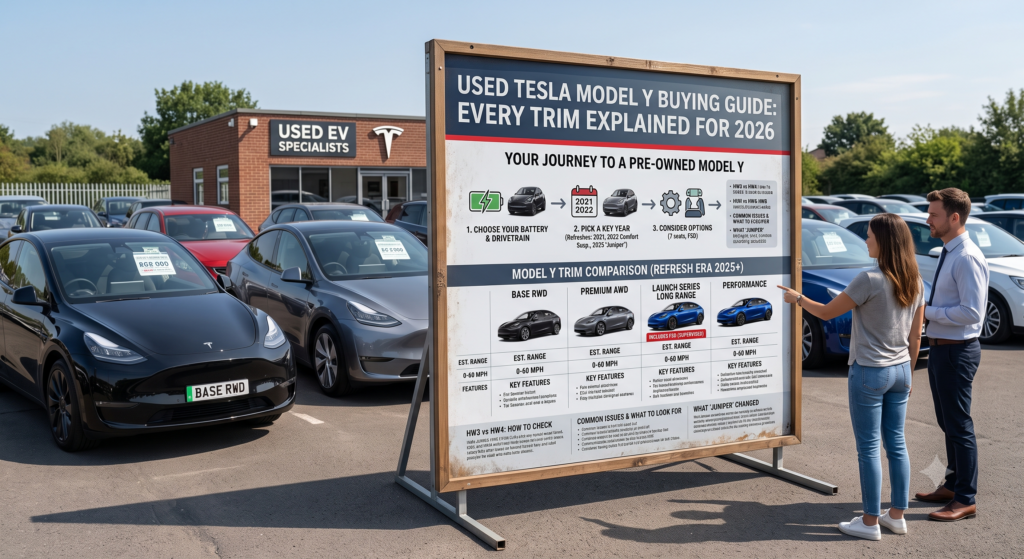
The Tesla Model Y has cemented itself as the definitive electric crossover of the decade, blending the practicality of an SUV with the efficiency and performance DNA of the Model 3 platform beneath its raised silhouette. By 2026, the used Model Y market has matured into one of the most liquid and competitive segments in the entire automotive industry, with hundreds of thousands of units circulating through private sales, dealer inventories, and certified pre-owned channels across every major continent. But this maturity brings complexity. Unlike the relatively straightforward sedan lineup of the Model 3, the Model Y has been offered in multiple regional configurations, battery chemistries, and trim levels that can confuse even experienced EV shoppers. Should you pursue the dual-motor Long Range for its all-weather security and superior mileage? Is the Performance variant worth the stiffer ride and larger wheels for a family hauler? Did the elusive Standard Range rear-wheel-drive version make sense when new, and does it still hold value today?
This exhaustive buying guide breaks down every Model Y trim that has reached the secondary market by 2026, explaining the real-world differences in range, acceleration, suspension tuning, interior appointments, and long-term reliability. Whether you are upgrading from a Model 3, transitioning from a gasoline SUV, or expanding your household fleet, this analysis provides the granular detail necessary to navigate the used Model Y market with authority and confidence.
The Model Y Trims: What Exists on the Used Market
Since its 2020 debut, the Model Y has been offered in several distinct configurations that vary by region, model year, and production timing. By 2026, the used market is dominated by three primary trims, with a handful of rare or discontinued variants appearing occasionally.
Model Y Long Range (Dual Motor All-Wheel Drive) This is the default Model Y that most buyers envision when they think of the vehicle. It features a 75 kWh battery pack, dual electric motors providing all-wheel drive, and an EPA-rated range that started at 316 miles when new and has incrementally improved through software updates and hardware refinements. The Long Range is the volume seller, the family choice, and the trim that holds value most stubbornly on the secondary market. In 2026, it remains the benchmark against which all other electric crossovers are measured.
Model Y Performance Sitting at the top of the lineup, the Performance variant shares the same dual-motor architecture and 75 kWh battery as the Long Range but receives a more powerful rear motor, a lowered sport suspension, larger 21-inch Überturbine wheels, performance brakes, and a carbon-fiber rear spoiler. The result is a 0-to-60 mph time of roughly 3.5 seconds when new—supercar territory for a compact crossover that can still haul groceries and car seats. The Performance commands a premium on the used market, but it also introduces compromises in ride comfort, tire cost, and winter practicality that family buyers must seriously consider.
Model Y Rear-Wheel Drive / Standard Range Tesla briefly offered a Standard Range rear-wheel-drive Model Y in select markets, utilizing a smaller battery pack and a single rear motor to hit a lower price point. This variant was discontinued and reintroduced in various forms depending on regional demand and battery supply. By 2026, early Standard Range examples appear on the used market at tempting prices, but they come with meaningful limitations in range, cold-weather capability, and acceleration that buyers must understand before committing.
Long Range vs. Performance: The Real-World Divide
On paper, the Long Range and Performance appear closely related. They share identical exterior dimensions, the same battery architecture, and the same fundamental interior layout. But after years of ownership and tens of thousands of miles, the divergent hardware choices create distinctly different ownership experiences that go far beyond the half-second difference in acceleration metrics.
Range and Efficiency in Daily Use When new, the Long Range carried a higher EPA range rating than the Performance due to its smaller 19-inch wheels, taller tire sidewalls, and less aggressive motor tuning. In 2026, this gap persists in real-world driving. A used Long Range with 50,000 miles typically delivers 270 to 290 miles of mixed driving range at 100% charge, while a comparable Performance with its larger wheels and stickier tires shows 250 to 270 miles under identical conditions. For buyers who frequently undertake road trips or lack home charging, this 20-mile delta is meaningful. For suburban commuters with nightly Level 2 charging, it is largely irrelevant.
Ride Quality and Suspension Perhaps the most consequential difference for family buyers is the suspension tuning. The Long Range rides on a comfort-biased suspension with 19-inch or 20-inch wheels that absorb broken pavement, expansion joints, and potholes with reasonable compliance. It is not a luxury air suspension, but it is perfectly adequate for daily family duty.
The Performance, by contrast, sits on a lowered sport suspension with 21-inch wheels and low-profile performance tires. The ride is noticeably firmer, transmitting every road imperfection into the cabin with a sharpness that can fatigue occupants on long drives. The larger wheels are also more susceptible to damage from potholes—a significant concern in regions with poor road maintenance. If your primary use case involves children in car seats, elderly passengers, or rough urban streets, the Performance’s ride quality may prove to be a daily annoyance that outweighs the thrill of rapid acceleration.
Tire Costs and Maintenance The Performance’s staggered 21-inch setup with wider rear tires is expensive to replace. A full set of quality performance tires costs $1,400 to $2,000, and the aggressive tread wear of high-performance rubber means replacements every 20,000 to 30,000 miles under enthusiastic driving. The Long Range’s19-inch all-season tires, by contrast, last 35,000 to 50,000 miles and cost roughly $800 to $1,200 for a complete set. Over a five-year ownership period, this difference alone can offset a significant portion of the Performance’s initial purchase premium.
Braking and Track Capability The Performance does receive legitimately upgraded brakes that resist fade during spirited mountain driving or occasional track use. However, few Model Y owners actually exploit this capability. For the vast majority of buyers who never see a racetrack, the Long Range’s standard brakes are more than sufficient for emergency stops and downhill mountain grades. The Performance’s brake upgrade is a nice-to-have feature that is rarely a need-to-have for crossover shoppers.
The Standard Range: Bargain or Compromise?
The Model Y Standard Range occupies a strange niche in the used market. Built primarily for price-sensitive buyers and fleet customers, it utilized a smaller battery pack—initially around 50 kWh usable—and a single rear motor producing less power than the dual-motor variants. When new, it offered an EPA range of approximately 244 miles, though real-world driving often yielded closer to 210 to 220 miles depending on climate and speed.
By 2026, battery degradation has further reduced these figures. A used Standard Range with 60,000 miles may show only 180 to 200 miles of real-world range in temperate weather, dropping to 140 to 160 miles in freezing winter conditions. This limitation transforms the vehicle from a versatile family crossover into a strictly urban commuter. If your driving is confined to a metropolitan area with reliable charging infrastructure, the Standard Range can be an exceptional value, often trading $5,000 to $8,000 below equivalent Long Range examples. However, if you plan road trips, live in a cold climate, or cannot install home charging, the Standard Range’s constraints will become frustrating within the first year of ownership.
Additionally, the rear-wheel-drive layout lacks the winter traction security of the dual-motor all-wheel-drive system. In snow, ice, or heavy rain, the Standard Range requires significantly more driver caution and high-quality winter tires to maintain safe mobility. For buyers in northern climates, the savings over a Long Range are quickly consumed by the anxiety and limitations of reduced range and traction.
Known Model Y Weaknesses to Inspect in 2026
The Model Y shares its platform with the Model 3, meaning it inherits many of the same age-related vulnerabilities. However, its unique body style, hatchback configuration, and higher center of gravity introduce specific issues that buyers must prioritize during inspection.
Rear Suspension and Lower Control Arms The Model Y’s rear suspension is particularly susceptible to wear on the lower control arms and trailing links. The increased weight of the crossover body, combined with the instant torque delivery of electric motors, places significant stress on these components. By 2026, most early Model Y examples will exhibit some degree of rear suspension bushing degradation. Listen for clunks when reversing out of driveways or driving over speed bumps. A full rear suspension refresh costs $800 to $1,500 depending on whether you use Tesla OEM parts or quality aftermarket alternatives.
Panoramic Glass Roof and Seal Integrity The Model Y’s expansive glass roof is a signature design element, but the seals around its perimeter can degrade over time, leading to wind noise at highway speeds and, in severe cases, water intrusion during heavy rain or automated car washes. Inspect the headliner edges for staining, musty odors, or delamination. Replacing the roof seal is a labor-intensive process that can exceed $1,000 at a service center.
Power Liftgate and Rear Hatch Alignment Early Model Y vehicles suffered from power liftgate motor failures and hatch alignment issues that caused uneven panel gaps, water leaks, and excessive wind noise. Test the liftgate multiple times, listening for strained motor sounds or uneven closing speeds. Verify that the hatch sits flush with the rear quarter panels when closed. Misalignment often indicates prior accident repair or factory defects that were never properly addressed.
Front Upper Control Arms Like the Model 3, the Model Y is prone to premature wear in the front upper control arm bushings. This manifests as a subtle clunk over bumps or a vague feeling in the steering during highway cruising. The issue is more pronounced in heavier Performance variants or vehicles that have been driven aggressively on rough roads.
Cabin Noise and Interior Rattles The Model Y’s large interior volume and hatchback design can amplify road noise and interior rattles that would be less noticeable in the sedan Model 3. Common rattle sources include the rear seat latch mechanisms, the center console trim, and the dashboard speaker grilles. While not mechanically serious, persistent rattles significantly degrade the premium feel that buyers expect from a Tesla. Identifying the exact source can be time-consuming, and dealer repairs often involve trial-and-error padding adjustments.
Heat Pump Issues (2020–2021) Early Model Y vehicles equipped with the heat pump—introduced as a major upgrade for efficiency—occasionally suffered from a defect where the heat pump would fail to operate in extremely cold temperatures, leaving the cabin without effective heating. Tesla addressed this through software updates and, in some cases, hardware retrofits. Verify that any 2020 or 2021 Model Y you consider has received the relevant service bulletins and that the heat pump functions properly in cold conditions.
Battery Health and Range Expectations by Trim
By 2026, all Model Y variants have aged sufficiently that battery health is the single most important inspection point, regardless of trim level.
Long Range and Performance These variants launched with 75 kWh NCA battery packs (or in some later regional builds, LG Chem or Panasonic cells with slight variations). After four to six years of typical ownership, well-maintained examples should retain 85% to 90% of original capacity. This translates to 260 to 290 miles for a Long Range and 240 to 270 miles for a Performance at 100% charge. Vehicles that were frequently charged to 100%, driven in extreme heat, or subjected to constant DC fast-charging may show degradation closer to 80%, which is the threshold where range anxiety becomes a daily concern.
Standard Range / Rear-Wheel Drive The smaller battery packs in these variants, particularly early examples with NCA chemistry, may exhibit slightly higher degradation rates due to the increased depth of discharge required for daily driving. A used Standard Range with 50,000 miles may show only 82% to 87% of original capacity, yielding 180 to 210 miles of real-world range. Buyers must honestly assess whether this is sufficient for their needs before prioritizing the lower purchase price.
Pricing Landscape for Used Model Y in 2026
As of mid-2026, the used Model Y market has stabilized after years of pandemic-related volatility. Fair private-party pricing for clean-title vehicles with average mileage breaks down approximately as follows:
- 2020–2021 Long Range: $28,000–$34,000
- 2020–2021 Performance: $33,000–$39,000
- 2022–2023 Long Range: $34,000–$40,000
- 2022–2023 Performance: $39,000–$46,000
- 2021–2023 Standard Range / RWD: $24,000–$29,000
- 2024+ Long Range (Updated): $42,000–$48,000
These figures assume no accidents, documented service history, and battery retention above 85%. Dealer listings and Tesla inventory typically add 8% to 15% to these baselines. Performance variants command premiums that are often difficult to justify for practical buyers, while Standard Range examples offer genuine value for urban dwellers who understand the limitations.
Don’t risk buying a used Model Y with hidden suspension wear, glass roof leaks, or degraded battery capacity. At Tesla.tl, every listing includes verified service history, battery health diagnostics, and detailed inspection reports covering the exact Model Y weaknesses you need to know about. Browse inspected inventory and buy with confidence at https://tesla.tl/.
Which Trim Should You Actually Buy?
The correct Model Y trim for your needs depends on an honest assessment of your climate, driving patterns, and budget.
Choose the Long Range if: You need maximum versatility, live in a region with cold winters or mountainous terrain, frequently take road trips exceeding 200 miles, or want the strongest resale value. The Long Range is the default recommendation for families and the trim that best justifies its price premium through tangible daily utility.
Choose the Performance if: You are an enthusiast who values acceleration above ride comfort, live in a region with smooth roads, do not transport small children who are sensitive to firm suspension, and can absorb the higher tire and maintenance costs. The Performance is a thrilling machine, but it is a compromised family hauler compared to the Long Range.
Choose the Standard Range / RWD if: Your driving is almost exclusively urban, you have reliable home charging, you live in a temperate climate, and your budget is strictly capped below $30,000. It is a competent commuter crossover, but it is not a do-everything vehicle.
Final Verdict
The used Tesla Model Y market in 2026 offers something for nearly every buyer, from budget-conscious city dwellers to performance-oriented enthusiasts to large families needing all-weather security. The Long Range remains the rational choice for most shoppers, delivering the best balance of range, comfort, and value retention. The Performance thrills but compromises daily livability in ways that crossover buyers often regret. The Standard Range tempts with low pricing but demands realistic acceptance of its range and traction limitations.
Regardless of trim, every used Model Y demands a meticulous inspection focused on rear suspension health, glass roof seal integrity, liftgate functionality, and battery degradation. Get these elements right, and the Model Y remains one of the most capable, efficient, and technologically advanced family vehicles on the road. Get them wrong, and you inherit a premium-priced headache.
Ready to find the perfect used Tesla Model Y? Search verified listings with trim-specific inspection data, battery health reports, and transparent pricing at Tesla.tl. Filter by Long Range, Performance, or Standard Range to match your exact needs and budget. Visit https://tesla.tl/ and upgrade to electric family driving today.
