Used Tesla with Salvage Title: Risks, Rewards & Red Flags
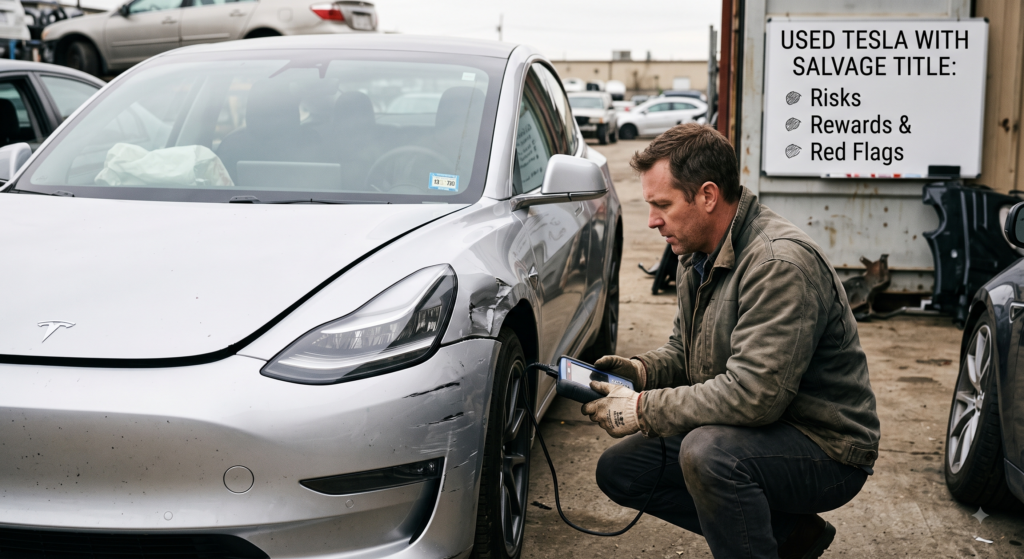
The used Tesla market in 2026 has matured to the point where even the most budget-conscious shopper can find a clean-title Model 3 or Model Y for less than the price of a new economy sedan. Yet despite this abundance of legitimate bargains, a persistent category of listings continues to tempt unsuspecting buyers with prices that seem almost too good to be true: the salvage title Tesla. These vehicles, declared total losses by insurance companies due to collision damage, flood exposure, fire, or theft recovery, often appear on secondary marketplaces at discounts of 30% to 50% below comparable clean-title examples. A 2019 Model 3 Long Range that might normally trade for $24,000 suddenly lists for $14,000. A 2021 Model Y Performance with cosmetic rear-end damage is offered at $28,000 when clean examples command $42,000. For buyers staring at these numbers, the temptation is visceral and understandable. But beneath the seductive sticker price lies a labyrinth of hidden costs, permanent restrictions, and safety hazards that can transform a seemingly smart financial decision into an automotive nightmare that costs more to resolve than simply buying the clean-title vehicle in the first place.
This comprehensive guide examines the brutal reality of buying a used Tesla with a salvage or rebuilt title. We dissect the exact mechanisms by which these vehicles lose their clean status, the permanent restrictions Tesla imposes that many sellers conveniently omit, the insurance and registration hurdles that vary wildly by jurisdiction, the genuine though narrow scenarios where a salvage Tesla might make sense, and the specific red flags that should send you sprinting away from a deal no matter how attractive the photographs appear. By the end, you will understand why most experts consider salvage-title Teslas suitable only for professional rebuilders, parts harvesters, and hobbyists with deep technical expertise—and why the average buyer should treat them as radioactive.
What Exactly Is a Salvage Title, and Why Do Teslas Get Them?
A salvage title is issued when an insurance company determines that the cost of repairing a vehicle exceeds a certain percentage of its pre-damage value, typically ranging from 60% to 80% depending on the state or country. This threshold is not arbitrary; it reflects the insurer’s calculation that paying the owner the vehicle’s market value and selling the damaged car to a salvage auction is more economical than funding repairs. For Teslas, this threshold is reached with surprising frequency because of the vehicles’ unique construction, proprietary repair networks, and astronomical parts costs.
The aluminum-intensive body structure of the Model S and Model X, and the steel-aluminum hybrid architecture of the Model 3 and Model Y, require specialized repair techniques that many conventional body shops cannot perform. Tesla’s collision repair network is smaller and more expensive than those of legacy automakers, and certain components—such as the battery pack, drive unit, or Autopilot computer—can only be sourced directly from Tesla at prices that quickly eclipse the vehicle’s depreciated value. A moderate rear-end collision that damages the rear quarter panel and crumple zone might cost $18,000 to repair properly because the Model 3’s rear body structure is bonded and riveted rather than bolted, requiring factory-specified replacement procedures. A front-end impact that damages the cooling system, the frunk structural elements, and the Autopilot camera array can easily approach $25,000 in repair bills. When these figures meet or exceed the $22,000 actual cash value of a 2019 Model 3, the insurer totals the vehicle and the salvage title is born.
Flood damage is another common pathway to salvage status for Teslas, and it is arguably the most dangerous. Electric vehicles are not inherently more vulnerable to water than internal combustion cars, but their dense packaging of high-voltage cabling, battery management computers, and low-voltage control modules beneath the floor and behind interior panels means that even moderate water intrusion can cause latent electrical failures that manifest months after the visible moisture is dried. A Model Y that sat in 12 inches of floodwater for six hours may appear to function normally after drying, but corrosion may be silently spreading through the 12-volt distribution block, the HV battery contactors, and the Autopilot wiring harnesses. Insurers know this, and they total flood-exposed Teslas with a speed that reflects the industry’s growing awareness of hidden electrical risk.
Theft recovery also generates salvage titles, particularly when stolen Teslas are stripped of their battery packs, interior components, or Autopilot hardware before being abandoned. Even if the vehicle is recovered with minimal physical damage, the cost of replacing stolen proprietary components can push repair costs past the total-loss threshold.
The Permanent Tesla Restrictions That Destroy Value
The single most consequential fact about owning a salvage-title Tesla is not the repair history, the potential safety issues, or the insurance complications. It is the permanent, irreversible restrictions that Tesla places on these vehicles through its internal systems. These restrictions are not widely advertised by sellers, are not always visible during a test drive, and can fundamentally alter what it means to own a Tesla.
Supercharger Network Ban When a Tesla is issued a salvage or rebuilt title, Tesla’s internal systems flag the Vehicle Identification Number and permanently revoke Supercharger access. This is not a temporary suspension that can be lifted after inspection or repair. It is a lifetime ban. For a vehicle whose primary value proposition includes access to the world’s most reliable fast-charging network, this restriction is devastating. A salvage-title Model 3 can still charge at home on a Level 2 wall connector, at public Level 2 stations, and at third-party DC fast chargers equipped with CCS or NACS adapters. But it cannot use Tesla’s proprietary Supercharger network, which remains the gold standard for long-distance EV travel in most markets. For buyers who planned to use their Tesla for road trips, this ban transforms the vehicle from a versatile tourer into a strictly local commuter.
Software Update Blocks Tesla has been known to restrict or delay over-the-air software updates for salvage-title vehicles. While the vehicle may still receive critical safety updates, access to new features, Full Self-Driving enhancements, and entertainment upgrades may be limited or blocked entirely. This means that a salvage-title Tesla gradually becomes a technological fossil, frozen in time while clean-title examples continue to improve through software.
Warranty Voidance The moment a salvage brand is applied to a title, all Tesla factory warranties evaporate permanently. This includes the New Vehicle Limited Warranty, the Battery and Drive Unit Warranty, and any Extended Service Agreement. Even if the vehicle has only 5,000 miles and was totaled due to cosmetic damage, the 8-year battery warranty is gone forever. If the battery fails six months after your purchase, you face a $12,000 to $20,000 replacement bill with no recourse. This voidance applies regardless of how expertly the vehicle was rebuilt or how many original Tesla parts were used in the restoration.
Service Center Refusal Tesla Service Centers may refuse to work on salvage-title vehicles altogether, or they may limit service to non-warranty paid repairs at the owner’s expense. Some independent shops specialize in salvage Teslas, but their expertise varies wildly, and certain procedures—particularly those involving high-voltage systems or software recalibration—require Tesla-specific tools and access that only authorized facilities possess. A salvage-title owner may find themselves unable to resolve even routine issues because no qualified technician will touch the car.
Don’t risk buying a used Tesla with hidden salvage history or revoked Supercharger access. At Tesla.tl, every listing includes verified title status, Tesla factory restriction checks, and Supercharger access confirmation so you know exactly what you are getting before you negotiate. Browse inspected clean-title inventory and buy with confidence at https://tesla.tl/.
Insurance and Registration: The Bureaucratic Minefield
Beyond Tesla’s internal restrictions, salvage and rebuilt titles create cascading complications with insurance and government registration that vary dramatically by jurisdiction and can trap unwary buyers in administrative purgatory.
In most US states, a salvage-title vehicle cannot be legally driven on public roads until it has been repaired, inspected by a state authority, and re-registered with a rebuilt title. The inspection process is not a casual formality. It typically requires documentation of every part used in the repair, proof that airbags were replaced with OEM units, verification that the structural repairs meet manufacturer specifications, and in some states, a mechanical inspection that includes brake tests and emissions checks—even for electric vehicles. The cost of this inspection process, combined with the repair expenses, often erodes the initial purchase savings entirely.
Insurance for salvage-title vehicles is notoriously difficult to obtain. Many major carriers refuse to write comprehensive or collision coverage for rebuilt-title cars, offering only liability policies that leave you financially exposed if the vehicle is stolen, vandalized, or damaged again. Those insurers that do offer full coverage typically charge premiums that are 20% to 40% higher than for clean-title equivalents, citing the elevated risk of hidden damage and the difficulty of assessing repair costs on aluminum-intensive vehicles. In the event of a second accident, the insurer may total the vehicle immediately at a drastically reduced payout because the rebuilt title already signals prior major damage.
Some states impose annual inspection requirements on rebuilt-title vehicles that clean-title cars do not face. Others restrict the ability to obtain personalized plates or participate in certain vehicle incentive programs. Before purchasing any salvage-title Tesla, contact your local Department of Motor Vehicles and your insurance agent to confirm exactly what restrictions apply in your jurisdiction. Do not rely on the seller’s assurance that “it registers fine” or “insurance is no problem.” These statements are meaningless until verified by the actual authorities who will govern your ownership.
The Rewards: Why Anyone Buys a Salvage Tesla
Despite the overwhelming risks, salvage-title Teslas do serve legitimate purposes for specific buyer profiles, and understanding these use cases helps clarify why the market exists at all.
Professional Rebuilders and Flippers Experienced automotive rebuilders with access to Tesla parts networks, aluminum welding equipment, and high-voltage certification can sometimes acquire salvage Teslas at auction, repair them economically using used or aftermarket components, and resell them at modest profits. These professionals understand exactly which damage is repairable and which is fatal. They have relationships with inspection stations, know how to navigate title branding procedures, and accept the Supercharger ban as a cost of doing business. For these buyers, salvage Teslas are inventory, not personal transportation.
Parts Harvesters A totaled Model S with a destroyed front end but an intact battery pack and rear drive unit is worth more as a donor vehicle than as a roadgoing car. Independent repair shops, hobbyists building electric conversions, and owners seeking affordable replacement parts for their clean-title Teslas frequently purchase salvage vehicles specifically to dismantle them. The battery modules, motors, touchscreens, and suspension components from a salvage Tesla can be resold individually at prices that often exceed the auction purchase price.
Track Day Enthusiasts and Experimenters Some buyers purchase lightly damaged salvage Teslas specifically for track use, autocross competition, or engineering experimentation. A Model 3 Performance with a salvage title but functional drivetrain makes a potent track weapon at a fraction of the cost of a clean example, provided the buyer never intends to register it for street use or rely on Tesla’s support infrastructure.
Extreme Bargain Hunters with Technical Skills A tiny subset of private buyers possesses the mechanical expertise, electrical safety training, and risk tolerance to rehabilitate a salvage Tesla for personal use. These individuals typically perform their own repairs, accept the Supercharger ban as a lifestyle limitation, and view the vehicle as a project rather than a product. For this group, the 50% discount can be justified. For everyone else, it is a trap.
Red Flags During Inspection: When to Walk Away Immediately
If you are seriously considering a salvage or rebuilt Tesla despite the warnings above, your inspection must be exponentially more rigorous than for a clean-title vehicle. Certain findings should trigger immediate abandonment of the deal, regardless of how tempting the price appears.
Battery Pack Damage or Replacement Any evidence that the high-voltage battery pack was punctured, flooded, removed, or replaced with a non-OEM unit is an absolute dealbreaker. The battery is the most dangerous and expensive component in the vehicle. Physical damage to the pack casing, corrosion on the high-voltage connectors, or mismatched serial numbers between the pack and the vehicle’s build sheet indicate that the vehicle may be a fire hazard or may fail catastrophically without warning. If the seller cannot provide documentation proving the battery was professionally inspected and certified by a Tesla-authorized facility, walk away.
Airbag System Compromises Salvage vehicles frequently have deployed airbags that were replaced with used units, aftermarket substitutes, or in the worst cases, simply left unrepaired with the deployment bags stuffed back into the steering wheel and dashboard. Verify that all airbags are present, that the airbag warning light illuminates briefly during startup and then extinguishes, and that the seller can provide receipts for OEM replacement airbags installed by a certified technician. Non-functional airbags in a vehicle with Tesla’s aluminum structure—a material that behaves differently than steel in collisions—create a deadly safety gap.
Structural Repairs Without Documentation If the vehicle required frame rail replacement, floor pan repair, or crumple zone reconstruction, demand the repair documentation including frame dimension printouts from a laser alignment system. Amateur structural repairs on Teslas often use incorrect welding techniques for aluminum, fail to restore crash-energy management paths, and create vehicles that perform unpredictably or dangerously in a subsequent collision. A rebuilt Tesla without documented structural repair records from a Tesla-certified facility is a death trap wearing a clean coat of paint.
Mismatched or Aftermarket VIN Plates Inspect the VIN plates on the dashboard, the driver’s door jamb, the front trunk area, and any service stickers under the hood. If these numbers do not match perfectly, or if any plate appears to have been removed and reattached, the vehicle may have been subjected to VIN cloning or may contain major components from a different donor car. This is fraud and creates registration nightmares that can result in vehicle seizure by law enforcement.
Evidence of Flood Damage Musty odors, water stains in the carpet padding, corrosion on seat rails, moisture in the headlight housings, or silt deposits in the trunk channels are telltale signs of flood exposure. As previously noted, flood-damaged Teslas suffer from latent electrical failures that can render the vehicle inoperable months after purchase. No discount is deep enough to justify this risk.
Seller Pressure and Evasive Behavior If the seller refuses to provide the original salvage auction listing, the insurance total-loss documentation, or the rebuild inspection certificates, they are hiding the vehicle’s true history. Legitimate rebuilders maintain meticulous records because these documents are required for registration and resale. A seller who becomes defensive when asked for paperwork, who insists that “the title is clean now” (rebuilt titles are never truly clean), or who demands a cash-only transaction without a bill of sale, is operating in bad faith.
The Supercharger Verification Test
Because the Supercharger ban is the most financially consequential restriction on salvage-title Teslas, you must verify the vehicle’s charging status before purchase if you harbor any hope of using Tesla’s network. Ask the seller to meet you at a Supercharger station and attempt to initiate a charging session. If the vehicle connects and charges normally, the title may be clean or the ban may not yet have been applied—though this is increasingly rare as Tesla’s systems flag salvage VINs within days of title branding. If the vehicle refuses to charge, displays an “Supercharging unavailable” message, or shows an error in the charging menu, assume the ban is active and permanent.
Even if the vehicle charges successfully during your test, do not assume immunity. Tesla occasionally applies restrictions retroactively when VINs are newly flagged in their system. The only way to confirm permanent access is to verify the clean title status through a vehicle history report and Tesla’s own records. A successful Supercharger session on a salvage-title vehicle is usually a temporary anomaly, not a guarantee.
Final Verdict
For the overwhelming majority of used Tesla buyers in 2026, salvage and rebuilt titles represent a false economy that trades short-term savings for long-term financial and operational ruin. The combination of permanent Supercharger bans, voided warranties, blocked software updates, insurance complications, and safety uncertainties creates a ownership experience that is fundamentally compromised compared to even the most basic clean-title alternative. A $15,000 salvage Model 3 with a rebuilt title may seem like an irresistible entry point into Tesla ownership, but the arithmetic of ownership quickly turns cruel. Add the cost of professional repairs to pass state inspection, the premium for limited insurance coverage, the inevitable out-of-pocket maintenance denied by Tesla service centers, and the operational handicap of a lifetime Supercharger ban. Within two years, the total expenditure often exceeds the price of a clean-title equivalent with intact warranty and full network access. The discount that initially seduced you becomes a surcharge paid in installments of frustration, administrative headaches, and unexpected invoices.
For the professional rebuilder, the parts harvester, or the technically gifted hobbyist, salvage Teslas serve a legitimate purpose in the automotive ecosystem. For the average buyer seeking reliable daily transportation, they represent a category of vehicle that should remain permanently off-limits. The risks are not merely financial; they are operational, legal, and sometimes physical. A rebuilt Tesla with undocumented structural repairs or a compromised battery pack is not just a bad investment—it is a potential safety hazard that places you and your passengers at risk every time you merge onto the highway.
If your budget only stretches to a salvage-title Tesla, the smarter play is patience. Save for another six months. Expand your search radius. Consider a higher-mileage clean-title example or a lower trim level. The used Tesla market in 2026 is sufficiently mature that legitimate bargains exist without crossing into the salvage wilderness. Do not let a low sticker price override your judgment. A clean title is not merely a piece of paper; it is your guarantee of warranty protection, charging network access, software support, and the peace of mind that comes from knowing your vehicle was never declared a total loss. Buy clean, buy verified, and buy with confidence. The alternative is a driveway ornament that drains your wallet while reminding you, every single day, that some discounts are far too expensive to accept.
Don’t risk buying a used Tesla with hidden salvage history or revoked Supercharger access. At Tesla.tl, every listing includes verified title status, Tesla factory restriction checks, and Supercharger access confirmation so you know exactly what you are getting before you negotiate. Browse inspected clean-title inventory and buy with confidence at https://tesla.tl/.
