
Buying a Used Model X 75D: Hidden Costs & Battery Truth
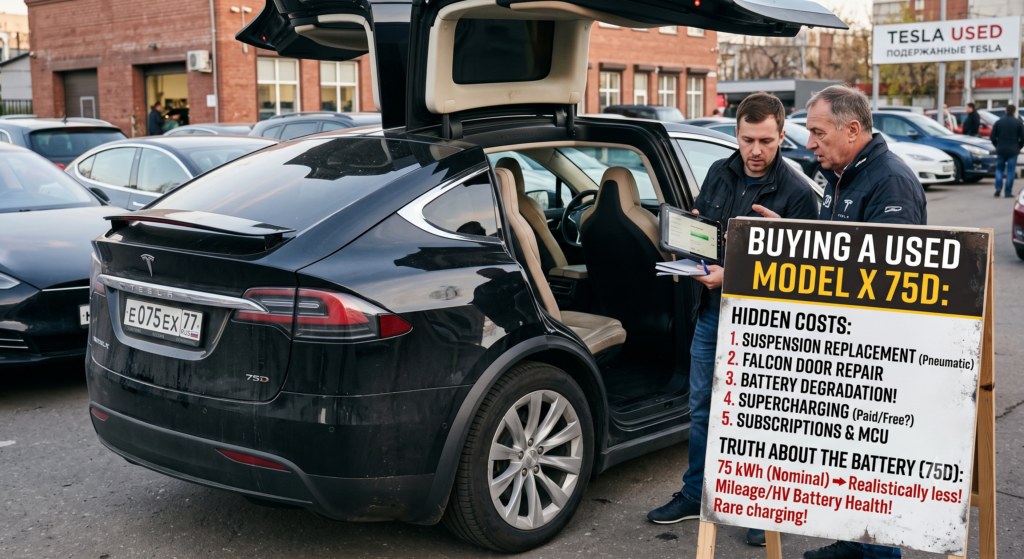
The Tesla Model X 75D occupies a seductive niche in the used electric vehicle market of 2026. It is the cheapest entry point into owning Tesla’s flagship SUV, the vehicle with the Falcon Wing doors, the available six- and seven-seat configurations, and the commanding road presence that makes a Model Y look like a compact hatchback by comparison. For buyers who have always dreamed of a Model X but cannot stomach the $40,000+ price tags of 100D or Raven examples, the 75D beckons with listings often priced between $20,000 and $28,000—a figure that undercuts many new economy crossovers and places genuine luxury electric SUV ownership within reach of mainstream budgets. But this accessibility is not without a dark side. The 75D was the smallest-battery variant of the heaviest, most complex, and most energy-hungry vehicle Tesla has ever mass-produced. Its 75 kWh pack must motivate a 5,300-pound aluminum monolith through the air with the aerodynamic subtlety of a luxury yacht. The result is a vehicle that, while undeniably impressive when new, ages in ways that can transform the dream of affordable flagship ownership into a daily exercise in range anxiety, charging obsession, and unexpectedly frequent repair bills.
This guide exposes the reality of buying a used Model X 75D in 2026. We dissect the battery truth that sellers rarely advertise, uncover the hidden costs that erode the initial purchase savings, and determine whether this bargain-basement Model X is a smart financial shortcut or a compromise that will cost you more in frustration than it saves in sticker price.
The 75D Battery: Small Pack, Massive Vehicle
To understand the 75D’s fundamental compromise, you must grasp the physics. The Model X is not merely a tall Model S; it is significantly heavier, with a larger frontal area and a drag coefficient that, while excellent for an SUV, still punches a bigger hole in the atmosphere than a sedan. When new, the 75D was EPA-rated for approximately 237 miles of range. That figure was already the lowest in the Model X lineup, positioned below the 90D’s 257 miles and the 100D’s 295 miles. But EPA ratings are laboratory ideals. In the real world, owners typically saw 210 to 220 miles in temperate mixed driving when the vehicle was fresh from the factory.
Fast forward to 2026, and the 75D’s battery has endured eight to ten years of charge cycles, calendar aging, and the unique stress of propelling a heavy SUV thousands of times. A well-maintained 75D with 60,000 to 80,000 miles typically retains between 82% and 87% of its original usable capacity. In practical terms, this means 100% charge now displays an estimated range of 175 to 195 miles in ideal conditions. Drive at 75 mph on the highway with the climate control active, and that figure drops to 150 to 165 miles. Enter freezing winter temperatures, where the resistive cabin heater of pre-2021 models draws enormous energy and battery chemistry slows, and the 75D can deliver as little as 120 to 140 miles of real-world range.
These numbers are not merely disappointing; they are transformative. A Model X 75D with 130 miles of winter range is not a long-distance family hauler. It is an urban and suburban shuttle that must be plugged in every night and carefully monitored on any journey exceeding 80 miles round trip. The psychological burden of this limitation is difficult to overstate. Every highway merge becomes a mental calculation. Every unexpected detour triggers anxiety. Every visit to relatives two towns over requires advance planning around Supercharger locations. The 75D does not liberate you from the gas station; it replaces it with a different, more frequent form of energy dependency.
The 75 kWh pack also uses the same NCA (nickel-cobalt-aluminum) chemistry as larger packs but with fewer cells to absorb the stress. Because the vehicle is heavy and less efficient, the 75D draws more energy per mile, meaning each individual cell works harder and experiences deeper depth of discharge for the same distance traveled. Over time, this can contribute to marginally faster degradation compared to a 100D that moves the same distance using a smaller percentage of its total capacity. While the difference is not catastrophic, it is real, and it compounds the 75D’s already constrained starting point.
Hidden Cost 1: The Falcon Wing Door Tax
Every Model X suffers from Falcon Wing door complexity, but the 75D presents a unique financial trap. Because it is the cheapest Model X, it attracts buyers who are already stretching their budgets to enter the segment. These buyers are often the least prepared for the $5,000 to $8,000 door repair bills that can materialize without warning. The 75D was not mechanically simpler than the 100D; it shared the exact same door architecture, the same sensors, the same actuators, and the same seal system. The only difference was the battery size.
By 2026, a 2016–2017 75D with original door mechanisms is virtually guaranteed to need attention. The torsion springs have weakened. The ultrasonic sensors have drifted. The rubber seals have hardened. If both doors require actuator rebuilds, seal replacements, and sensor recalibration, you are looking at a repair bill that can approach 40% of the vehicle’s purchase price. For a buyer who spent $22,000 on the 75D thinking they had found a bargain, an $8,000 door repair is a financial gut punch that transforms the “cheap” SUV into an expensive mistake.
The cruel irony is that the 75D’s lower purchase price leaves no financial buffer for these repairs. A 100D buyer who paid $40,000 has more equity cushion and typically more disposable income to absorb a door overhaul. The 75D buyer does not. This dynamic makes the 75D the most dangerous Model X to own from a total-cost-of-ownership perspective.
Hidden Cost 2: Air Suspension Failure
Like all Model X variants of this era, the 75D relies on an air suspension system that is luxurious when functional and ruinously expensive when it fails. The 75D’s weight—already substantial—is often compounded by the fact that budget-conscious buyers use the vehicle as a family hauler, loading it with children, cargo, and roof-mounted accessories that push the chassis even closer to its design limits.
After eight to ten years, the air struts leak, the compressor overheats from compensating for pressure loss, and the ride-height sensors drift. A single front air strut replacement costs $1,200 to $1,800. A full four-corner refresh can exceed $5,000. The 75D buyer who thought they were saving money by avoiding the 100D premium suddenly finds themselves paying the exact same repair costs as the flagship owner, but without the range or performance to justify the expense.
Hidden Cost 3: MCU1 and the Infotainment Time Bomb
Most 75D vehicles on the used market in 2026 are 2016–2018 builds that shipped with MCU1, the original NVIDIA Tegra-based infotainment system with the infamous 8GB eMMC memory chip. This chip wears out after years of write cycles, causing the touchscreen to slow down, develop yellow border discoloration, reboot randomly, or fail entirely. A Model X without a functional touchscreen is deeply compromised—you lose climate control, navigation, suspension settings, and even the ability to open the glove box without the smartphone app.
The MCU2 retrofit costs $1,500 to $2,500. For a 75D purchased at bargain pricing, this upgrade represents a significant percentage of the vehicle’s value. Yet it is essentially non-negotiable. A Model X with a failing MCU1 in 2026 is not a usable daily driver; it is a project car. Budget for the upgrade immediately, or negotiate the purchase price downward to reflect this mandatory expense.
Hidden Cost 4: Tire Consumption and Efficiency Penalties
The 75D came standard with 20-inch wheels, though many owners upgraded to 22-inch options that are visually striking but catastrophically expensive to maintain. A full set of quality tires for a Model X costs $1,200 to $2,000, and the vehicle’s weight and torque chew through rubber faster than a lighter Model S or Model 3. Because the 75D is already range-constrained, running on worn or non-efficient tires further reduces usable distance, creating a vicious cycle where you charge more frequently, pay more for electricity, and replace tires more often than you anticipated.
Additionally, the 75D’s lower efficiency means that every mile costs more in energy than it would in a 100D or a Model Y. If you rely on public Supercharging, where rates can reach $0.40 to $0.50 per kWh, the 75D’s thirst translates into higher per-mile fueling costs that erode the savings you thought you were achieving by buying the cheaper variant.
Don’t risk buying a used Model X 75D with a degraded battery and no repair budget. At Tesla.tl, every listing includes verified battery State of Health, door mechanism diagnostics, and air suspension condition reports so you know the real cost before you buy. Browse inspected Model X inventory and buy with confidence at https://tesla.tl/.
When the 75D Actually Makes Sense
Despite its limitations, the Model X 75D is not universally a bad purchase. There are specific buyer profiles for whom it is a rational, even clever, choice.
Urban and Suburban Commuters with Home Charging If your daily driving consists of a 40-mile round-trip commute, school runs, and grocery trips, and you have a Level 2 wall connector in your garage, the 75D’s range limitations are irrelevant. You start every morning with a full charge, never visit a Supercharger, and simply enjoy the Model X’s space, safety, and presence for local errands. In this scenario, the 75D is a spacious electric minivan that happens to have cool doors, and the lower purchase price is genuinely smart economics.
Temperate Climate Buyers If you live in California, Arizona, Florida, or any region where temperatures rarely drop below freezing, the 75D’s winter range penalty disappears. A 75D that delivers 180 miles in January in San Diego is a very different proposition from one that delivers 130 miles in Minneapolis. Warm-climate buyers can exploit the 75D’s lower price without suffering its most punishing compromise.
DIY Enthusiasts with Repair Skills If you are mechanically inclined, have access to a competent independent Tesla shop, and can perform or source affordable repairs for the doors, suspension, and MCU, the 75D represents maximum Model X per dollar. You accept the complexity as a hobby and the battery limitations as a known constraint.
When You Should Absolutely Avoid the 75D
Conversely, there are buyer profiles for whom the 75D is a guaranteed disappointment.
Cold-Climate Families If you live in the northern United States, Canada, or northern Europe, the 75D’s winter range is simply inadequate for a family vehicle. A 130-mile effective range in January, further reduced by highway speeds, means you cannot confidently undertake winter road trips, ski weekends, or even long holiday drives to relatives without obsessive charging planning.
Road-Trip Enthusiasts The Model X was designed as a long-distance cruiser, but the 75D fails at this mission. The combination of limited range, high energy consumption, and the need for frequent charging stops transforms interstate travel from a pleasure into a logistics exercise. If you dream of cross-country family adventures, the 75D will crush that dream.
Buyers Without Home Charging If you rely on public charging infrastructure, the 75D’s frequent charging needs become a lifestyle burden. You will visit Superchargers or public Level 2 stations twice as often as a 100D owner, spending more time and more money per mile than you would with a larger battery or a more efficient vehicle.
Buyers with a Strict Maintenance Budget The 75D saves money upfront but does not reduce the Model X’s repair costs. If you cannot comfortably absorb a $5,000 door or suspension repair without financial stress, the 75D is too risky. Its lower purchase price leaves no safety net.
Pre-Purchase Inspection Checklist for the 75D
Before committing to any Model X 75D, verify the following with particular rigor:
- [ ] Battery State of Health: Confirm 85% or higher SOH. Below this, winter range becomes critically compromised.
- [ ] Real-World Range Test: Drive 50 miles at highway speed and verify that the energy consumption aligns with the displayed range estimates.
- [ ] Falcon Wing Door Function: Test both doors ten times. Listen for grinding, check seal condition, and verify obstacle detection.
- [ ] Air Suspension Health: Cycle through all ride heights. Check for overnight sagging and compressor strain.
- [ ] MCU Generation: Verify MCU2 upgrade status. If still MCU1, budget $2,000 for immediate retrofit.
- [ ] Tire Condition: Check tread depth and brand. Budget $1,500+ for replacement if needed.
- [ ] Supercharger Access: Confirm the vehicle can initiate a charging session and is not banned due to title issues.
- [ ] Title and Warranty Status: Verify clean title and remaining battery/drive unit warranty eligibility.
Final Verdict
The used Tesla Model X 75D in 2026 is a vehicle of extremes. It offers the lowest possible price of entry into one of the most distinctive and capable electric SUVs ever built, but it demands compromises that many buyers are unprepared to make. The battery is small for the vehicle’s mass, the range is constraining for anyone beyond urban commuting, and the repair costs are identical to those of far more expensive variants while the purchase price savings leave no financial cushion.
For warm-climate, home-charging, local-driving buyers who view the Model X as a spacious urban shuttle rather than a grand tourer, the 75D is a legitimate bargain. For cold-climate families, road-trip enthusiasts, or buyers without dedicated home charging, it is a compromise that will generate more regret than savings.
The truth is simple: the 75D is cheap for a reason. That reason is not a secret conspiracy against buyers; it is the basic physics of moving a massive vehicle with a modest battery. Understand this truth, budget for the hidden costs, and the 75D can still deliver years of satisfying electric family motoring. Ignore it, and you will join the ranks of owners who thought they bought a flagship at a discount, only to discover they bought a very expensive, very heavy, very complex urban runabout with wings.
Ready to find a used Model X that actually fits your driving needs? Search Tesla.tl for curated listings with verified battery health, door diagnostics, and transparent pricing. Compare 75D, 90D, and 100D variants side by side to see which Model X delivers the space you want without the range anxiety you don’t. Visit https://tesla.tl/ and drive the right electric SUV today.
