
Used Model X Long Range vs Plaid: Family SUV Face-Off
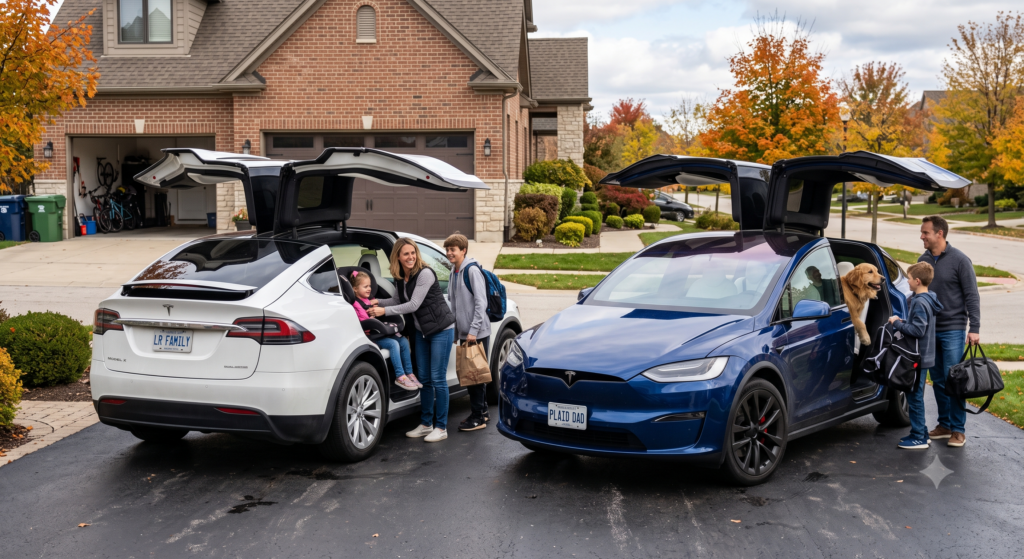
The Tesla Model X has always been an exercise in contradictions. It is a three-row family SUV that can out-accelerate most dedicated sports cars, a vehicle designed for school runs that happens to feature doors borrowed from a science fiction film set, and a luxury people-mover that weighs nearly three tons yet corners with the urgency of a vehicle half its size. But when you enter the used Model X market in 2026, the most consequential decision you face is not whether you can tolerate the Falcon Wing doors or live with the air suspension maintenance schedule. It is the binary choice between the Long Range dual-motor variant and the range-topping Plaid tri-motor flagship. Both share the same aluminum body shell, the same available six- and seven-seat configurations, the same panoramic windshield, and the same access to the Supercharger network. Yet beneath their nearly identical exteriors, these two variants diverge into fundamentally different vehicles that serve radically different family missions.
The Plaid promises hypercar acceleration in a grocery-getter wrapper, a tri-motor powertrain delivering over 1,000 horsepower and sub-three-second sprints to 60 mph that seem physically impossible for a vehicle of this size and mass. The Long Range, by contrast, offers a more restrained dual-motor setup that still delivers brutal acceleration by any objective standard but prioritizes range, ride comfort, and tire longevity over drag-strip theatrics. For families shopping the used market in 2026, where both variants are now available at depreciated prices that place them within reach of mainstream luxury SUV buyers, the question is not which one is faster. The question is which one is actually better at being a family SUV after years of daily use, road trips, winter weather, and the mundane indignities of child seats, spilled juice, and Costco runs.
This face-off examines the used Model X Long Range and Plaid through the lens of real-world family ownership. We compare their actual range after battery degradation, the ride quality differences that affect rear-seat passengers, the hidden costs of maintaining a tri-motor performance machine, and the practical reality of whether your children will benefit from—or be nauseated by—the Plaid’s relentless acceleration.
Powertrain and Performance: The Numbers That Matter
On paper, the performance gap between the Long Range and Plaid is staggering. The Long Range dual-motor setup produces approximately 670 horsepower when new, launching the Model X from zero to 60 mph in roughly 3.9 seconds. This is already faster than nearly every three-row SUV on the road and quicker than many sports sedans. It delivers instantaneous torque for effortless highway merging, confident mountain-pass passing, and the quiet satisfaction of knowing that your family hauler can embarrass most vehicles at a stoplight without drama.
The Plaid exists in an entirely different universe. Its tri-motor architecture—one motor at the front and two independently controlled motors at the rear—produces 1,020 horsepower and achieves 0-to-60 mph in approximately 2.5 seconds when new. This is not merely quick for an SUV; it is quicker than virtually any production vehicle of any category from just a decade prior. The acceleration is violent, visceral, and genuinely uncomfortable for unprepared passengers. Heads snap back against headrests. Loose items in the cabin become projectiles. Children who are not warned in advance may cry.
But here is the reality that Plaid owners discover after the novelty fades: in family duty, this performance is almost entirely theoretical. School zones have speed limits. Highway traffic flows at 70 mph regardless of your horsepower. The line at the Supercharger does not move faster because your vehicle is a Plaid. Your daily driving consists of gentle accelerator inputs, gradual braking, and the occasional merge onto an interstate where even the Long Range’s 670 horsepower is overkill. The Plaid’s extra 350 horsepower is a party trick that you deploy perhaps twice per month for your own amusement, and the rest of the time it is simply extra weight, extra complexity, and extra tire consumption that serves no practical family purpose.
The Long Range’s dual-motor setup is also mechanically simpler. With one motor at each axle, there are fewer components to fail, fewer contactors to degrade, and less thermal stress on the rear drivetrain during repeated acceleration. The Plaid’s dual rear motors add weight, complexity, and a second set of potential failure points that the Long Range simply does not have.
Range, Efficiency, and Real-World Battery Life
Both the Long Range and Plaid utilize 100 kWh battery packs, but the Plaid’s more aggressive motor tuning, larger wheels, and performance-oriented tires extract a meaningful penalty in efficiency. When new, the Long Range was EPA-rated at approximately 348 miles, while the Plaid was rated at roughly 333 miles. That 15-mile gap seems minor, but after years of real-world use and the inevitable battery degradation that affects all lithium-ion packs, the difference compounds.
In 2026, a used Model X Long Range with 40,000 to 60,000 miles typically retains 280 to 310 miles of real-world range at 100% charge in temperate weather. A comparable Plaid with similar mileage shows 265 to 290 miles under identical conditions. The gap widens in winter, where the Plaid’s larger wheels and stickier rubber reduce efficiency further, and in highway cruising, where the performance tires generate more rolling resistance than the Long Range’s all-season or touring rubber.
For family road trips, this difference is not merely academic. A Long Range traveling at 75 mph with a full load of passengers and cargo might achieve 250 miles between charges in summer, allowing you to skip a Supercharger stop that the Plaid would require. Over a 600-mile journey, the Long Range saves you 30 to 45 minutes of charging time. For families with young children who view every stop as an opportunity for a meltdown, this efficiency translates directly into parental sanity.
The Plaid’s tri-motor system also generates more heat during sustained high-speed driving or repeated acceleration runs. While the Plaid features enhanced thermal management compared to the Long Range, this very complexity means more coolant pumps, more radiators, and more software-controlled thermal valves that can fail as the vehicle ages. The Long Range’s simpler thermal loop is easier to maintain and less prone to the sensor failures that can trigger “Power Reduced” warnings on high-performance Teslas.
Ride Quality, Wheels, and Family Comfort
Perhaps the most underappreciated difference between these two variants is how they ride on imperfect roads—and all roads are imperfect when you are transporting a family.
The Long Range rides on 20-inch wheels as standard, with an optional 22-inch upgrade that most sensible buyers avoided. The 20-inch setup provides a reasonable tire sidewall that absorbs expansion joints, potholes, and the frost heaves that plague northern climates. The air suspension, shared with the Plaid but tuned more softly in the Long Range, delivers a genuinely comfortable ride that keeps rear-seat passengers settled and napping toddlers undisturbed.
The Plaid, by contrast, ships with staggered 22-inch wheels and performance tires that prioritize grip over compliance. The ride is noticeably firmer, transmitting road imperfections directly into the cabin with a sharpness that the Long Range filters out. The 22-inch wheels are also more susceptible to damage from potholes—a significant concern when you are navigating school parking lots and suburban streets that were not designed for low-profile performance rubber. A bent 22-inch rim on a Model X Plaid costs $800 to $1,200 to replace, and the low-profile tires offer minimal protection against impacts.
For rear-seat passengers, the difference is even more pronounced. The Plaid’s firmer suspension and larger wheels create more head toss over broken pavement, which can trigger motion sickness in sensitive children. The Long Range’s softer calibration keeps the cabin more level and the occupants more comfortable on long drives. If your family includes anyone prone to car sickness, the Plaid’s ride quality is a genuine liability rather than a feature.
Don’t risk buying a used Model X with hidden air suspension wear or degraded battery contactors. At Tesla.tl, every listing includes verified service history, battery health reports, and Falcon Wing door diagnostics so you know exactly what you are getting. Browse inspected Model X Long Range and Plaid inventory and buy with confidence at https://tesla.tl/.
Tire Costs: The Silent Budget Killer
One of the most significant hidden costs of Model X ownership separates these two variants dramatically. The Long Range on 20-inch wheels can be fitted with long-wearing all-season or touring tires that typically last 35,000 to 50,000 miles and cost $1,200 to $1,600 for a full set. These tires are widely available from multiple manufacturers, and the square setup allows for rotation to equalize wear.
The Plaid’s staggered 22-inch performance tires are an entirely different financial proposition. A full set of factory-specification rubber costs $2,000 to $2,800, and the rear tires are wider than the fronts, preventing rotation. Under enthusiastic driving, the soft compound performance rubber may last only 15,000 to 25,000 miles. Even with conservative family driving, the aggressive tread pattern and high-grip compound rarely exceed 30,000 miles. Over a five-year ownership period, a Plaid owner can easily spend $6,000 to $8,000 on tires alone, compared to $2,500 to $3,500 for a Long Range owner.
For families on a budget, this tire cost differential is not trivial. It represents the annual cost of a family vacation, several months of groceries, or a significant home improvement. The Plaid demands this premium not because you are driving aggressively, but simply because the vehicle was engineered for performance rubber that wears quickly regardless of your right-foot discipline.
Braking, Towing, and Practical Capability
Both the Long Range and Plaid feature robust regenerative braking systems that minimize brake pad wear during normal driving. However, the Plaid receives upgraded Brembo performance brakes with larger rotors and more aggressive pad compounds. These are essential for managing the tri-motor power during repeated high-speed deceleration, but they add cost when replacement is eventually needed.
For towing—a task that many Model X owners actually undertake—the Long Range is often the more practical choice. While both variants are rated for similar towing capacities, the Plaid’s performance tires and firmer suspension are less comfortable when hauling a trailer. The Long Range’s softer calibration and more durable tires provide a more stable, predictable towing experience. Additionally, towing drastically reduces range in any electric vehicle, and the Long Range’s superior efficiency provides a slightly larger buffer when pulling a load.
Interior and Technology: Shared Strengths
Inside the cabin, the Long Range and Plaid are nearly identical, particularly in 2022+ examples. Both feature the 17-inch landscape touchscreen, the AMD Ryzen processor, the rear passenger entertainment screen, and the same available seating configurations. The yoke steering wheel was standard on early Plaid examples but later became optional on both variants, so this is not a differentiating factor in the used market.
The Plaid does receive some cosmetic distinctions: carbon-fiber interior trim, aluminum alloy pedals, and badging that reminds passengers they are in the flagship. But for family use, these are trivial concerns. The third row is identical. The cargo capacity is identical. The Falcon Wing doors function identically—and fail identically. From a practical family perspective, the interior experience is the same, which makes the performance premium even harder to justify.
Pricing and Value Retention in 2026
As of mid-2026, the used Model X market has settled into clear pricing tiers that reflect the Plaid’s performance premium and the Long Range’s superior value proposition.
- 2022–2023 Long Range: $52,000–$62,000
- 2022–2023 Plaid: $68,000–$85,000
The Plaid commands a $15,000 to $25,000 premium over an equivalent-mileage Long Range. For buyers who genuinely value the tri-motor acceleration and can absorb the higher operating costs, this premium is justifiable. For family buyers who will rarely exploit the extra power, the premium represents money spent on capability that exists only in theory.
Depreciation curves also favor the Long Range. The broader market of family SUV shoppers prioritizes range, comfort, and lower operating costs over raw acceleration. This means that Long Range examples typically sell faster and retain their value more consistently than Plaid variants, which appeal to a narrower audience of performance enthusiasts.
Which Should You Buy for Family Duty?
The answer depends entirely on your honesty about how you will use the vehicle.
Buy the Long Range if:
- You prioritize ride comfort and rear-seat passenger tranquility.
- You want maximum range and lower tire replacement costs.
- You tow trailers or haul heavy loads regularly.
- You live in a region with poor road surfaces where 22-inch wheels are a liability.
- You view the Model X as a family tool rather than a performance statement.
- You plan to keep the vehicle for five or more years and want predictable operating costs.
Buy the Plaid if:
- You are a performance enthusiast who will genuinely use the tri-motor capability for track days or spirited mountain drives.
- Your roads are smooth and your climate is temperate.
- You can absorb the higher tire, brake, and potential repair costs without financial stress.
- You rarely carry motion-sensitive passengers in the rear seats.
- You view the Model X as a dual-purpose family hauler and weekend toy.
- The Plaid premium does not strain your budget or compromise other financial priorities.
Final Verdict
For the vast majority of families shopping the used Model X market in 2026, the Long Range is the correct choice. It delivers 95% of the Model X experience— the space, the doors, the technology, the safety—without the compromises in ride quality, tire costs, and range efficiency that the Plaid introduces. The Plaid’s acceleration is extraordinary, but it is a feature that serves the driver’s ego far more than the family’s needs. After the first month of ownership, when the novelty of launching a three-row SUV like a supercar has worn off, you are left with a firmer ride, more expensive tires, and less range than the Long Range owner who paid significantly less for the privilege.
The Model X is at its best when it is a serene, spacious, and capable family fortress on wheels. The Long Range preserves this mission. The Plaid distorts it into something that is undeniably thrilling but slightly less practical for the daily realities of family life. Unless you have a specific need for tri-motor performance, the Long Range is not merely the better value. It is the better family SUV.
Ready to choose between the Model X Long Range and Plaid? Compare verified listings side by side with real battery health data, tire condition reports, and suspension diagnostics at Tesla.tl. Filter by trim, price, and family-ready features to find the perfect used Model X for your life. Visit https://tesla.tl/ and drive your family electric today.
