Buying a Used Tesla from a Private Seller: Complete Safety Checklist
Purchasing a used Tesla from a private seller can unlock some of the best deals in the entire electric vehicle market, but it also exposes buyers to risks that simply do not exist when buying from a dealership or Tesla’s own certified inventory. A private party transaction means you are inheriting the vehicle exactly as it sits, with no implied warranty, no return policy, and often no legal recourse if hidden problems emerge after the money has changed hands. The Tesla ecosystem adds additional layers of complexity to these transactions because the most expensive potential failures are invisible to the naked eye. A battery with accelerated degradation, a Media Control Unit approaching eMMC failure, or a Supercharger access ban tied to undisclosed salvage history can transform what looks like a bargain into a financial catastrophe that costs more to repair than the vehicle itself is worth.
This comprehensive safety checklist provides a step-by-step framework for navigating private party Tesla purchases with the same level of confidence you would bring to a dealership transaction. We cover the pre-meeting research that filters out scams before you ever leave your house, the physical inspection protocol that reveals hidden damage and deferred maintenance, the software verification steps that expose locked features and obsolete hardware, the financial safeguards that protect your payment, and the post-purchase transfer procedures that ensure you actually own what you paid for. Follow this checklist religiously, and you will avoid the scams, misrepresentations, and expensive surprises that trap unprepared buyers in the wild west of private EV sales.
Phase 1: Pre-Meeting Research and Vetting
Before you agree to meet a private seller in person, you should already know more about their vehicle than they expect. This digital vetting phase eliminates the majority of scams and misrepresented listings without wasting your time or risking your safety.
Start by requesting the Vehicle Identification Number (VIN) and running it through multiple databases. A Tesla-specific VIN decoder reveals the exact factory configuration: model year, trim level, battery size, drivetrain type, paint code, interior materials, and original options. Compare this factory build sheet against the seller’s listing description. If the seller advertises a Long Range but the VIN decodes to a Standard Range Plus, or claims Full Self-Driving was factory-installed but the build sheet shows no such option, you are dealing with either ignorance or intentional fraud. Either way, proceed with extreme caution.
Next, purchase a comprehensive vehicle history report from a reputable provider. Look specifically for salvage, rebuilt, flood, or lemon law buyback branding. These designations are permanent stains on a vehicle’s title that dramatically reduce value and often trigger Tesla’s internal restrictions. A salvage-title Tesla may have its Supercharger access permanently revoked, its over-the-air software updates blocked, and its warranty voided regardless of mileage or age. Some unscrupulous sellers attempt to obscure salvage history by transferring titles through multiple states or by using title washing schemes. Cross-reference the history report against the current title document the seller presents. If the names, dates, or mileage entries do not align perfectly, demand an explanation in writing.
Research the seller themselves. A legitimate private seller should have a digital footprint that matches their identity. Search their phone number, email address, and name against marketplace profiles, social media accounts, and public records. Be especially wary of sellers who refuse to provide a permanent phone number, insist on communicating only through app-based messaging platforms with disappearing messages, or claim to be selling on behalf of a relative who is conveniently unavailable. The classic curbstoning scam involves unlicensed dealers posing as private sellers to avoid consumer protection laws. If the seller has multiple vehicle listings across different platforms, they are operating as a dealer without a license, and you should walk away immediately.
Finally, request documentation before the meeting. Ask for photographs of the title document (with sensitive personal information redacted if necessary), the current registration, recent service records from the Tesla app or service center, and any third-party battery health reports. A legitimate seller with nothing to hide will provide these promptly. A seller who becomes evasive, claims they “lost the paperwork,” or insists that “everything is fine, just come see it” is waving a red flag that you should not ignore.
Phase 2: The Physical Meeting and Personal Safety
Once you have vetted the vehicle digitally and decided to inspect it in person, prioritize your physical safety above all else. Arrange to meet in a public, well-lit location with security camera coverage. Tesla Service Centers are ideal meeting spots because they offer professional surroundings, the possibility of requesting a same-day pre-purchase inspection, and the implicit deterrence of scam artists who do not want to expose their vehicle to factory-trained technicians. If a service center is unavailable, choose a busy shopping center parking lot during daylight hours, and inform a friend or family member of your exact location, the seller’s contact information, and your expected return time.
Never bring large amounts of cash to a first meeting. Your initial visit should be purely for inspection and test driving. If the seller pressures you to bring a deposit, a bank draft, or cash to “hold the vehicle,” recognize this as a high-pressure sales tactic designed to bypass your due diligence. A genuine private seller who has accurately represented their vehicle will not object to a thorough inspection followed by a second meeting for payment and paperwork.
When you arrive, verify the seller’s identity against the name on the title document and registration. If the person presenting the vehicle is not the legal owner named on the title, they cannot legally sell it to you without a notarized power of attorney or other documentation that proves their authority. Do not accept promises that the owner will “sign later” or that paperwork will be mailed after the fact. These arrangements are unenforceable and frequently precede title disputes that leave you without a legally registrable vehicle.
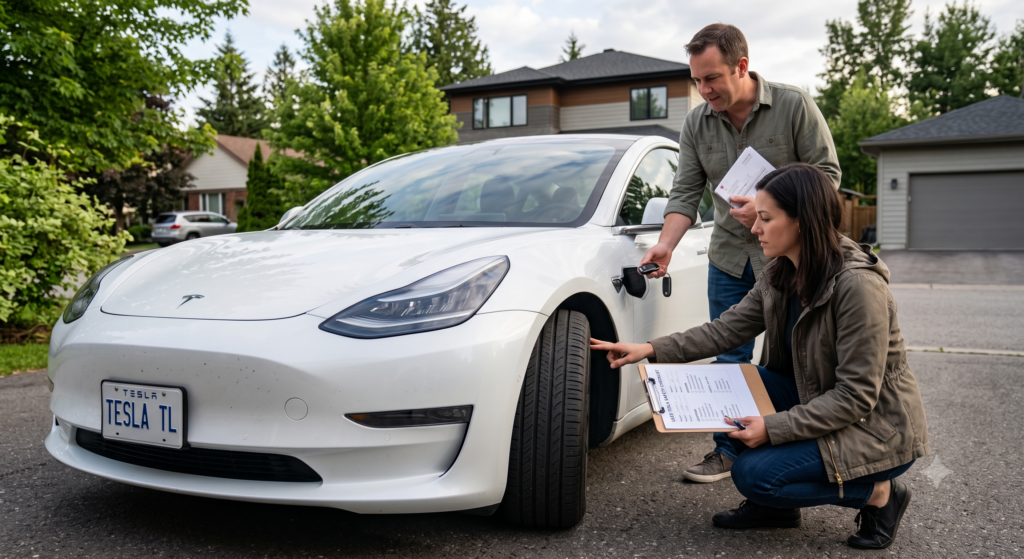
Inspect the exterior methodically. Walk slowly around the vehicle with your phone’s flashlight, examining panel gaps for inconsistencies that indicate prior collision repair. Tesla’s aluminum body panels are difficult to repair properly; poorly matched paint, overspray on rubber seals, or ripples in the metal suggest bodywork that may have compromised structural integrity or sensor calibration. Check the glass carefully, including the windshield, panoramic roof, and rear hatch, for chips, cracks, or delamination at the edges. Glass replacement on a Model S or Model X can exceed $1,500, and even a Model 3 windshield with integrated Autopilot camera housing runs $800 to $1,200.
Examine the tires with a tread depth gauge. Electric vehicles are heavy and torque-rich, consuming tires faster than comparable gasoline cars. Uneven wear patterns across the tread indicate alignment issues, worn suspension bushings, or prior curb strikes that may have bent a wheel or damaged steering components. Verify that all four tires match in brand and model, as mismatched rubber suggests cost-cutting maintenance that may extend to other deferred repairs.
Open the frunk and trunk, inspecting the cargo areas for signs of water intrusion, staining, or musty odors that indicate seal failures. In the frunk, check that the emergency release cable is intact and that the front compartment shows no evidence of prior collision damage or amateur repairs. Lift the trunk floor panels and feel the spare tire well or foam padding for dampness. Water damage in a Tesla is particularly dangerous because the low-voltage electrical systems, battery management computers, and cabin sensors are routed beneath the floor and behind interior panels where moisture can cause corrosion that takes months to manifest.
Don’t risk meeting a private seller without knowing exactly what to inspect or how to verify their claims. At Tesla.tl, every listing includes verified title status, service history, and battery health reports so you can skip the guesswork and buy from vetted sellers who disclose everything upfront. Browse inspected inventory and buy with confidence at https://tesla.tl/.
Phase 3: The Software and Systems Verification
The physical inspection protects you from cosmetic and structural issues, but the software verification protects you from the financial landmines that are unique to Tesla ownership. These checks must be performed with the seller present, using the vehicle’s own systems.
First, verify the Autopilot hardware generation. Navigate to Controls > Software > Additional Vehicle Information on the center touchscreen. Confirm whether the vehicle carries HW2.5, HW3, or HW4. The hardware generation determines whether advertised Full Self-Driving features will actually function and whether future software updates will remain compatible. A seller advertising FSD on a vehicle with HW2.5 is either uninformed or deceptive, because HW2.5 cannot run modern FSD Beta regardless of what the touchscreen claims. If the hardware does not match the seller’s software promises, adjust your offer downward or walk away.
Next, verify the Full Self-Driving status directly. Look at the software menu and the vehicle’s Tesla Account association. Determine whether the FSD license is a permanent purchase tied to the vehicle or a subscription that will lapse. Ask the seller to initiate the ownership transfer process through the Tesla app while you watch. If they refuse or claim they “will do it later,” recognize that FSD transfer is not automatic in private sales and may require Tesla support intervention. Never pay an FSD premium unless you have witnessed the seller remove the vehicle from their account and confirmed that the FSD badge remains active in the software menu afterward.
Check the Supercharger access status. Ask the seller to demonstrate a successful connection to a Supercharger or, at minimum, show the Supercharging menu in the vehicle’s software without error messages or access restrictions. Tesla can and does ban vehicles from the network for salvage history, unpaid idle fees, or association with fraudulent accounts. A banned vehicle is worth thousands less than an equivalent car with full network access, because Supercharger availability is one of the primary value propositions of Tesla ownership.
Test every software feature mentioned in the listing. If the seller claims Enhanced Autopilot, test Navigate on Autopilot, Auto Lane Change, and Summon during your test drive. If they claim Premium Connectivity is active, verify that live traffic visualization, satellite maps, and streaming services function without prompting for subscription renewal. If they claim the heat pump works efficiently, cycle the climate control and feel the air temperature from the vents. Software features are intangible until they fail to appear, and a seller who has misrepresented one feature has likely misrepresented others.
Run the onboard battery health check by charging the vehicle to 100% and recording the displayed range estimate. Compare this against the original EPA rating for the specific trim and year. Then cross-reference with any third-party diagnostic data the seller provides from Scan My Tesla, TeslaFi, or similar tools. A significant discrepancy between the onboard range and the diagnostic State of Health suggests either software calibration issues or a battery management system that is masking deeper degradation.
Phase 4: The Test Drive and Mechanical Assessment
The test drive in a private party transaction is not merely a formality to confirm that the vehicle moves. It is a diagnostic procedure designed to reveal hidden mechanical and electrical issues that static inspection cannot expose.
Begin with a cold start. If possible, arrange to inspect the vehicle after it has been sitting for several hours rather than arriving to find it already warmed up and running. A cold start reveals 12-volt battery weakness, suspension noises that disappear after lubricants warm up, and motor milling sounds that are most pronounced when components are cold. Listen carefully during the initial power-on sequence for any unusual clicks, buzzes, or grinding from beneath the floor or behind the dashboard.
Drive a route that includes stop-and-go traffic, smooth highway cruising, rough urban pavement, and sharp turning maneuvers. In traffic, test the regenerative braking at various speeds. It should feel smooth, predictable, and strong down to low speeds. Jerky or weak regen suggests either software calibration issues or battery thermal management problems that limit energy recapture. On the highway, engage Autopilot or cruise control and verify that the system maintains lane position without constant correction, phantom braking, or calibration errors.
On rough roads, listen specifically for suspension clunks, rattles, and squeaks. The Model 3 and Model Y are prone to rear upper shock mount degradation and front upper control arm bushing wear. The Model S may exhibit air suspension compressor strain or air strut leaks. The Model X can develop Falcon Wing door hinge grinding and rear subframe bushing noise. None of these sounds are normal, and all indicate repairs that should be negotiated into the purchase price.
Test acceleration at various states of charge if possible. A healthy Tesla delivers consistent, instant torque regardless of whether the battery is at 90% or 30%. Noticeably softer acceleration at lower charge levels suggests either battery degradation or thermal limiting that restricts power output. While some power reduction at very low states of charge is normal, a significant drop indicates a pack that is struggling to deliver consistent current.
Pay attention to steering feel and alignment. The steering wheel should be centered during straight-line driving, with no pulling to either side and no vibration through the column. Pulling indicates alignment issues, which on a Tesla often stem from curb strikes, worn bushings, or prior collision damage that was not properly corrected. Vibration at highway speeds suggests wheel imbalance, bent rims, or damaged half-shafts.
Finally, test the charging port physically and electronically. Open and close the charge port door multiple times. Inspect the internal pins for corrosion, discoloration, or damage. If you have access to a charging cable, plug it in and verify that the vehicle initiates charging immediately without error messages. A charge port that is finicky, slow to respond, or displays intermittent connection errors may need a $400 to $700 replacement that should be factored into your offer.
Phase 5: Documentation, Payment, and Transfer Security
If the vehicle passes your inspection and test drive, the final phase is protecting yourself financially during the transaction. Private party vehicle sales are prime territory for payment fraud, title scams, and post-sale disputes that civil courts struggle to resolve.
Never pay with cash unless you are meeting at a bank where the seller can immediately deposit the funds and you can witness the authentication of the bills. Cash transactions leave no paper trail, offer no recourse if the title is defective, and expose you to personal safety risks. The preferred payment method for private party sales is a cashier’s check drawn from a major bank, which you should obtain in the seller’s presence after confirming the final agreed price. Alternatively, an escrow service specifically designed for vehicle transactions provides the highest level of security. The escrow agent holds your funds until you receive the clean title and confirm the vehicle’s condition, at which point funds are released to the seller.
Verify the title document with obsessive detail before handing over any payment. Confirm that the VIN matches the vehicle exactly, character for character. Verify that the seller’s name matches their government-issued identification. Check that there are no liens listed on the title; if a lienholder appears, the seller cannot legally transfer ownership until the loan is paid off and a lien release is obtained. Examine the odometer reading on the title against the vehicle’s current display. Significant discrepancies suggest odometer tampering or title fraud. Ensure the title is clean and not branded as salvage, rebuilt, flood, or lemon law buyback.
Complete a bill of sale that includes the exact VIN, sale price, date, odometer reading, and signatures of both parties. Most jurisdictions require this document for registration and tax purposes. Keep copies of everything: the signed title, the bill of sale, the seller’s identification, and any service records provided. Photograph the seller’s ID and the vehicle’s license plates before they are removed, in case post-sale issues arise.
Immediately after purchase, initiate the Tesla account transfer. The seller must remove the vehicle from their Tesla account through the mobile app or website. You must then add it to your account using the VIN and proof of purchase. Do not leave the seller’s possession until you have confirmed that the vehicle appears in your Tesla app with full functionality. If Full Self-Driving, Premium Connectivity, or other software features do not transfer properly, address this with Tesla support immediately while the seller is still accessible. Once the seller disappears, resolving software transfer issues becomes exponentially more difficult.
Phase 6: Post-Purchase Immediate Actions
Your safety checklist does not end when you drive away. Within the first 48 hours of ownership, take several protective steps.
First, schedule a comprehensive inspection at a Tesla Service Center or an independent specialist familiar with high-voltage electric vehicles. Even if the vehicle appeared perfect during your private party inspection, a professional lift inspection can reveal underbody damage, coolant leaks, or battery casing issues that are invisible from above. This inspection typically costs $150 to $300 and provides either peace of mind or documentation of issues that may allow you to unwind the sale if fraud is discovered.
Second, update the Tesla app and vehicle software to the latest available version. Verify that all features transfer correctly and that no error messages appear after the update. Software updates sometimes reveal latent hardware issues that were masked by older firmware.
Third, purchase insurance immediately. Private party sales typically do not include any grace period for insurance coverage. Driving an uninsured Tesla is financially reckless given the repair costs associated with even minor collisions.
Fourth, register the vehicle with your local Department of Motor Vehicles within the legally required timeframe. Delayed registration can result in penalties and may complicate your legal ownership if disputes arise.
Final Verdict
Buying a used Tesla from a private seller is not inherently dangerous, but it is unforgiving. The combination of high-voltage complexity, software-dependent features, and title-sensitive value means that a single overlooked detail can cost you thousands. This checklist provides the armor you need: vet digitally before meeting, inspect physically with methodical precision, verify software with paranoid thoroughness, protect payment with escrow or bank oversight, and document every step of the transfer.
The private party market rewards buyers who are patient, informed, and disciplined. It punishes those who are impulsive, trusting, or intimidated by the seller’s urgency. If a deal feels rushed, if documentation is incomplete, or if any element of this checklist cannot be satisfied, the correct response is always to walk away. There will always be another Tesla listing tomorrow. There will not be another chance to recover the money you hand to a scam artist today.
Ready to find a used Tesla without the risks of private party guesswork? Explore verified listings on Tesla.tl where every seller is vetted, every vehicle includes transparent history reports, and every transaction is supported by secure payment tools. Skip the uncertainty and buy with complete confidence at https://tesla.tl/.
