Used Model Y with Hardware 3 vs Hardware 4: What Buyers Need to Know
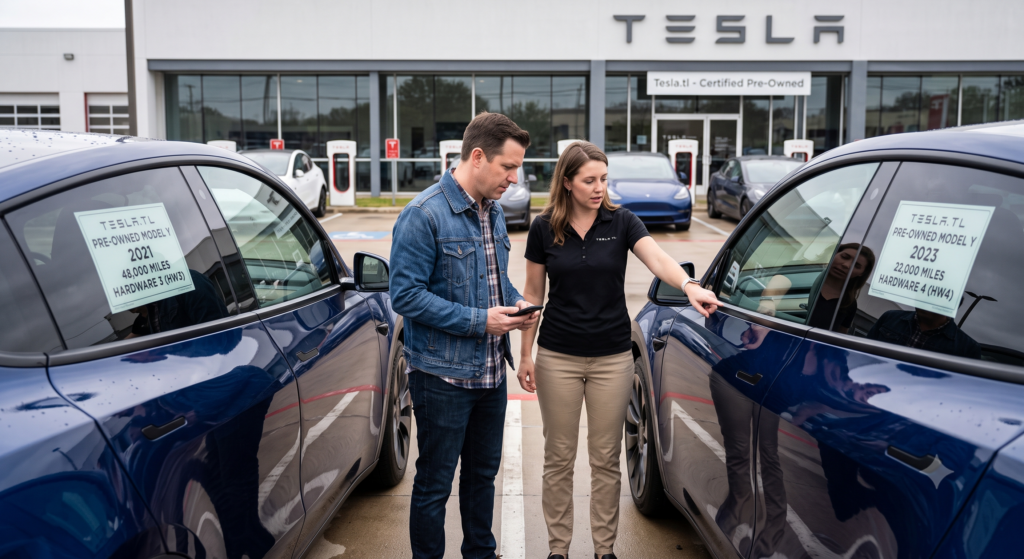
The used Tesla Model Y market in 2026 has introduced a new layer of complexity that did not exist for previous generations of car buyers. When shopping for a pre-owned gasoline vehicle, the primary concerns were typically mechanical: engine condition, transmission smoothness, and rust. In the Tesla ecosystem, however, a significant portion of the vehicle’s value—and its future utility—is determined not by pistons or crankshafts, but by silicon. Specifically, the Autopilot hardware generation installed at the factory has become one of the most consequential variables in the purchasing equation. The transition from Hardware 3 (HW3) to Hardware 4 (HW4) represents the most significant computational and sensor upgrade in Tesla’s history, and by 2026, the used Model Y market contains a substantial mix of both architectures. Understanding the real-world differences between these two systems is no longer optional for informed buyers; it is the difference between purchasing a vehicle that will remain technologically relevant for the next decade and one that is already approaching the end of its autonomous development path.
This comprehensive guide examines exactly what separates HW3 from HW4 in the context of the used Model Y, how each generation performs in 2026, whether the hardware gap justifies the price premium on newer vehicles, and the specific verification steps you must take before committing to a purchase. We cut through the marketing specifications and focus on what actually matters for daily driving, software compatibility, and long-term resale value.
What Is Autopilot Hardware and Why Does It Matter?
Before comparing generations, it is essential to understand what Autopilot hardware actually does. Unlike traditional automotive features that are defined by physical components you can see and touch—leather seats, sunroofs, or alloy wheels—Tesla’s Full Self-Driving (FSD) and Autopilot systems rely on a dedicated computer, an array of cameras, and increasingly sophisticated neural networks that interpret the visual world in real time. The hardware generation determines the maximum resolution of the cameras, the processing power available to analyze that visual data, and ultimately the software capabilities that Tesla can deploy through over-the-air updates.
When you buy a used Model Y, you are not merely buying a body shell and battery pack. You are buying a specific generation of autonomous driving potential. A vehicle with obsolete hardware may be permanently locked out of future features that Tesla develops over the next five years, regardless of how much you pay for software subscriptions. This makes the hardware generation a core component of the vehicle’s intrinsic value, comparable to the battery capacity or drivetrain configuration.
Hardware 3 (HW3): The Workhorse of the Tesla Fleet
Hardware 3 debuted in 2019 and became standard across all Model Y vehicles from the model’s 2020 launch through approximately mid-2023. It is built around Tesla’s custom-designed Full Self-Driving Computer, a dual-chip architecture capable of processing 144 trillion operations per second. HW3 processes visual input from eight cameras positioned around the vehicle: three forward-facing cameras behind the windshield (wide, main, and narrow), two side cameras on the front fenders, two side-rear cameras on the B-pillars, and one rear-facing camera above the license plate.
In 2026, HW3 remains a remarkably capable system. It supports all current Autopilot features, including Navigate on Autopilot, Auto Lane Change, Autopark, Summon, Smart Summon, and the FSD Beta (Supervised) urban driving stack. For the vast majority of daily driving scenarios—highway cruising, traffic jam assistance, parking maneuvers, and even complex city street navigation—HW3 delivers a fully functional experience that reduces driver fatigue and enhances safety. Millions of Tesla owners worldwide rely on HW3 every day without feeling that their vehicles are technologically deficient.
However, HW3 has definitive limitations that have become increasingly apparent as Tesla’s software ambitions have expanded. The cameras connected to HW3 are lower resolution than those introduced with HW4, meaning the system has less granular detail for identifying distant objects, reading faded road markings, or interpreting complex urban environments with heavy pedestrian and cyclist activity. The processing architecture, while powerful for its era, has a finite ceiling. Tesla has indicated that certain next-generation autonomous features planned for late 2026 and beyond may require computational capabilities that exceed HW3’s design parameters.
For buyers in 2026, this means that an HW3-equipped Model Y is a fully functional vehicle today but may face a software obsolescence horizon within the next three to five years. If you plan to keep the car for only two or three years before upgrading, this horizon is irrelevant. If you intend to own the vehicle for eight to ten years and want access to the most advanced autonomous capabilities throughout that period, HW3 represents a compromise that you must consciously accept.
Hardware 4 (HW4): The Next Generation Arrives
Hardware 4 began appearing in Model S and Model X vehicles in early 2023 and became standard across the Model 3 and Model Y lineup with the Highland refresh and subsequent production updates in late 2023. By 2026, HW4 is found in all newer Model Y builds and has begun filtering into the used market as these vehicles complete their first lease cycles and enter secondary ownership.
HW4 represents a ground-up redesign rather than an incremental upgrade. The computer itself features a more powerful processor with significantly higher memory bandwidth. But the most visible improvement is the camera suite. HW4-equipped vehicles utilize higher-resolution cameras with improved dynamic range, allowing the system to see finer details at greater distances and perform better in challenging lighting conditions—dawn, dusk, heavy shadow, and direct sun glare. The forward-facing camera array has been restructured to provide wider fields of view with less distortion at the edges, improving lane-keeping confidence on sharp curves and better detecting vehicles merging from steep angles.
Additionally, HW4 includes redundant power supplies and upgraded GPS hardware that provides more precise positioning data, critical for future features that rely on centimeter-level accuracy. While Tesla has not yet fully exploited all of HW4’s capabilities as of mid-2026, the hardware is explicitly designed as a forward-looking platform meant to support autonomous driving features that HW3 cannot process.
For used Model Y buyers, the practical implication is clear: an HW4 vehicle is more future-proof. It will receive software updates longer, support more advanced features when they are released, and retain stronger resale value as the market gradually shifts away from HW3 inventory.
Real-World Performance Differences in 2026
Despite the technical superiority of HW4, the honest truth is that in day-to-day driving during 2026, the difference between HW3 and HW4 is often subtle rather than transformative. Both systems currently run the same FSD Beta software stack, and both handle highway driving, lane changes, and parking with comparable competence. If you are buying a used Model Y primarily for its electric efficiency, cargo space, and access to the Supercharger network, you may not notice a dramatic difference in Autopilot behavior between the two hardware generations.
Where HW4 begins to pull ahead is in edge-case scenarios that are becoming more common as FSD Beta expands into denser urban environments. HW4’s higher-resolution cameras provide better detection of:
- Small or partially obscured road debris at highway speeds
- Cyclists and pedestrians in low-light conditions
- Faded or temporary road markings in construction zones
- Traffic light state changes at steep angles or long distances
For drivers who frequently use FSD Beta in complex city centers, these improvements translate to fewer disengagements, smoother navigation through ambiguous intersections, and greater overall confidence in the system’s decisions. For suburban commuters who primarily use basic Autopilot on well-marked highways, the difference is negligible.
The Sentry Mode and Dashcam systems also benefit from HW4’s superior cameras. Recorded footage is sharper, license plates are more legible, and nighttime recordings show significantly more detail. This is not merely a convenience; it can be the difference between identifying a hit-and-run perpetrator and capturing useless blurry footage.
FSD Transferability and Subscription Compatibility
One of the most financially significant considerations when comparing HW3 and HW4 is how Full Self-Driving licenses interact with each hardware generation. In 2026, Tesla continues to sell FSD as both a permanent one-time purchase and a monthly subscription. However, the company’s long-term roadmap increasingly treats HW4 as the primary development target.
While Tesla has committed to supporting HW3 with FSD updates for the foreseeable future, industry observers and software release patterns suggest that HW3 will eventually hit a ceiling where new features cannot be backported due to hardware constraints. When that ceiling is reached—whether in 2027, 2028, or beyond—HW3 owners may find themselves unable to access the latest autonomous capabilities without purchasing an entirely new vehicle.
For used buyers, this creates a strategic calculation. An HW4 Model Y with a transferable FSD license is arguably the most valuable configuration in the secondary market because it bundles future-proof hardware with permanent software rights. An HW3 vehicle with FSD is still valuable today but carries a depreciating software asset that may eventually stall. When negotiating prices, HW4 examples with FSD justify a meaningful premium, while HW3 examples with FSD should be priced more conservatively to reflect their finite upgrade path.
Don’t risk buying a used Model Y with obsolete hardware or non-transferable FSD. At Tesla.tl, every listing clearly identifies the Autopilot hardware generation, confirms FSD license type, and verifies software transfer status so you know exactly what you are buying. Browse inspected HW3 and HW4 inventory with full transparency at https://tesla.tl/.
Resale Value and Market Trajectories
The used Tesla market in 2026 is already showing divergence in how HW3 and HW4 vehicles are priced and how quickly they sell. HW4 Model Y examples, even with higher mileage, command stronger interest from buyers who are explicitly seeking future-proof technology. Dealers and private sellers can typically ask $2,000 to $4,000 more for an HW4 vehicle compared to an equivalent HW3 example from the same model year with similar mileage and battery health.
Conversely, HW3 inventory is increasingly marketed toward budget-conscious buyers who prioritize immediate value over long-term software support. This bifurcation will likely accelerate as Tesla releases new features exclusive to HW4, making older hardware less desirable for tech-forward shoppers. If you are buying a used Model Y as a short-term transitional vehicle, the HW3 discount represents smart economics. If you view the purchase as a long-term investment, the HW4 premium pays dividends in extended relevance and stronger exit pricing.
It is worth noting that HW2.5 vehicles from the earliest Model Y production runs are now effectively obsolete for modern FSD features and trade at significant discounts. Buyers should verify that any 2020 or early 2021 Model Y they consider has either shipped with HW3 or received the factory-approved HW3 retrofit. HW2.5 without retrofit is a dealbreaker for anyone interested in autonomous features.
Which Should You Buy? HW3 or HW4?
The decision depends on your ownership timeline, budget, and how much you value staying on the bleeding edge of autonomous driving technology.
Choose HW3 if:
- Your budget is capped and you need maximum value per dollar today.
- You plan to own the vehicle for three years or less before upgrading.
- You primarily use basic Autopilot on highways and rarely engage FSD Beta in urban environments.
- You live in a region with simple road infrastructure where camera resolution is less critical.
- You found an exceptionally well-maintained HW3 example with healthy battery and strong service history at a compelling price.
Choose HW4 if:
- You plan to keep the vehicle for five to eight years and want access to the longest possible software support lifecycle.
- You frequently use FSD Beta in dense urban areas with complex traffic patterns.
- You value superior Sentry Mode and Dashcam recording quality for security and insurance purposes.
- You want the strongest possible resale value when it is time to sell or trade.
- Your budget allows for the modest premium that HW4 commands on the used market.
How to Verify Hardware Generation When Buying Used
Sellers do not always know—or honestly disclose—which hardware generation their vehicle contains. Some confuse software features with hardware capabilities, believing that because their car has “Full Self-Driving” displayed on the screen, it must have the latest hardware. This is false. You must verify independently.
Method 1: Vehicle Software Menu Navigate to Controls > Software > Additional Vehicle Information on the center touchscreen. Look for the “Autopilot Computer” or “Full Self-Driving Computer” entry. HW3 is sometimes listed as “FSD Computer” or “HW3,” while HW4 may appear as “HW4” or simply as a newer hardware revision number. If the menu is ambiguous, proceed to Method 2.
Method 2: Camera Visual Inspection HW4 vehicles have noticeably different camera housings. The forward-facing camera module behind the windshield is larger and more rectangular on HW4, with a revised lens arrangement. The side cameras on the front fenders and B-pillars also have slightly different housing shapes. If you are comparing two vehicles side by side, the difference is visible to a trained eye.
Method 3: Tesla Account or Service Center Verification The most reliable method is to provide the VIN to a Tesla Service Center or check the vehicle’s original Monroney sticker (window sticker) if available. The factory build sheet explicitly lists the Autopilot hardware generation. On Tesla.tl, we require sellers to disclose this information and verify it against factory records whenever possible.
Method 4: Feature Testing If the vehicle is running recent FSD Beta software with advanced visualization—showing detailed renderings of adjacent vehicles, road edges, and traffic controls with high fidelity—it is likely HW4. HW3 vehicles can run the same software but often display lower-resolution visualizations with less granular detail.
Final Verdict
The Hardware 3 vs. Hardware 4 decision for a used Model Y in 2026 is not a choice between good and bad. It is a choice between proven present-day capability and future-proofed potential. HW3 remains an excellent system that satisfies the needs of most Tesla owners today and will continue to do so for years. It represents exceptional value on the used market and should not be dismissed simply because a newer generation exists.
However, HW4 is definitively the smarter long-term investment. Its superior cameras, more powerful compute architecture, and explicit design for next-generation autonomous features ensure that an HW4 Model Y will remain technologically relevant longer, command stronger resale value, and deliver a more refined experience in challenging driving environments. For buyers who can afford the modest premium, HW4 is the recommended choice.
Ultimately, the correct hardware generation is the one that aligns with your budget, your ownership timeline, and your honest assessment of how much you will use advanced autonomous features. Do not overpay for HW4 if you only need basic cruise control. Do not settle for HW3 if you dream of a vehicle that drives itself through city streets five years from now.
Ready to find the perfect used Tesla Model Y with verified Autopilot hardware? Search Tesla.tl for listings that clearly identify HW3 vs HW4, include FSD transfer status, and provide factory build verification. Filter by hardware generation, battery health, and price to find the exact Model Y that matches your technical needs and budget. Visit https://tesla.tl/ and drive into the future with confidence today.
