
Used Tesla Model X Buying Guide: Falcon Doors, Batteries & Reality
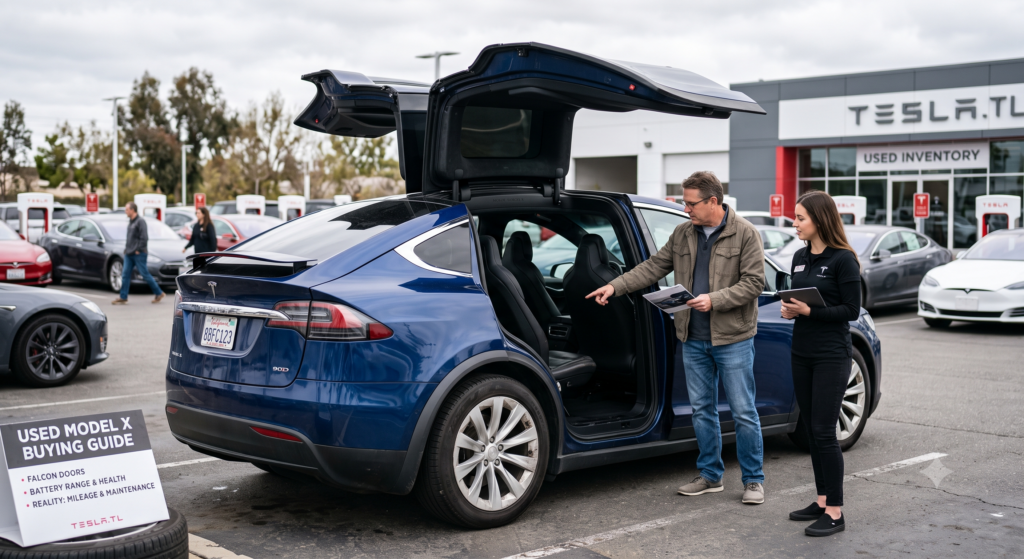
The Tesla Model X has always occupied a peculiar and somewhat contradictory space in the automotive universe. It is simultaneously a technological marvel and a mechanical liability, a family hauler that can outrun supercars and a luxury SUV whose signature party trick—the Falcon Wing doors—has generated more warranty claims, owner frustration, and internet memes than perhaps any other single feature in Tesla’s history. By 2026, the used Model X market has matured into a fascinating bazaar of high-mileage workhorses, garage-kept family treasures, and cautionary tales disguised as bargain listings. For buyers tempted by the Model X’s cavernous interior, available six- and seven-seat configurations, and undeniable road presence, the journey from initial interest to confident purchase is fraught with pitfalls that do not exist for the simpler Model 3 or Model Y. The Model X is not merely a taller Model S with fancy doors. It is an entirely different beast with unique failure modes, astronomical repair costs, and a driving experience that either captivates or infuriates depending on whether you entered the transaction with your eyes wide open.
This guide is your unvarnished roadmap to buying a used Tesla Model X in 2026. We dissect the Falcon Wing door reality without nostalgia, examine how the Model X battery ages under the stress of moving a 5,400-pound vehicle, compare the practical differences between the 75D, 90D, and 100D configurations, and confront the specific inspection points that separate a worthy family SUV from a money pit that will have you on a first-name basis with your local Tesla service advisor. If you are considering a used Model X, you need this information more than you need the vehicle itself.
The Falcon Wing Doors: Engineering Theater Meets Daily Reality
Let us address the elephant—or rather, the bird—in the room immediately. The Falcon Wing doors are the defining visual feature of the Model X, and they are simultaneously the reason most buyers want the vehicle and the reason many experienced owners warn against it. When they function correctly, the doors are genuinely magical. They rise in a theatrical arc, sensors detect obstacles overhead and to the sides, and passengers can step into the second row without the awkward duck-and-shuffle required by traditional SUVs with conventional doors. In tight parking spaces, the doors require less lateral clearance than a standard minivan sliding door, and the drama of the opening sequence never fails to draw crowds at charging stations.
But the mechanical complexity required to achieve this theater is staggering. Each Falcon Wing door contains multiple electric motors, a torsion spring system, ultrasonic and capacitive sensors, rubber seals that must maintain airtight integrity across a massive moving surface, and software algorithms that interpret sensor data in real time to avoid crushing garage ceilings, garage door openers, or the hands of curious children. After six to eight years of daily use, this complexity reveals itself in a litany of expensive failures.
The most common issue is sensor drift and miscalibration. The doors rely on ultrasonic sensors to detect obstacles, but these sensors can become dirty, damaged by road debris, or simply drift out of calibration over time. When this happens, the doors may refuse to open in situations where they previously functioned perfectly, or worse, they may attempt to open into a low ceiling or nearby vehicle, causing paint damage or bending the aluminum door skin. The door seals—massive rubber gaskets that must compress and flex thousands of times per year—harden, crack, and leak. Water intrusion through degraded door seals is a well-documented Model X weakness that can damage interior trim, corrode the floor pan, and short-circuit the low-voltage electronics routed beneath the sills.
The torsion springs and actuator motors are another weak point. These components bear the entire weight of the massive doors and work hardest in cold weather when grease thickens and rubber becomes less pliable. In freezing temperatures, the doors may open slowly, make alarming groaning noises, or fail to open entirely until the vehicle’s cabin has warmed. Snow and ice accumulation on the door seals can prevent proper closure, triggering endless warning chimes and leaving the vehicle in a partially secured state. In severe cold, the doors have been known to seal themselves shut with ice, requiring owners to manually break the ice bond before the motors can function.
Repair costs are sobering. A single Falcon Wing door actuator replacement at a Tesla Service Center can cost $1,500 to $2,500. A complete door seal replacement runs $800 to $1,200 per side. If the door requires structural realignment due to a minor collision or years of stress on the hinges, body shops familiar with aluminum Tesla construction may charge $3,000 to $5,000 per door. For a vehicle with two of these doors, a comprehensive refresh of both sides can approach the cost of a used Model 3.
For used buyers in 2026, the inspection protocol for the doors must be exhaustive. Open and close each door ten times in succession, listening for grinding, clicking, or uneven motor strain. Test the obstacle detection by holding your hand in the door’s path during closing—it should stop immediately and reverse. Inspect the rubber seals for cracks, flattening, or sections that no longer spring back to shape. Check the interior door panels and carpet edges beneath the doors for water stains or musty odors that indicate past leaks. If the seller lives in a cold climate, ask specifically about winter behavior. Any hesitation, unusual noise, or history of “door won’t open” errors should be treated as a major price negotiation point or a reason to walk away entirely.
Battery Reality: Moving a Heavy SUV Takes Its Toll
The Model X is a heavy vehicle. Even the “light” 75D variant tips the scales at over 5,300 pounds, while the 100D and Performance versions approach 5,500 pounds. This mass, combined with the Model X’s substantial frontal area and drag coefficient, places enormous energy demands on the battery pack. A Model X consumes significantly more watt-hours per mile than a Model S or Model Y, which means that every charge cycle stresses the battery more deeply and that range degrades more noticeably over time.
The Model X was offered with three primary battery configurations during its most common production years: the 75 kWh pack in the 75D, the 90 kWh pack in the 90D, and the 100 kWh pack in the 100D and P100D. Each has aged differently in the real world, and understanding these differences is critical to avoiding range anxiety.
The 75D was the entry point, offering approximately 237 miles of EPA-rated range when new. By 2026, a 75D with 50,000 to 70,000 miles typically shows 190 to 210 miles of real-world range at 100% charge in temperate weather. In winter, with the cabin heater working to warm a massive interior volume, this can drop to 140 to 160 miles. For a family SUV that may be loaded with passengers, cargo, and roof-mounted accessories, these numbers are genuinely constraining. A 75D is adequate for suburban duty and short highway hops, but it is not a confident road-trip vehicle unless you are prepared for frequent charging stops and careful energy management.
The 90D offered a step up to roughly 257 miles when new, but the 90 kWh pack developed a reputation for slightly faster degradation than the 85 kWh it replaced. Some owners reported that their 90D batteries lost capacity more aggressively than expected, particularly in hot climates. In 2026, a 90D with moderate mileage often shows 210 to 230 miles of usable range, but the variance is wider than with other packs. Buyers should verify battery health meticulously and be wary of examples that have fallen below 85% State of Health prematurely.
The 100D and P100D are the sweet spot for used Model X buyers who actually intend to use the vehicle as a family hauler. With 295 miles of EPA range when new, these variants typically retain 250 to 275 miles of real-world range after 50,000 miles, depending on climate and charging habits. Even in winter, a 100D can deliver 200+ miles, which is enough for a full day of driving without range anxiety. The 100 kWh pack also uses improved cell chemistry that has proven more durable than the 90 kWh formulation. For buyers who plan road trips, ski weekends, or simply want the psychological comfort of a large buffer, the 100D is worth the premium it commands on the used market.
All Model X batteries suffer from the vehicle’s weight and aerodynamic profile, but they also benefit from the same thermal management systems found in the Model S. The key for used buyers is to verify that the previous owner did not habitually charge to 100% or rely exclusively on DC fast charging, both of which accelerate degradation in a vehicle that already works its battery harder than lighter Teslas.
Don’t risk buying a used Model X with failing Falcon Wing doors or a degraded battery that can’t handle family road trips. At Tesla.tl, every listing includes verified door mechanism diagnostics, battery health reports, and water intrusion checks so you know exactly what you are inheriting. Browse inspected Model X inventory and buy with confidence at https://tesla.tl/.
6-Seat vs. 7-Seat: The Configuration That Defines Utility
Unlike the Model Y, where the third row is a cramped afterthought, the Model X was designed from the outset as a genuine three-row vehicle. The 6-seat configuration features two captain’s chairs in the second row with a walkthrough aisle between them. The 7-seat configuration adds a smaller middle seat in the second row, creating a more traditional bench arrangement. Both configurations use the Falcon Wing doors for second and third-row access, which means that regardless of layout, passengers enter through the same theatrical portal.
The 6-seat configuration is generally preferred by families who value the walkthrough space and the individual comfort of the captain’s chairs. The aisle allows parents to move between the front and rear rows without exiting the vehicle—a genuine convenience during road trips with children. The second-row captain’s chairs also offer more adjustability and comfort than the narrower middle seat in the 7-seat layout. However, the 6-seat configuration eliminates one passenger position, reducing total capacity to six rather than seven.
The 7-seat configuration maximizes passenger count but compromises second-row comfort. The middle seat is narrower and less supportive than the outboard positions, and it complicates the folding mechanism for the second row. In the Model X, the second-row seats do not fold completely flat in either configuration—a persistent criticism of the vehicle’s cargo versatility—but the 7-seat middle seat creates additional hard points and angles that make loading large items even more awkward.
For used buyers, the choice depends on your family size and cargo priorities. If you have four children or frequently transport seven people, the 7-seat is essential. If you have two or three children and value comfort and walkthrough space, the 6-seat is the superior daily experience. Be aware that the 6-seat configuration is rarer on the used market and sometimes commands a slight premium due to buyer preference.
Other Known Weaknesses: What the Brochure Does Not Show
Beyond the doors and battery, the Model X suffers from several additional weaknesses that buyers must inspect for.
Front Suspension and Air Struts Like the Model S, the Model X uses an air suspension system that is prone to leaks and compressor failures. However, the Model X’s additional weight places even more stress on the front air struts, which are common failure points. A sagging front corner, a compressor that runs excessively, or a “Suspension Needs Service” warning are all signs of impending expensive repairs. A full front air suspension refresh can cost $3,000 to $5,000 at a Tesla Service Center.
Panoramic Windshield and Roof Leaks The Model X features a massive panoramic windshield that extends over the front occupants’ heads, creating an almost helicopter-like view of the road. This glass is visually stunning but expensive to replace if cracked by road debris. The windshield seal and the smaller rear roof panel seal can also develop leaks, allowing water to enter the headliner and A-pillar areas. Check for staining on the headliner, musty odors, and delamination of the fabric edges.
Wind Noise and Seal Issues The Model X’s complex door geometry and massive glass surfaces create multiple opportunities for wind noise at highway speeds. The Falcon Wing door seals, the front door seals, and the panoramic windshield perimeter are all common sources of whistling and rushing air. Some wind noise is normal for a vehicle with this much glass, but excessive noise indicates degraded seals or misaligned doors that will require adjustment.
MCU1 and the Infotainment Time Bomb Early Model X vehicles through 2017 shipped with MCU1, the same NVIDIA Tegra-based unit that plagued early Model S cars. The 8GB eMMC memory chip wears out, causing slow boot times, touchscreen lag, yellow border discoloration, and eventual total failure. An MCU2 retrofit is essential for any early Model X that still runs the original unit. Verify the MCU generation before purchase, and budget $1,500 to $2,500 for the upgrade if it has not been completed.
Seventh-Seat Access and Comfort If you are considering a 7-seat configuration, physically climb into the third row during your inspection. The Model X’s third row is more usable than the Model Y’s, but it is still tight for adults on long journeys. Verify that the second-row seats tilt and slide forward smoothly to allow access, and check that the third-row seatbelts and ISOFIX anchors are intact and functional.
Pricing Expectations for Used Model X in 2026
The used Model X market in 2026 reflects the vehicle’s mixed reputation: desirable for its uniqueness and space, but feared for its potential repair costs.
- 2016–2017 75D: $24,000–$32,000
- 2016–2017 90D: $28,000–$36,000
- 2017–2018 100D: $36,000–$46,000
- 2017–2018 P100D (Performance): $45,000–$58,000
- 2019+ Raven Long Range: $48,000–$58,000
- 2019+ Raven Performance: $55,000–$70,000
These figures assume clean titles, functional doors, and battery retention above 85%. Vehicles with documented door repairs, MCU2 upgrades, and recent air suspension service can command premiums, while those with lingering door issues, degraded batteries, or salvage history should trade well below these ranges.
Final Verdict
The used Tesla Model X is not a vehicle for the faint of heart or the thin of wallet. It is the most complex, most expensive to maintain, and most polarizing vehicle in Tesla’s lineup. The Falcon Wing doors are a genuine marvel when they work and a genuine nightmare when they do not. The battery demands are higher than any other Tesla due to the vehicle’s mass. The air suspension, panoramic glass, and intricate interior add layers of potential failure that simply do not exist in the simpler Model Y.
Yet for buyers who understand these risks and inspect accordingly, the Model X offers something no other Tesla can match: genuine three-row seating, a commanding road presence, and the undeniable cool factor of those rising doors. A 2018 100D with refreshed door mechanisms, an MCU2 upgrade, and a healthy battery is one of the most capable family electric vehicles on the road. A 2016 75D with original door seals, MCU1, and a leaking front air strut is a financial trap.
If you are mechanically inclined, have access to a competent independent Tesla shop, and view the Model X as a passion project as much as a transportation tool, the rewards can justify the risks. If you want a trouble-free electric family hauler with minimal drama, buy a Model Y Long Range and never look back.
Ready to find a used Model X that has already survived its teething problems? Search Tesla.tl for listings with verified Falcon Wing door diagnostics, MCU generation confirmation, and battery health reports. Filter by seating configuration, battery size, and service history to find the Model X that fits your family without emptying your repair fund. Visit https://tesla.tl/ and drive the most distinctive electric SUV on the road today.
