
Used Model S Refresh (2021+) vs Older Models: What’s Actually Different?
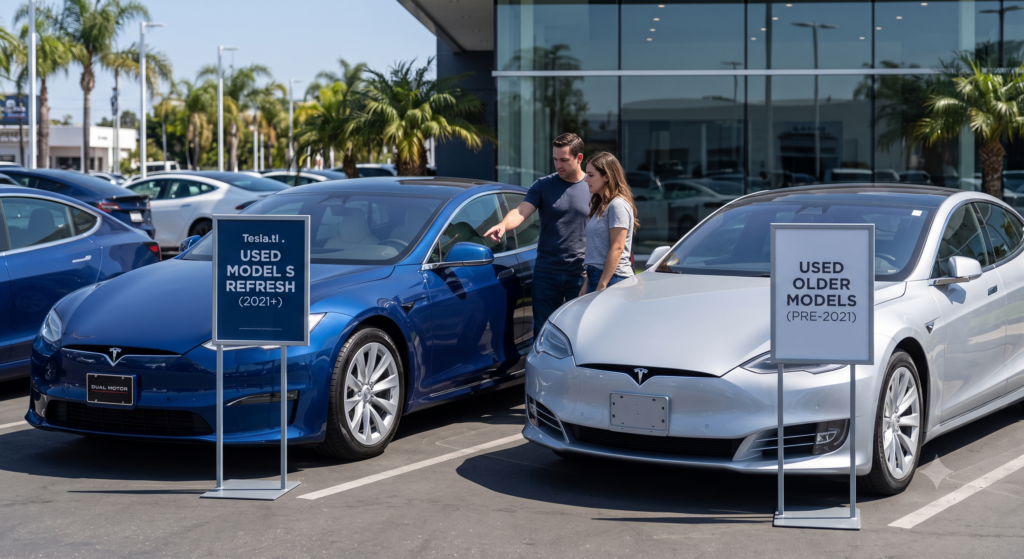
The Tesla Model S has always occupied a unique position in the automotive hierarchy—a fully electric luxury sedan that redefined performance benchmarks while simultaneously serving as the technological flagship for an entire company. But in 2021, Tesla executed a refresh so comprehensive that it effectively split the Model S into two distinct eras. To the casual observer, a 2021+ refreshed Model S might appear similar to the 2012–2020 original. The silhouette remains unmistakable, the falcon-wing doors are absent, and the general proportions echo the vehicle that first stunned the world nearly a decade earlier. However, step inside, press the accelerator, or simply attempt to adjust the wiper speed, and the differences become immediately, sometimes jarringly, apparent.
For buyers navigating the used Model S market in 2026, understanding exactly what changed in the 2021 refresh is not merely an academic exercise in automotive history. It is a purchasing decision that affects everything from daily usability to long-term software support to whether your passengers will mutiny after a three-hour road trip. The refreshed Model S introduced a radical interior redesign, an entirely new computing architecture, the tri-motor Plaid powertrain, and controversial control interfaces that divided the owner community. Meanwhile, the pre-refresh models, despite their age-related weaknesses, retain certain charms and practical advantages that the newer cars sacrificed in pursuit of futurism.
This comprehensive analysis dissects every meaningful difference between the 2021+ refreshed Model S and its older predecessors, helping you determine whether the modernized experience justifies the premium or whether a well-maintained Raven-era vehicle delivers superior value for your specific needs.
Exterior: Evolution, Not Revolution
Tesla deliberately avoided dramatic exterior changes with the 2021 refresh, opting instead for subtle refinements that improved aerodynamics and modernized the vehicle’s presence without alienating existing owners. The front fascia received a slightly reshaped lower bumper with more efficient air intakes for cooling the Plaid’s tri-motor architecture. The headlights were updated with a more sophisticated LED signature, and the rear diffuser was revised to accommodate the Plaid’s extreme performance capabilities. The overall effect is cleaner and more planted, but a 2021 Model S parked next to a 2019 Raven does not scream “new generation” to casual observers.
The most visible exterior change is actually at the wheels. The Plaid variant introduced staggered 21-inch wheels with wider rear tires to manage the tri-motor torque, while the standard Long Range retained more conservative 19-inch and 20-inch options. For used buyers, this means that older pre-refresh Model S vehicles with aftermarket wheels can sometimes mimic the refreshed look, while genuine refresh models are distinguished primarily by their lighting details and wheel designs rather than any dramatic sheet-metal transformation.
Interior: The Spaceship vs. The Scandinavian Living Room
If the exterior evolution was cautious, the interior revolution was anything but. The 2021 refresh completely gutted and rebuilt the Model S cabin, creating an environment that feels closer to a gaming lounge or aircraft cockpit than a traditional luxury sedan.
The Yoke and Steering Interface The most controversial change was the replacement of the traditional round steering wheel with an optional yoke—a rectangular, aviation-inspired control device with no upper rim. Tesla claimed the yoke improved forward visibility and created a more immersive driving experience. In practice, it proved divisive. Many owners struggled with the lack of a traditional grip during low-speed maneuvers, parking, and u-turns. The integrated capacitive buttons for turn signals, horn, and headlights eliminated physical stalks entirely, forcing drivers to relearn muscle memory developed over decades of driving. By 2023, Tesla bowed to customer pressure and made a conventional round steering wheel a no-cost option, though many early refresh vehicles still carry the yoke.
Pre-refresh Model S vehicles, by contrast, use a completely conventional steering wheel with physical stalks for signals and gear selection. For buyers who prioritize intuitive control and do not wish to adapt to Tesla’s experimental interfaces, the older interior is objectively easier to live with. There is no learning curve, no accidental horn honks, and no fumbling for the turn signal at a four-way stop.
The Screens The pre-refresh Model S featured a 17-inch vertical touchscreen that was revolutionary in 2012 but aged into a somewhat dated portrait-oriented display by 2020. The 2021 refresh reoriented the screen to landscape mode, matching the Model 3 and Model Y layout but with significantly higher resolution and processing power. Behind this screen sits an AMD Ryzen processor—the same architecture found in modern gaming consoles—delivering responsiveness that makes the old NVIDIA Tegra-based systems feel like antique calculators.
More significantly, the refresh added an 8-inch rear passenger screen mounted on the center console between the front seats. This screen controls rear climate zones, provides access to streaming entertainment, and allows backseat passengers to play games independently. For families with children, this is a genuine quality-of-life improvement that transforms long drives. Pre-refresh vehicles have no such feature; rear passengers stare at the back of the front seats or their own phones.
Materials and Build Quality The refresh introduced improved materials, including more premium textiles, better-damped switchgear, and ambient lighting that runs across the dashboard and doors. Pre-refresh vehicles, particularly early builds, suffered from inconsistent material quality, though the Raven era (2019–2020) had already addressed many of these complaints. By 2026, the refresh’s interior still feels contemporary, while even the best pre-refresh cabins show their age in screen resolution, processing speed, and rear-seat amenities.
Powertrain: Plaid Changes Everything
The pre-refresh Model S topped out with the Performance variant, delivering brutal acceleration via dual motors. The 2021 refresh introduced the Plaid tri-motor system, pushing output to 1,020 horsepower and achieving 0-to-60 mph times below two seconds under ideal conditions. This is not merely faster than the old Performance; it is a different category of vehicle entirely, encroaching on hypercar territory.
Even the standard refreshed Long Range benefited from improved motor efficiency and thermal management. The refreshed dual-motor setup delivers more consistent performance during repeated acceleration runs and improved efficiency that translates to slightly better real-world range despite similar battery capacities.
For used buyers in 2026, the practical implication is that a 2021+ Plaid remains one of the fastest production vehicles ever built, while even a 2019 Performance feels merely “very quick” by comparison. However, the Plaid’s extreme capabilities come with extreme costs: tire replacement expenses that can exceed $2,000 per set, accelerated brake wear if track-used, and the ever-present temptation to launch the car at every stoplight, which stresses the battery contactors and drivetrain mounts over time.
Autopilot Hardware: HW3 and the Future-Proofing Question
All 2021+ refreshed Model S vehicles shipped with Hardware 3 (HW3), Tesla’s custom-designed Full Self-Driving computer. This was a significant upgrade over the HW2.5 found in many late pre-refresh vehicles and a monumental leap over the HW2 and HW1 systems in earlier cars. HW3 supports all current Autopilot and FSD Beta features, with enough processing headroom to handle the computational demands of Tesla’s neural networks.
However, by 2026, HW3 itself is facing obsolescence pressure. The Model 3 Highland and newer Model S/X production have transitioned to Hardware 4 (HW4), featuring higher-resolution cameras and more powerful processors. While Tesla continues to support HW3 with software updates, industry observers anticipate that certain next-generation autonomous features planned for 2027 and beyond may eventually require HW4 or later hardware.
Pre-refresh Model S vehicles with HW2 or HW2.5 are already permanently locked out of modern FSD Beta. They can handle basic highway Autopilot but will never navigate city streets autonomously. For buyers who view self-driving capability as a core purchasing motivation, the 2021+ refresh is the only viable option among Model S variants, though even it may face a finite software support horizon compared to HW4-equipped vehicles.
Suspension and Ride Quality
The 2021 refresh retained the adaptive air suspension introduced with the Raven update but refined it further. The refreshed system features faster-acting dampers, improved ride-height calibration, and better isolation from road imperfections. In subjective testing, the refreshed Long Range delivers a more composed, luxury-car ride than even the best pre-refresh Raven examples, while the Plaid’s sport-tuned variant manages to balance supercar acceleration with surprisingly civilized daily comfort.
That said, the underlying air suspension architecture remains fundamentally similar to the Raven era. This means that while the refreshed system is more sophisticated when new, it carries the same long-term reliability concerns: air strut leaks, compressor failures, and ride-height sensor drift that can generate $5,000+ repair bills as the vehicle ages. A 2021 Model S with 40,000 miles in 2026 may still have healthy suspension components, but it is not immune to the degradation that plagues all air-ride systems eventually.
Don’t risk buying a used Model S with obsolete Autopilot hardware or a failing air suspension. At Tesla.tl, every listing identifies refresh vs pre-refresh status, verifies hardware generation, and includes detailed suspension health reports. Browse inspected Model S inventory and buy with confidence at https://tesla.tl/.
Software, Gaming, and the AMD Ryzen Advantage
The AMD Ryzen processor in refreshed Model S vehicles is not merely about faster touchscreen response. It enables a level of in-car entertainment that pre-refresh vehicles cannot approach. The refreshed Model S runs modern video games with console-quality graphics on both the main and rear passenger screens. It handles video streaming, web browsing, and multitasking without the lag that plagues older Teslas when multiple apps are active.
For pre-refresh vehicles, the infotainment experience depends entirely on whether the original MCU1 has been upgraded to MCU2. Even with MCU2, the older vertical screen and less powerful processor cannot match the refresh’s fluidity. For tech-forward buyers who view their vehicle as a digital living space, the refresh offers an experience that pre-refresh cars simply cannot replicate, regardless of upgrades.
Reliability: Old Weaknesses vs. New Unknowns
Pre-refresh Model S vehicles suffer from well-documented, predictable issues: door handle failures, MCU1 eMMC degradation, early air suspension leaks, and drive unit bearing wear. These problems are expensive but understood. A knowledgeable buyer can inspect for them, budget for them, and find a pre-refresh vehicle that has already had these issues addressed by a previous owner.
The refreshed Model S, being newer, has fewer accumulated miles to reveal long-term weaknesses. However, early production 2021 models experienced issues with the yoke’s capacitive buttons, software glitches in the new user interface, and occasional quality control inconsistencies as Tesla adapted to the new interior architecture. By 2026, most of these early teething issues have been resolved through software updates and production refinements, but buyers of the earliest refresh builds should verify that all relevant service bulletins have been applied.
The Plaid’s tri-motor complexity also introduces potential failure points that simply do not exist in dual-motor pre-refresh vehicles. The rear carbon-sleeved motor, while durable, is expensive to replace if damaged. The enhanced thermal management system, while effective, adds components that can fail. For buyers prioritizing mechanical simplicity and lower long-term repair risk, a pre-refresh 100D or Raven Long Range may actually be the safer bet.
Pricing in 2026: What the Market Says
By mid-2026, the price gap between refreshed and pre-refresh Model S vehicles has stabilized into clear tiers.
- Pre-Refresh (2017–2020): $20,000–$45,000 depending on trim, battery, and condition
- Refresh Long Range (2021+): $50,000–$65,000
- Refresh Plaid (2021+): $65,000–$85,000
The refreshed vehicles command a substantial premium, often $20,000 to $30,000 more than an equivalent-mileage pre-refresh Raven. For buyers who must have the latest interior, the tri-motor performance, and the most current software support, this premium is justifiable. For buyers who view the Model S as a comfortable highway cruiser and do not need sub-two-second acceleration or rear-seat gaming screens, the pre-refresh Raven offers 80% of the experience at half the cost.
Final Verdict
The 2021+ refreshed Tesla Model S is a fundamentally different vehicle from its predecessors in the areas that matter most to modern buyers: interior technology, processing power, and raw performance. It is the correct choice for tech enthusiasts, performance absolutists, and families who value rear-seat entertainment. The Plaid variant remains one of the most extraordinary production vehicles ever built.
However, the pre-refresh Model S—particularly the 2019–2020 Raven—is not obsolete. It offers superior value, a more intuitive steering interface, proven reliability once common issues are addressed, and a ride quality that still competes with luxury sedans costing far more. For buyers who prioritize financial rationality over bleeding-edge features, the older car is often the smarter purchase.
The refreshed Model S is the future. The pre-refresh Model S is the mature, discounted present. Your choice depends on whether you are buying a vehicle for what it does today or for what it represents tomorrow.
Ready to choose between a refreshed Model S and a proven pre-refresh classic? Compare verified listings side by side at Tesla.tl with detailed hardware generation checks, interior condition reports, and performance specifications. Filter by year, trim, and budget to find the Model S that matches your vision. Visit https://tesla.tl/ and drive the future today.
