
Used Tesla Model Y Battery Health: What to Expect After 50,000 Miles
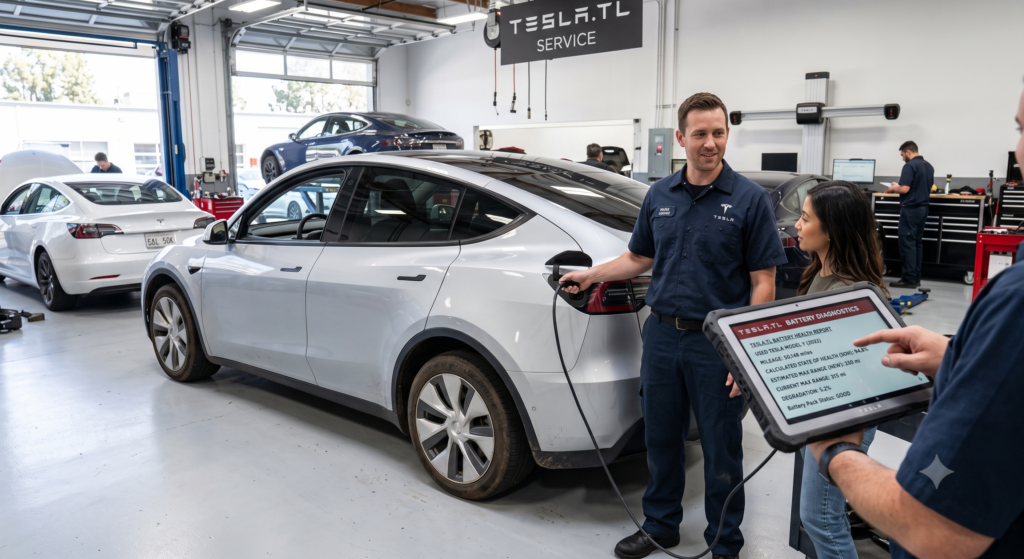
The battery pack is the single most expensive and consequential component in any electric vehicle, and nowhere is this truth more acute than in the used Tesla Model Y market. When you are evaluating a pre-owned Model Y with 50,000 miles on the odometer, you are not merely buying a four-year-old crossover with some cosmetic wear and tired tires. You are inheriting a battery that has already completed hundreds of charge cycles, survived countless thermal expansions and contractions, and been subjected to charging habits that may have either preserved its capacity or accelerated its decline. Unlike a gasoline engine, where 50,000 miles is barely broken in, an electric vehicle battery at this mileage reveals its history in measurable, unambiguous ways. Understanding exactly what battery health looks like after 50,000 miles is the difference between purchasing a vehicle that will serve you reliably for another decade and buying a range-anxious money pit that forces you to plan every trip around charging stops.
This comprehensive guide examines the realistic State of Health (SOH) you should expect from a used Model Y at the 50,000-mile mark, how different battery chemistries and trims age differently, which owner behaviors accelerate or slow degradation, and the precise diagnostic steps you must take before signing any purchase agreement.
Why 50,000 Miles Is a Critical Benchmark
Fifty thousand miles represents a fascinating inflection point for the Tesla Model Y. It is roughly the distance at which early lease returns flood the market, fleet vehicles rotate out of service, and original owners begin trading up to newer models. It is also the mileage at which battery degradation transitions from theoretical to tangible. A brand-new Model Y Long Range might show 330 miles of EPA-rated range, but after 50,000 miles of real-world driving, that figure exists only in memory. What remains is the critical question: how much has been lost, and is what remains sufficient for your needs?
At this mileage, the Model Y has typically undergone between 300 and 500 full charge cycles, depending on driving efficiency, climate, and whether the owner routinely charged to 100% or maintained a conservative daily ceiling. The battery management system has logged thousands of hours of thermal management data. The cells have experienced seasonal temperature swings, highway-speed discharges, and DC fast-charging sessions that each contributed microscopically to the overall capacity fade. By 50,000 miles, these microscopic contributions have accumulated into a macroscopic reality that you can measure, verify, and either accept or reject before purchase.
Expected Battery Health by Trim and Chemistry
Not all Model Y batteries age identically. The degradation trajectory depends heavily on which battery chemistry and capacity the vehicle shipped with from the factory.
Model Y Long Range and Performance (NCA Chemistry) The Long Range and Performance variants launched with 75 kWh nickel-cobalt-aluminum (NCA) battery packs sourced primarily from Panasonic or LG Chem, depending on production location and timing. Under normal conditions with responsible charging habits, these packs typically retain between 87% and 92% of their original capacity after 50,000 miles. In practical terms, this means a Long Range that originally delivered approximately 330 miles of EPA-rated range will now show between 285 and 305 miles at a 100% state of charge in temperate weather. A Performance variant, which was rated slightly lower at 303 miles new, will display between 265 and 280 miles under identical conditions.
This range of 87% to 92% assumes the previous owner avoided habitual 100% charging, minimized reliance on DC fast charging for daily top-ups, and lived in a moderate climate without extreme heat or prolonged freezing temperatures. If the vehicle spent its life in Arizona or Nevada, routinely baked in parking lots without cabin overheat protection, and was charged to 100% daily at Superchargers, degradation could push toward 82% to 85%, yielding real-world range below 280 miles for a Long Range—a significant functional compromise.
Model Y Standard Range / Rear-Wheel Drive (LFP Chemistry) The Standard Range and later base Rear-Wheel Drive variants transitioned to lithium-iron-phosphate (LFP) cells, primarily sourced from CATL for Shanghai-built vehicles. LFP chemistry behaves differently from NCA. It is inherently more tolerant of 100% charging, exhibits slower calendar degradation over time, and generally maintains capacity through more charge cycles. However, the smaller pack size—roughly 50 to 60 kWh depending on the exact variant—means that each mile driven represents a deeper percentage of total capacity, creating a different stress profile.
After 50,000 miles, a well-maintained LFP pack typically retains between 89% and 94% of original capacity, slightly better than NCA in percentage terms. But because the starting range was lower—approximately 244 to 260 miles when new—the absolute range after degradation is more constrained. A 50,000-mile LFP Model Y might show 220 to 240 miles at 100% charge, which is adequate for urban commuting but can induce anxiety on longer highway journeys, particularly in winter when efficiency drops further.
The Factors That Accelerate Degradation
Battery degradation is not random. It follows predictable patterns based on how the vehicle was treated during its first 50,000 miles. When evaluating a used Model Y, these are the historical factors you must investigate.
Climate Exposure Heat is the silent killer of lithium-ion batteries. A Model Y that spent its life in Phoenix, Las Vegas, or inland California, parked daily in direct sunlight without garage protection or cabin overheat protection enabled, will show measurably worse battery health than an identical vehicle from Seattle or Portland. High temperatures accelerate the chemical reactions that degrade cathode materials and increase internal resistance. Conversely, extreme cold does not directly damage the battery but forces the thermal management system to consume energy for heating, masking the true capacity during winter readings and potentially contributing to slower degradation through repeated thermal cycling.
Charging Habits How the previous owner charged the vehicle is arguably the most important determinant of battery health. NCA batteries in the Long Range and Performance are happiest when charged daily to 80% to 90% and only taken to 100% before long trips. Owners who plugged in every night to 100% out of habit or range anxiety inflicted unnecessary stress on the cathode structure. LFP batteries are more forgiving and can be charged to 100% regularly without significant penalty, though they still benefit from occasional partial cycling.
DC Fast Charging Frequency Regular use of Superchargers or third-party DC fast chargers generates more heat and lithium plating stress than Level 2 AC charging. A Model Y whose first owner relied exclusively on Supercharging for daily energy—common among apartment dwellers without home charging—will typically show 2% to 4% worse battery health than an identical vehicle charged primarily on a home wall connector. This does not mean DC charging is destructive; it simply means that frequent fast charging accelerates the aging curve modestly.
State of Charge Extremes Leaving a Model Y parked at very low states of charge (below 10%) for extended periods, or storing it at 100% for weeks without driving, both damage cell chemistry. Low states of charge can trigger deep discharge events that reduce capacity permanently, while prolonged 100% storage accelerates electrolyte decomposition. A vehicle with 50,000 miles but irregular usage patterns—such as a vacation home car driven only monthly—may show worse battery health than a daily commuter with twice the mileage but consistent charging discipline.
How to Verify Battery Health Before You Buy
Sellers will tell you the battery is “fine” or “like new.” Do not trust words. Trust data. Here are the verification methods that actually work in 2026.
Method 1: Onboard Energy Graph The most accessible check is the Energy app on the center touchscreen. Navigate to the consumption graph and switch to the “Range” view. With the battery charged to 100%, the displayed estimated range is a rough proxy for current capacity. Compare this figure against the original EPA rating for the specific trim. If a Long Range shows 260 miles at 100% charge, that represents roughly 79% of its original 330-mile rating—a red flag indicating accelerated degradation.
Method 2: Third-Party Diagnostic Tools Applications like Scan My Tesla, TeslaFi, or TeslaScope can interface with the vehicle’s onboard diagnostics port to reveal the precise State of Health (SOH) percentage. These tools read the battery management system’s internal calculations, which are far more accurate than the range estimate. A healthy 50,000-mile Model Y should show SOH between 87% and 92% for NCA packs, and 89% to 94% for LFP. If the seller has these apps installed, ask for a screenshot. If not, offer to pay for a mobile diagnostic session.
Method 3: Tesla Service Center Report The gold standard is a Tesla Service Center battery health inspection. For a nominal fee—typically $100 to $200—Tesla can generate a report showing the battery’s current capacity, any error codes, and whether the pack has experienced thermal events or cell imbalances that warrant concern. This report also verifies warranty status. If the battery has degraded below 70% within the warranty period, Tesla is obligated to repair or replace it under the 8-year/120,000-mile battery and drive unit warranty.
Method 4: Watt-Hours Per Mile History Ask the seller to show the lifetime or recent watt-hours per mile consumption figure from the Trip menu. A vehicle with significant battery degradation often shows higher consumption rates because the battery management system works harder to deliver the same output. While this metric is influenced by driving style, consistently elevated figures across multiple trip logs suggest underlying battery stress.
Don’t risk buying a used Model Y with a degraded battery that turns every drive into a charging hunt. At Tesla.tl, every listing includes verified battery health reports, State of Health diagnostics, and charging history snapshots so you know exactly what range you are getting before you buy. Browse inspected inventory with full battery transparency at https://tesla.tl/.
What 50,000 Miles Means for Winter Range
Battery health at the 50,000-mile mark cannot be discussed without addressing winter performance, because this is where degraded batteries reveal their true cost. A new Model Y Long Range might lose 20% of its summer range in freezing temperatures due to cabin heating, battery conditioning, and reduced chemical efficiency. A 50,000-mile example with 88% SOH suffers a compounding penalty: it starts from a lower baseline and then loses the same winter percentage on top.
For example, a new Long Range showing 330 miles in summer might deliver 264 miles in a Minnesota January. A 50,000-mile example with 88% SOH showing 290 miles in summer might drop to only 232 miles in the same January conditions. For buyers who commute 100 miles round trip, this difference is the margin between arriving home with comfortable reserve and white-knuckling the final 20 miles with the heater turned off.
This compounding effect makes battery health especially critical for cold-climate buyers. A 5% difference in SOH that feels negligible in July becomes a dealbreaker in February.
Warranty Protection and Replacement Realities
Tesla’s battery warranty for Model Y Long Range and Performance covers the battery and drive unit for 8 years or 120,000 miles, whichever comes first. The warranty guarantees that the battery will retain at least 70% of its original capacity during this period. For a 50,000-mile vehicle, this means you still have 70,000 miles and several years of warranty protection remaining—provided the vehicle has not been declared salvage, rebuilt, or modified in ways that void coverage.
However, warranty replacement is not an instant or guaranteed process. Tesla will attempt software balancing, module replacement, or other remediation before authorizing a full pack replacement. And if the battery is at 72% SOH—below the warranty threshold but not catastrophically so—you may face months of diagnostic appointments and negotiation before Tesla approves action. For buyers of used Model Y vehicles approaching the 50,000-mile mark, understanding the remaining warranty timeline is as important as understanding the battery itself.
If a battery falls outside warranty and requires replacement, the cost is substantial. As of 2026, out-of-warranty battery replacement for a Model Y typically ranges from $12,000 to $18,000 depending on whether Tesla performs the work or an independent shop handles it using salvage or refurbished modules. This figure dwarfs the cost of most other used vehicle repairs and makes battery verification the single most important due diligence step in the entire purchase process.
When to Walk Away
There are specific battery health thresholds that should trigger immediate rejection of a 50,000-mile Model Y, regardless of how attractive the price appears.
NCA Packs Below 85% SOH If a Long Range or Performance has lost more than 15% of its capacity at only 50,000 miles, the previous owner subjected it to abuse—extreme heat, constant 100% charging, or relentless DC fast charging. Even if the vehicle is under warranty, the hassle of pursuing a replacement and the uncertainty about other hidden issues make this a poor bet.
LFP Packs Below 88% SOH While LFP chemistry is more durable, a reading below 88% at 50,000 miles suggests manufacturing defects, physical damage, or extreme neglect. LFP should age more gracefully than this.
Inconsistent Cell Voltages Diagnostic tools reveal whether individual cell groups within the pack are balanced. Wildly divergent cell voltages indicate a battery management system struggling to maintain equilibrium, which often precedes more serious failure. This is a warranty issue if documented early, but a nightmare if discovered after purchase.
Thermal Event History Any record of battery overheating, thermal runaway warnings, or service bulletins related to cooling system failures should be treated as a permanent disqualifier. Even if repaired, these batteries carry elevated long-term risk.
Final Verdict
A used Tesla Model Y with 50,000 miles is not inherently risky. In fact, it often represents the sweet spot of the used market: past the steepest depreciation curve, young enough to retain meaningful warranty coverage, and mature enough that any factory defects have likely been addressed. But this sweet spot exists only if the battery health aligns with reasonable expectations.
For NCA equipped Long Range and Performance variants, expect 87% to 92% State of Health, translating to 265 to 305 miles of real-world summer range depending on original spec and driving efficiency. For LFP equipped Standard Range or Rear-Wheel Drive models, expect 89% to 94% SOH and 220 to 240 miles of usable range. Anything significantly below these benchmarks demands either aggressive price negotiation or outright rejection.
Verify through onboard diagnostics, third-party tools, or Tesla Service Center reports. Factor winter range penalties into your calculations. Understand your remaining warranty protection. And never allow a low purchase price to blind you to the reality that a degraded battery transforms an electric crossover from a liberating experience into a constant exercise in energy management.
Ready to find a used Model Y with a healthy battery and verified range? Search Tesla.tl for listings that include State of Health reports, charging history, and winter range estimates. Filter by battery health percentage, trim, and warranty status to find the Model Y that delivers the range you need without the anxiety you don’t. Visit https://tesla.tl/ and drive with confidence today.
