
Is a Used Tesla Model S Plaid Worth It Over a Brand-New Model 3?
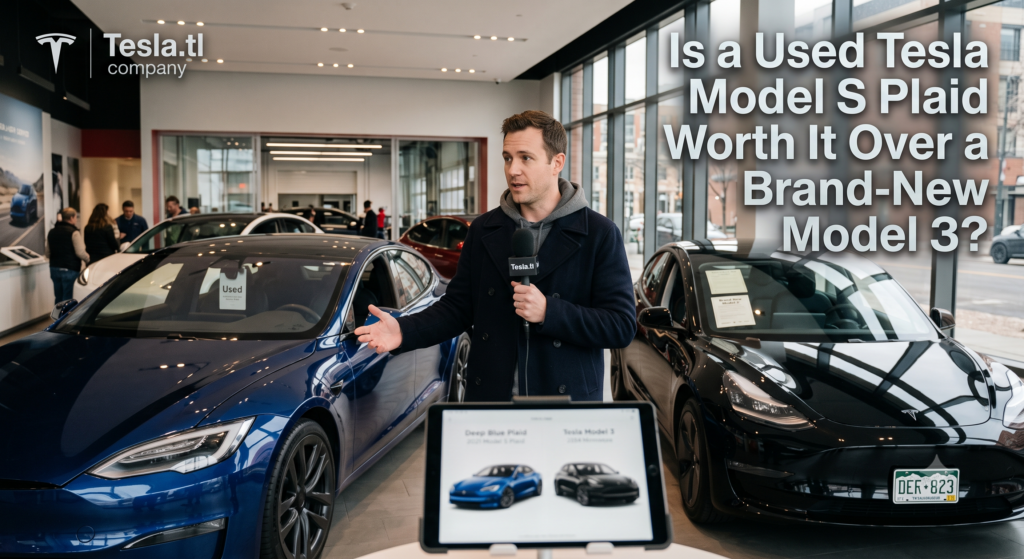
The question that echoes through every Tesla forum, Reddit thread, and enthusiast meetup in 2026 is deceptively simple: should you spend your money on a used Model S Plaid—a former flagship with hypercar acceleration and limousine dimensions—or on a brand-new Model 3, specifically the refreshed Highland variant, with its modernized interior, cutting-edge Hardware 4, and that intoxicating new-car smell? On the surface, these two vehicles share the same DNA: both are electric, both access the Supercharger network, both receive over-the-air updates, and both will silently embarrass most sports cars at a stoplight. But beneath the shared Tesla ethos lies a fundamental divergence in mission, ownership experience, and long-term financial trajectory that makes this comparison far more nuanced than a spreadsheet of specifications.
This analysis examines the used Model S Plaid versus the brand-new Model 3 Highland across every dimension that actually matters to owners after the initial purchase excitement fades: real-world performance usability, technology longevity, running costs, warranty security, passenger comfort, and the intangible prestige factor that still commands a premium. By the end, you will know which vehicle deserves your garage space and which one is merely a fantasy that reality will quickly deflate.
The Price Convergence: Where the Comparison Becomes Real
In 2026, the used Model S Plaid market has undergone a depreciation curve that would have seemed impossible when the vehicle launched with a sticker price approaching $130,000. Early 2021–2022 Plaid examples with 30,000 to 50,000 miles now trade between $65,000 and $80,000 in private-party sales, with higher-mileage or earlier-build examples occasionally dipping below $60,000. Meanwhile, a brand-new Model 3 Highland Long Range with typical optioning costs approximately $48,000 to $52,000, while the base Rear-Wheel Drive variant starts closer to $40,000.
This creates a genuine price overlap. A buyer with $55,000 to $70,000 to spend can choose between a used flagship with tri-motor insanity and a new compact with factory-fresh warranty and modern architecture. The decision is no longer between a luxury car and an economy car; it is between two fundamentally different philosophies of what a Tesla should be. And that is where the analysis becomes interesting.
Performance: The Plaid’s Advantage Is Real but Narrowing
There is no diplomatic way to state this: the Model S Plaid is one of the fastest production vehicles ever built. Its tri-motor architecture delivers 1,020 horsepower and a 0-to-60 mph time that hovers around 1.99 seconds under ideal conditions. This is not merely quick; it is a physical experience that compresses your chest, blurs your vision, and triggers an adrenaline response that few road-legal vehicles can replicate. The Plaid will out-accelerate virtually every Model 3 ever built, including the Performance variant, by a margin that is measurable in entire seconds.
However, the Model 3 Highland Performance—and even the Long Range—delivers acceleration that is already excessive for public roads. The Highland Long Range achieves 0-to-60 in approximately 4.2 seconds, while the Highland Performance trims that to roughly 3.1 seconds. Both figures are faster than 95% of vehicles you will encounter in daily traffic. The Plaid’s additional capability is a party trick, a bragging right, and an occasional thrill on deserted highways. It is not a feature you exploit during your Tuesday morning commute.
More importantly, the Plaid’s brutal acceleration comes with hidden costs. The tri-motor system consumes tires at a ferocious rate. The 21-inch wheels are fragile and expensive. The heat generated by repeated launch control events stresses the battery contactors and cooling system. For buyers who view performance as something to be used rather than merely possessed, the Plaid demands a maintenance budget that the Model 3 does not.
Technology: New vs. Proven, HW4 vs. HW3
Here is where the brand-new Model 3 Highland begins to pull ahead decisively. The Highland ships standard with Hardware 4 (HW4), Tesla’s latest autonomous driving computer featuring higher-resolution cameras, more powerful processing, and architectural headroom for features that have not yet been released. It also includes the updated interior with a rear passenger screen, ventilated front seats, and the controversial but modernized steering wheel controls. The build quality of 2024–2025 Model 3 vehicles is measurably tighter than early Plaid examples, with panel gaps, material consistency, and acoustic isolation that approach true luxury standards.
The 2021–2022 Model S Plaid, by contrast, rides on an older platform architecture despite its staggering performance. These vehicles shipped with Hardware 3 (HW3), which is competent today but lacks the camera resolution and processing bandwidth of HW4. While Tesla continues to support HW3 with software updates, industry observers anticipate that certain next-generation autonomous features planned for 2027 and beyond may require HW4 or later hardware. A buyer planning to keep their vehicle for eight to ten years must consider whether a used Plaid with HW3 will feel technologically obsolescent while a new Highland continues to receive cutting-edge capabilities.
The Plaid’s interior, while spacious and luxurious, also shows its age compared to the Highland. The yoke steering wheel—optional but common on early Plaid examples—remains divisive, with many owners retrofitting traditional round wheels at their own expense. The 17-inch landscape touchscreen is impressive, but the overall cabin design lacks the minimalist freshness of the Highland’s reimagined interior. For tech-forward buyers who prioritize being on the latest platform, the new Model 3 offers a more future-proof package despite its lower price.
Space, Comfort, and Daily Livability
The Model S Plaid is a full-size luxury sedan. It offers rear-seat legroom that rivals a BMW 7 Series, a massive front trunk that swallows luggage with ease, and a commanding road presence that the compact Model 3 simply cannot match. For buyers who frequently transport adult passengers in the rear seats, the Plaid is in a different league. The Model 3, while perfectly adequate for four adults on short trips, becomes cramped on cross-country journeys, particularly for rear-seat passengers who must contend with less legroom and a more upright seating position.
Ride quality also diverges significantly. The Plaid features an adaptive air suspension that can glide over broken pavement in comfort mode or firm up for aggressive cornering. Even with its performance orientation, the Plaid in its softest setting delivers a more isolated, luxurious ride than the Model 3, which uses a fixed steel spring suspension. For buyers with back issues, sensitive passengers, or simply a preference for isolation from road imperfections, the Plaid’s air suspension is a genuine quality-of-life upgrade.
However, the Plaid’s larger dimensions create practical drawbacks. It is harder to park in tight urban spaces, more challenging to navigate through narrow European streets, and less efficient in dense traffic. The Model 3 Highland slips through gaps, fits into smaller parking spots, and feels more nimble in urban environments. If your driving is primarily city-based, the Plaid’s size can feel like a liability rather than an asset.
Don’t risk buying a used Model S Plaid with hidden track wear or degraded battery contactors. At Tesla.tl, every Plaid listing includes verified service history, battery thermal health reports, and hardware generation confirmation so you know exactly what you are buying. Browse inspected Plaid inventory and compare side-by-side with new Model 3 listings at https://tesla.tl/.
Warranty, Maintenance, and Total Cost of Ownership
This is where the brand-new Model 3 delivers its most compelling argument. A new vehicle arrives with a 4-year/50,000-mile comprehensive warranty and an 8-year battery and drive unit warranty. You are covered against defects, you enjoy the peace of mind of factory-fresh components, and you know exactly how the vehicle has been treated since day one—because you are day one.
A used Model S Plaid from 2021–2022, by contrast, has already consumed two to three years of its warranty. The comprehensive coverage may have expired entirely, leaving you responsible for any mechanical issues that arise. While the battery and drive unit warranty still provides protection, the Plaid’s complexity—tri-motor architecture, air suspension, motorized door handles, and advanced thermal management—creates more potential failure points than the simpler Model 3. An out-of-warranty air suspension repair can cost $3,000 to $5,000. A drive unit issue on a Plaid can exceed $10,000 if not covered by warranty.
Insurance costs also favor the Model 3. The Plaid’s six-figure original price, aluminum-intensive construction, and supercar performance classification push premiums significantly higher. Younger drivers or those in urban areas may face quotes that are 50% to 100% higher than an equivalent Model 3 Long Range. Over five years, this insurance delta can amount to $5,000 to $10,000 in additional costs.
Tire replacement on the Plaid is another budget item that Model 3 owners rarely contemplate. The staggered 21-inch performance tires cost $2,000 to $2,500 per set and may last only 15,000 to 25,000 miles under aggressive driving. The Model 3 Highland’s 19-inch all-season tires cost half as much and last nearly twice as long.
Charging Efficiency and Real-World Range
The Model 3 Highland is simply more efficient than the Model S Plaid. The smaller, lighter sedan extracts more miles per kilowatt-hour from its battery pack. A Model 3 Long Range can achieve 4.0 to 4.5 miles per kWh in mixed driving, while the heavier, more powerful Plaid typically manages 2.8 to 3.2 miles per kWh. This means that despite the Plaid’s larger battery, its real-world range is not dramatically superior to the Model 3’s, and its charging costs are higher per mile.
For buyers who charge primarily at home, this efficiency difference is modest—pennies per day. For those who rely heavily on public Supercharging, particularly in regions with high electricity rates, the Plaid’s thirst adds up over thousands of miles. The Model 3 also charges slightly faster on a miles-per-minute basis because its smaller battery can accept a higher percentage of its capacity in the same timeframe.
The Intangibles: Prestige, Emotion, and Status
We cannot ignore the emotional dimension of this comparison. A Model S Plaid is a statement. It is a vehicle that, even in 2026, turns heads and commands respect at charging stations. The silhouette is iconic, the acceleration is legendary, and the interior spaciousness conveys success in a way that the compact Model 3 does not. For buyers who derive genuine satisfaction from owning the flagship, from knowing they possess one of the fastest sedans ever built, the Plaid delivers a psychological reward that specifications cannot capture.
The Model 3 Highland, by contrast, is a rational choice. It is the intelligent, efficient, modern tool for the buyer who views a car as transportation rather than identity. It attracts less attention, costs less to operate, and offers the quiet confidence of knowing you are on the latest platform with the longest warranty horizon. There is no shame in this choice; in fact, for many buyers, it is the wiser path.
Who Should Buy the Used Model S Plaid?
The used Plaid is the correct choice for a specific buyer profile. You should choose it if:
- You have the financial cushion to absorb potential out-of-warranty repairs without stress.
- You frequently transport adult passengers and value rear-seat space and ride comfort.
- You are a performance enthusiast who will genuinely use the tri-motor capability on track days or spirited drives.
- You prioritize presence, prestige, and the emotional satisfaction of owning a flagship.
- You plan to keep the vehicle for three to five years, not a decade, minimizing concerns about HW3 obsolescence.
Who Should Buy the Brand-New Model 3 Highland?
The new Model 3 is the rational default for most buyers. You should choose it if:
- You want maximum warranty coverage and zero uncertainty about prior ownership history.
- You value modern technology, HW4 hardware, and the longest possible software support lifecycle.
- Your driving is primarily urban or suburban, and you do not need full-size sedan space.
- You want lower insurance, tire, and maintenance costs over the ownership period.
- You plan to keep the vehicle for seven to ten years and need it to remain technologically relevant throughout that period.
Final Verdict
In 2026, the used Model S Plaid versus brand-new Model 3 Highland decision is not about which vehicle is objectively better. It is about which vehicle better serves your specific life, budget, and emotional needs. The Plaid is a spectacular machine that offers supercar performance, limousine space, and undeniable presence. But it demands a higher cost of ownership, carries expired or expiring warranty coverage, and rides on hardware that is no longer Tesla’s cutting edge.
The Model 3 Highland is the smarter financial decision for most buyers. It offers modern efficiency, factory-fresh reliability, lower operating costs, and a technology platform that will remain current for years. It sacrifices the Plaid’s raw power and interior grandeur, but it delivers 95% of the daily Tesla experience at a lower total cost of ownership with significantly less risk.
If you are wealthy enough that a $5,000 repair bill is an inconvenience rather than a crisis, buy the Plaid and enjoy one of the most thrilling vehicles ever built. If you are a pragmatic buyer who views a car as a tool to be used efficiently and sold reliably, buy the Highland and sleep soundly knowing you made the rational choice.
Ready to decide between a used Model S Plaid and a brand-new Model 3? Compare verified listings side by side at Tesla.tl. Filter by price, warranty status, hardware generation, and performance specs to find the Tesla that matches your budget and your ambition. Visit https://tesla.tl/ and drive your perfect electric vehicle today.
