
Model X Falcon Door Problems: What Every Used Buyer Must Know
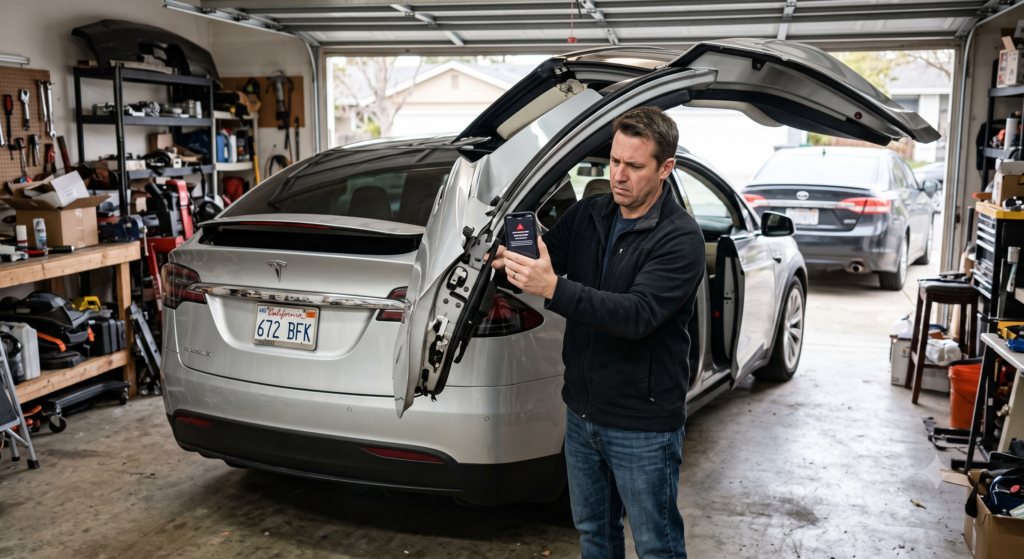
The Tesla Model X is arguably the most visually striking vehicle in the brand’s entire lineup, and that distinction rests almost entirely on its signature Falcon Wing doors. These dramatic, articulated rear doors rise like the wings of a bird of prey, creating a sense of theater every time passengers enter or exit. They allow easy access in tight parking spaces, provide a panoramic opening for installing child seats, and make the Model X instantly recognizable in any parking lot. But for buyers considering a used Model X in 2026, the Falcon Wing doors represent the single greatest source of potential regret in the entire Tesla ecosystem. Beneath their futuristic appearance lies one of the most complex door mechanisms ever mass-produced: a network of ultrasonic sensors, dual-hinge articulation, cable-driven actuators, sealed ball joints, and software-controlled motors that must operate in perfect harmony thousands of times per year. When they work, they are magical. When they fail, they are a financial and logistical nightmare that can render a $70,000 luxury SUV less practical than a base-model hatchback.
This comprehensive guide examines exactly what goes wrong with the Model X Falcon Wing doors, how the problems have evolved across different production years, what repairs actually cost in 2026, and the specific inspection protocol you must follow before purchasing any used Model X. We separate the manageable quirks from the deal-breaking defects, explain which model years improved the hardware, and help you determine whether the Model X’s unique doors are a novelty worth embracing or a liability worth avoiding entirely.
Understanding the Falcon Wing Mechanism: Why Complexity Breeds Failure
To appreciate why Falcon Wing doors cause so many headaches, you must first understand what makes them different from conventional doors. A standard car door has one hinge, one latch, and minimal electronics. The Model X Falcon Wing door has two primary hinges (one at the roof rail and one midway up the door), multiple ultrasonic proximity sensors, capacitive touch sensors in the door handles, cable-driven actuators that control the opening angle, sealed ball joints that must remain lubricated for life, and a central control module that processes inputs from the vehicle’s gyroscope, rain sensors, and obstacle detection systems to determine exactly how far and how fast the door should open in any given environment.
This complexity is necessary because the doors must adapt to their surroundings. If the Model X is parked in a garage with a low ceiling, the doors must detect the obstruction and stop before impact. If parked between two vehicles in a tight lot, the doors must open outward minimally, then hinge upward to avoid contact. If it is raining or snowing, the software must adjust motor torque to compensate for ice accumulation on the seals. Every one of these scenarios requires precise sensor calibration, healthy mechanical components, and software that correctly interprets conflicting data streams.
The problem is that this system was engineered for perfection but deployed in the real world, where sensors get dirty, ball joints lose lubrication, cables stretch, and software glitches. A used Model X with 50,000 to 80,000 miles has likely cycled its Falcon Wing doors 15,000 to 25,000 times. Each cycle places stress on the hinges, wears the seals, and incrementally degrades the sensors. By 2026, early Model X vehicles are a decade old, and their door systems have aged in ways that even Tesla’s engineers did not fully anticipate during the vehicle’s rushed development cycle.
The Most Common Falcon Wing Failures by Category
After analyzing years of owner reports, service bulletins, and repair invoices, we have identified the specific failure modes that plague used Model X buyers. These issues cluster into five categories, and every prospective buyer must inspect for all of them.
1. Obstruction Sensor Errors and Phantom Obstructions
The Falcon Wing doors rely on ultrasonic sensors embedded in the door panels and roof rails to detect nearby objects. When functioning correctly, they prevent the doors from striking adjacent vehicles, garage ceilings, or low-hanging pipes. However, these sensors are notoriously sensitive to dirt, snow, ice, and even heavy rain. A sensor that is slightly misaligned after years of vibration may interpret empty space as a solid object, causing the door to stop mid-opening, reverse direction unexpectedly, or refuse to open entirely.
In 2026, this manifests as doors that open fully in your driveway but refuse to open more than twelve inches in a parking garage, or doors that abruptly reverse direction as if they have hit an invisible wall. The issue is usually resolved through sensor recalibration at a Tesla Service Center or by an independent specialist with the correct diagnostic software. However, persistent phantom obstructions often indicate deeper issues: failing sensor modules, corroded wiring harnesses, or software incompatibilities between the door controller and the vehicle’s main computer. Recalibration costs $200 to $400, but if multiple sensors need replacement, the bill can exceed $1,500.
2. Door Seal Degradation and Water Intrusion
The Falcon Wing doors use complex rubber seals that must maintain a watertight barrier across multiple hinge planes and articulation points. Unlike a conventional door with a single continuous seal, the Model X seals must flex, compress, and stretch as the door moves through its arc. Over time, the rubber compounds harden, develop micro-cracks, and lose their ability to conform to the door frame. This is particularly severe in hot climates where UV exposure accelerates seal degradation.
When the seals fail, water enters the cabin during heavy rain or automated car washes. It pools in the rear footwells, saturates the carpet padding, and can damage the low-voltage wiring harnesses that run beneath the floor. Musty odors are often the first symptom, followed by corrosion of the seat mounting brackets and, in severe cases, failure of the rear seat heaters. Replacing all Falcon Wing door seals is a labor-intensive process that can cost $1,200 to $2,000 at a service center because the seals are integrated with the hinge mechanisms and must be precisely aligned to prevent binding.
During your inspection, run a garden hose gently over the closed doors or ask the seller to run the vehicle through a car wash. Then immediately check the rear carpet edges, the seat rail channels, and the storage compartments beneath the rear floor for any dampness. Even minor moisture is a red flag indicating that the seals are no longer performing their primary function.
3. Hinge and Ball Joint Wear
The dual-hinge system that allows the Falcon Wing doors to articulate upward and outward simultaneously depends on sealed ball joints at the primary and secondary hinge points. These joints were designed to be lubricated for life, but in practice, the lubricant breaks down after years of thermal cycling and mechanical stress. When the ball joints become dry, the doors develop a grinding or squeaking sound during operation. In advanced cases, the hinges develop play that causes the doors to sit misaligned when closed, creating uneven panel gaps and wind noise.
Worse, worn hinges place additional stress on the cable-driven actuators that physically move the doors. The cables, which resemble high-tension bicycle brake lines, must pull with precise force against the hinge resistance. When hinges are stiff, the cables work harder, stretch, and eventually fray or snap. A broken actuator cable leaves the door partially open or completely immobilized, requiring immediate repair to secure the vehicle.
Hinge refurbishment is possible at specialized independent shops, but it requires disassembling the door from the roof rail—a procedure that demands specific tools and expertise. Costs range from $800 to $1,500 per door depending on whether only the ball joints need repacking or the entire hinge assembly requires replacement. If you hear any grinding, clicking, or metallic squeaking during door operation, assume hinge service is imminent and negotiate accordingly.
4. Motor and Actuator Failure
Each Falcon Wing door contains multiple electric motors: a primary motor for the main hinge, a secondary motor for the mid-door articulation, and smaller motors for the latch mechanisms. These motors are sealed units that are not designed for user service. After years of operation, the motor brushes wear down, internal gears develop flat spots, and the motor controllers fail due to heat or moisture intrusion.
A failing motor typically manifests as slow or hesitant door movement, unusual whining sounds, or complete inability to open or close without manual assistance. In cold weather, motors that are already weakened by age may lack the torque to overcome stiff seals or ice accumulation, causing the doors to stall mid-cycle. Tesla’s diagnostic software can identify motor faults, but replacement requires removing the interior door panel and often the entire door assembly from the vehicle.
Motor replacement costs are substantial. Each motor runs $400 to $700 in parts, with labor adding another $600 to $1,000 per door because of the disassembly complexity. If both rear doors need motor service, the total can approach $3,000. For a used Model X buyer on a budget, this is a potential dealbreaker that must be identified before purchase.
5. Software Calibration and Controller Issues
Not all Falcon Wing problems are mechanical. The doors are governed by a dedicated door control module that communicates with the vehicle’s main computer over Tesla’s internal network. Software bugs, corrupted calibration data, or failed firmware updates can cause doors that are mechanically perfect to behave erratically. Common software symptoms include doors that open to different heights on each side, doors that ignore the key fob or smartphone app commands, or doors that require multiple button presses to respond.
Tesla has issued numerous over-the-air updates over the years to address door behavior, but early Model X vehicles with outdated firmware may lack critical patches. Additionally, if the vehicle’s 12-volt battery is weak—a common issue on aging Teslas—the door controllers may receive insufficient voltage, causing intermittent failures that mimic software glitches. Before assuming a door needs mechanical repair, verify that the vehicle is running the latest software and that the 12-volt battery has been replaced within the last three years.
Don’t risk buying a used Model X with failing Falcon Wing doors that trap your passengers or leak water into the cabin. At Tesla.tl, every Model X listing includes a detailed Falcon Wing inspection report covering sensor functionality, seal integrity, hinge condition, and motor health. Browse verified Model X inventory and buy with confidence at https://tesla.tl/.
Year-by-Year Reliability: Which Model X to Target
Tesla incrementally improved the Falcon Wing door system throughout Model X production, and understanding these improvements is critical for used buyers.
2016–2017 Early Production The first Model X vehicles suffer from the highest rate of door-related issues. The seals were a early compound that degraded quickly, the sensors had overly sensitive calibration, and the hinge lubricant was prone to premature breakdown. These early cars are now eight to nine years old, and unless they have had comprehensive door overhauls, they are likely to present multiple failure modes. Only consider these if the price reflects significant risk—typically $20,000 to $28,000 for a 75D—and you have budgeted $3,000 to $5,000 for eventual door refurbishment.
2018–2019 Mid-Cycle Improvements By 2018, Tesla had revised the door seal compounds to be more UV-resistant, improved the sensor mounting tolerances to reduce phantom obstruction errors, and updated the hinge lubrication specification. These vehicles are significantly more reliable than early examples and represent the sweet spot for buyers who want a Model X without paying the premium for the latest hardware. A 2018 or 2019 Model X with documented door service history is a relatively safe bet, though the usual inspections still apply.
2020–2021 Late Production The final production years before the Model X refresh introduced additional refinements, including more robust actuator cables, improved motor sealing against moisture, and software updates that provided smoother door operation. These late pre-refresh vehicles command higher prices but offer the most trouble-free Falcon Wing experience of the original design era.
2022+ Refresh (Plaid/Long Range) The refreshed Model X retained the Falcon Wing doors but with substantially redesigned internals. The sensors were upgraded, the hinge mechanisms were reinforced, and the software logic was rewritten for faster, more confident operation. By 2026, these refreshed vehicles are just beginning to enter the used market at premium prices, and their door systems have proven significantly more durable than the original 2016–2017 designs.
The Winter Problem: Ice, Snow, and Frozen Seals
Perhaps no scenario exposes Falcon Wing door weaknesses more brutally than winter weather. The complex seal geometry that keeps water out in summer becomes a trap for melting snow and freezing rain in winter. Moisture seeps between the seal layers, freezes overnight, and effectively glues the door to the body. When the owner presses the door button in the morning, the motors strain against the ice bond, potentially damaging actuators or stripping cables.
Tesla addressed this partially through software updates that preheat the door seals when the vehicle is preconditioning, but this feature is only effective if the vehicle is plugged in and the battery has sufficient charge. A used Model X parked outdoors overnight in Minnesota or Quebec during a ice storm may simply refuse to open its rear doors until ambient temperatures rise or the owner manually de-ices the seals with warm water—a humiliating procedure for a luxury SUV owner.
If you live in a region with harsh winters, a used Model X demands either indoor parking, diligent garage storage, or a tolerance for occasional door immobilization. The Falcon Wing doors are not compatible with the “park it anywhere” lifestyle that conventional SUVs tolerate. This is not a minor lifestyle adjustment; it is a fundamental constraint that affects how you use the vehicle for five months of the year.
Inspection Protocol: The 10-Point Falcon Wing Checklist
Before purchasing any used Model X, conduct the following door-specific inspection. Do not rely on the seller’s assurances or a casual demonstration in perfect weather.
- [ ] Open and close each door five times in succession. Listen for grinding, squeaking, or clicking. The operation should be smooth and relatively quiet.
- [ ] Test obstacle detection by placing a soft object (a foam pool noodle works well) in the door’s path. The door should detect it and reverse direction smoothly.
- [ ] Check seal condition by visually inspecting the rubber across the entire door perimeter. Look for cracks, flattening, or sections that no longer spring back when compressed.
- [ ] Run a water test by spraying the closed doors with a hose for two minutes, then checking the interior for leaks.
- [ ] Verify panel alignment when doors are closed. They should sit flush with the body and match the opposite side.
- [ ] Test all entry methods: key fob, smartphone app, interior buttons, and B-pillar touch controls. Each should respond promptly.
- [ ] Inspect the door struts and hinges for signs of corrosion, particularly in coastal regions where salt accelerates degradation.
- [ ] Check software version and confirm the vehicle has received recent door-related firmware updates.
- [ ] Operate doors in different environments: tight parking space simulation, open sky, and near a wall. The opening arc should adapt intelligently.
- [ ] Ask for service records specifically related to door repairs, recalibrations, or seal replacements. A blank history is either a miracle or evidence of private, undocumented repairs.
Final Verdict: Are the Falcon Wings Worth the Risk?
The Tesla Model X Falcon Wing doors are a masterpiece of engineering ambition and a cautionary tale about the cost of complexity. They make the Model X unforgettable, provide genuine utility in tight spaces, and delight children every time they operate. But they also introduce more potential failure points than any other Tesla component, and they demand a level of maintenance attention that conventional doors do not require.
For buyers in 2026, the risk is manageable if you choose the right year and inspect ruthlessly. A 2018 or newer Model X with documented door service history, fresh seals, and responsive sensors can deliver years of reliable operation. An early 2016 with original seals and creaky hinges is a ticking time bomb that will transform your ownership experience into a series of service appointments and unexpected repair bills.
If you are mechanically handy, enjoy troubleshooting, and view the Falcon Wing doors as a charming quirk rather than an appliance, the Model X offers a driving and ownership experience unlike anything else on the road. If you prioritize absolute reliability, minimal maintenance, and the ability to park anywhere without anxiety, the Model X may not be the right Tesla for you. The Model Y or Model S provide 90% of the utility with 10% of the door drama.
Ultimately, the used Model X is a vehicle you buy with your eyes open. The Falcon Wing doors are not a dealbreaker, but they are a deal-definer. Understand them, inspect them, budget for them, and they will reward you with theater and practicality. Ignore them, and they will become the single biggest regret of your automotive life.
Ready to find a used Model X with Falcon Wing doors that actually work? Search Tesla.tl for listings that include detailed door mechanism inspections, seal condition reports, and sensor calibration verification. Filter by year, trim, and door service history to find the Model X that delivers the drama without the headaches. Visit https://tesla.tl/ and drive the most distinctive electric SUV on the road today.
