
Used Model X vs Used Model Y: Which Tesla SUV Fits Your Budget?
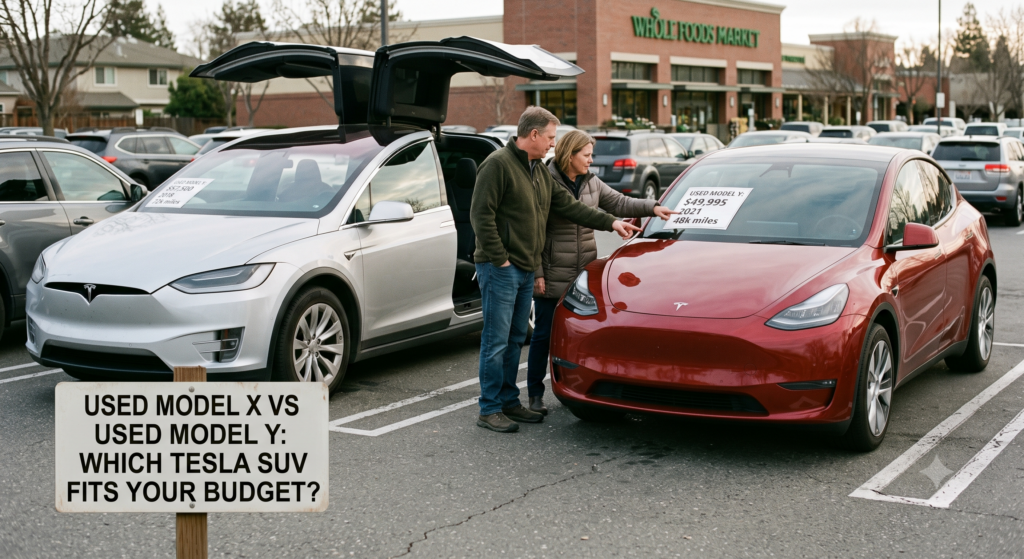
The used Tesla SUV market in 2026 presents buyers with a fascinating crossroads. On one side stands the Tesla Model X, the original flagship family hauler with its dramatic Falcon Wing doors, cavernous three-row interior, and undeniable road presence. On the other side sits the Tesla Model Y, the compact crossover that outsold virtually every competitor in its class and became the default choice for families transitioning to electric mobility. When both vehicles appear on the secondary market at overlapping price points, the question becomes less about which is the “better” SUV and more about which one aligns with your actual budget, tolerance for maintenance risk, and daily driving reality. A 2018 Model X 75D and a 2021 Model Y Long Range might list within $3,000 of each other, yet they represent entirely different philosophies of ownership: one is a depreciated luxury statement with aging complexity, the other is a mass-market tool with modern efficiency and lower running costs.
This comprehensive comparison breaks down the real-world financial and practical differences between buying a used Model X and a used Model Y in 2026. We examine purchase prices, hidden repair risks, daily usability, technology relevance, and the total cost of ownership over a typical three-to-five-year period. By the end, you will know definitively whether your garage needs the grandeur of the X or the pragmatic efficiency of the Y.
The Price Overlap: Where Budgets Collide
As of mid-2026, the used Model X market has depreciated to levels that place it in direct competition with newer Model Y inventory. Early 2016–2017 Model X 75D examples with higher mileage now trade between $24,000 and $32,000, while cleaner 2018–2019 Long Range variants typically list from $32,000 to $45,000. Late 2020–2021 Model X vehicles before the refresh command $45,000 to $58,000, and refreshed 2022+ Long Range examples remain premium products at $65,000+.
The used Model Y market, by contrast, offers a narrower but more value-dense range. A 2020–2021 Long Range with moderate mileage trades between $28,000 and $36,000, while 2022–2023 examples with remaining warranty coverage list from $34,000 to $44,000. Even 2024 Highland-influenced Model Y vehicles are beginning to appear on the secondary market at $42,000 to $48,000.
This creates several direct budget confrontations. A buyer with $35,000 can choose between a 2018 Model X 75D with 70,000 miles and a 2021 Model Y Long Range with 45,000 miles. A buyer with $45,000 can select a 2019 Model X Long Range or a nearly new 2023 Model Y Performance. The Model X offers more space, presence, and luxury cachet, but it is older, likely out of warranty, and carries the notorious Falcon Wing door liability. The Model Y is newer, more efficient, cheaper to insure, and mechanically simpler, but it lacks the third-row versatility and commanding road presence of its larger sibling. Understanding this trade-off is the foundation of making the right choice.
Interior Space and Family Practicality
If your primary need is moving people and cargo, the Model X remains unrivaled within the Tesla ecosystem. It is a true full-size SUV with available seating for up to seven adults, though the third row is best suited for children or shorter passengers. The Falcon Wing doors, when functioning correctly, provide an enormous opening for installing child seats, assisting elderly passengers, or loading bulky items in tight parking spaces. The front trunk is significantly larger than the Model Y’s, and the overall cabin volume creates an airy, lounge-like atmosphere that the compact Model Y cannot replicate.
However, the Model Y is not the penalty box that its smaller exterior dimensions might suggest. Its five-seat configuration offers generous rear legroom for two adults or three children, and the optional third row—while extremely cramped—can accommodate small children in a pinch. The Model Y’s hatchback cargo area is deep and continuous, lacking the Model X’s stepped floor and door mechanism intrusions. For families of four or fewer, the Model Y provides entirely adequate space, while families of five or more who regularly use every seat will find the Model X’s larger footprint genuinely necessary.
The critical distinction is how often you need that extra space. If you transport seven people twice a year, the Model Y’s limitations are manageable. If you carpool daily or have three children in car seats, the Model X’s easier access and wider cabin justify its complexities. Do not pay for Model X space that you will not actually use.
Reliability and Repair Costs: The Hidden Budget Killer
This is where the Model Y pulls decisively ahead for budget-conscious buyers. The Model X is one of the most complex vehicles Tesla has ever built, and that complexity translates directly into repair invoices that can dwarf the Model Y’s entire annual operating budget.
The Falcon Wing doors alone represent a potential $3,000 to $8,000 liability over five years of ownership. Sensor recalibration, seal replacement, hinge refurbishment, and actuator motor failures are not hypothetical concerns; they are statistical probabilities on any Model X built before 2020. Even a single door motor replacement can cost $1,200, and a full seal refresh approaches $2,000. These are not maintenance items; they are inevitable wear points that the Model Y’s conventional doors simply do not have.
The Model X’sair suspension is another budget risk. While it delivers a sublime ride when functioning, the compressors, air struts, and ride height sensors are prone to failure after six to eight years. A corner that sags overnight indicates a leaking strut; replacement costs $1,500 to $2,500 per corner at a Tesla Service Center. The Model Y uses conventional steel springs that are virtually maintenance-free and cost a fraction to replace if a shock absorber eventually wears out.
Battery and drivetrain reliability are more comparable, as both vehicles use similar NCA cell chemistry and dual-motor architectures in their Long Range trims. However, the Model X is heavier and less aerodynamic, placing slightly more stress on its drive units during acceleration. Early Model X vehicles also suffered from half-shaft wear and front motor milling noise at higher mileages—issues that are far less common in the lighter, simpler Model Y.
For buyers financing their purchase, the Model Y’s predictability is a financial sanctuary. You can budget for tires, brake pads, and a 12-volt battery replacement. The Model X demands an emergency repair fund that the Model Y simply does not require.
Technology and Hardware: New vs. Aging Platforms
The Model Y benefits from being a newer platform designed with manufacturing lessons learned from the Model S and Model X. Every Model Y from 2020 onward ships with Hardware 3 (HW3) or later, ensuring compatibility with current Autopilot and Full Self-Driving features. The 2024+ examples feature Hardware 4 (HW4), future-proofing them for the next wave of autonomous software. The interior, while less luxurious than the Model X’s, is ergonomically modern, with wireless charging, USB-C ports, and a minimalist layout that has aged well.
The Model X, particularly 2016–2019 examples, carries older technology that affects daily satisfaction. Early vehicles shipped with MCU1, the infamous NVIDIA Tegra unit prone to yellow border screen discoloration and eMMC memory failure. Even 2017–2018 vehicles with MCU2 lack the processing responsiveness of newer Intel-based systems. The Autopilot hardware on pre-2020 Model X vehicles ranges from HW2.0 to HW2.5, none of which can run modern FSD Beta. If autonomous driving capability matters to you, a used Model X from the earlier years is technologically obsolete regardless of its physical grandeur.
The refreshed 2022+ Model X finally addressed these issues with HW3, a new yoke or round steering wheel option, and a rear passenger screen. But these refreshed vehicles command prices that place them well above any Model Y, eliminating the budget comparison entirely. For the overlapping price range of $30,000 to $45,000, you are comparing an aging Model X against a modern Model Y, and the technology gap is significant.
Don’t risk buying a used Model X with failing Falcon Wing doors or a degraded air suspension. At Tesla.tl, every Model X listing includes verified door mechanism health, suspension diagnostics, and battery reports so you know exactly what maintenance budget you are inheriting. Browse inspected Model X inventory and buy with confidence at https://tesla.tl/.
Daily Driving Dynamics and Efficiency
The Model Y is the more efficient vehicle by every measurable metric. Its smaller frontal area, lighter curb weight, and more aerodynamic shape allow it to extract significantly more miles per kilowatt-hour. A Model Y Long Range typically achieves 3.8 to 4.2 miles per kWh in mixed driving, while a Model X Long Range manages 2.8 to 3.3 miles per kWh. Over 12,000 miles annually, this efficiency difference translates to roughly $200 to $400 in additional electricity costs for the Model X, assuming home charging rates. For drivers who rely on Superchargers where per-kWh rates are higher, the gap widens further.
The Model Y is also more nimble. Its compact dimensions make parking effortless, lane changes confident, and urban navigation stress-free. The Model X, while not unwieldy, feels large in tight parking structures, narrow European streets, or congested city centers. The Falcon Wing doors require overhead clearance that standard parking garages sometimes lack, forcing you to park in open-air spaces or constantly worry about ceiling height.
Ride quality favors the Model X when its air suspension is healthy. In comfort mode, it glides over broken pavement with a isolation that approaches German luxury SUVs. The Model Y’s steel-spring suspension is firmer and more communicative, which enthusiasts appreciate but passengers on rough roads may find less cosseting. However, if the Model X’s air suspension is even slightly degraded—a common scenario on used examples—the ride becomes bouncy, uneven, and genuinely unpleasant, while the Model Y’s simpler setup remains consistent.
Insurance, Tires, and Total Cost of Ownership
Insurance companies view the Model X as a luxury vehicle with expensive repair potential, and premiums reflect this reality. In 2026, annual insurance for a used Model X typically runs $400 to $1,000 higher than an equivalent Model Y, depending on the driver’s age, location, and record. The Model X’s aluminum body panels, complex door mechanisms, and higher original MSRP push it into premium insurance brackets even after depreciation.
Tire costs also diverge. The Model X wears larger, more expensive tires, particularly on Performance variants with 22-inch wheels. A full set can cost $1,800 to $2,500 and may last only 25,000 to 35,000 miles. The Model Y’s19-inch or 20-inch tires are cheaper, more widely available, and longer-lasting. Over a five-year ownership period, the Model X owner may spend $3,000 to $5,000 more on rubber alone.
When you aggregate insurance premiums, tire replacements, potential door repairs, suspension maintenance, and higher electricity consumption, the Model X can cost $6,000 to $12,000 more than a Model Y over a typical ownership cycle. This is not a trivial difference. It represents the cost of luxury and space that must be justified by genuine need rather than desire.
When the Model X Is the Right Choice
Despite its higher costs, the used Model X remains the correct choice for specific buyers. Choose it if you genuinely require three-row seating on a weekly basis, particularly for children who benefit from the easy access provided by the Falcon Wing doors. Choose it if you frequently transport bulky cargo that benefits from the larger front trunk and wider cargo bay. Choose it if you value the commanding road presence, the panoramic windshield, and the luxury ambiance that the Model Y simply cannot replicate. And choose it if your budget includes a $5,000 emergency repair reserve without financial strain.
The Model X is also the better tow vehicle. When properly equipped, it can tow significantly more than the Model Y, and its heavier curb weight provides more stability with a trailer. For buyers with boats, campers, or utility trailers, this capability is non-negotiable.
When the Model Y Is the Smarter Financial Decision
For the vast majority of buyers comparing these two vehicles on a budget, the Model Y is the rational, lower-risk choice. It offers sufficient space for small families, modern technology that will remain relevant longer, dramatically lower maintenance costs, cheaper insurance, and better efficiency. The money saved on purchase price and running costs can fund a home charging installation, a solar array, or simply remain in your emergency fund.
The Model Y is also the better choice for buyers who plan to keep their vehicle for seven to ten years. Its newer platform, simpler mechanics, and ongoing software support ensure that a 2021 Model Y will feel current in 2031, while a 2018 Model X will increasingly feel like a vintage luxury car with expensive upkeep.
Final Verdict: Budget vs. Grandeur
The used Model X vs. Model Y decision in 2026 is fundamentally a choice between grandeur and pragmatism. The Model X offers space, presence, and luxury that the Model Y cannot match, but it demands a higher purchase price, a larger maintenance budget, and a tolerance for complexity. The Model Y sacrifices the flagship experience for modern efficiency, lower risk, and stronger long-term value retention.
If your budget is strict and your needs are typical—a family of four, suburban commuting, occasional road trips—the Model Y delivers 95% of the Tesla SUV experience at 60% of the total ownership cost. If your budget is flexible and your needs are specific—three rows, frequent cargo hauling, or an emotional attachment to the Falcon Wing spectacle—the Model X can be a rewarding choice, provided you enter the relationship with eyes wide open and wallet appropriately padded.
Do not let the Model X’s depreciated sticker price seduce you into ignoring its true cost of ownership. A cheap 2017 Model X 75D that needs $6,000 in door and suspension repairs within the first year is more expensive than a pristine 2021 Model Y Long Range purchased at fair market value. Buy the vehicle that fits your life, your budget, and your tolerance for maintenance, not the one that impresses your neighbors.
Ready to choose between a used Model X and a used Model Y? Compare verified listings side by side at Tesla.tl. Filter by budget, seating capacity, door mechanism health, and warranty status to find the Tesla SUV that matches your financial plan and your family needs. Visit https://tesla.tl/ and drive electric with confidence today.
