
Raven Model S vs Pre-Raven: Used Buyer’s Technical Guide
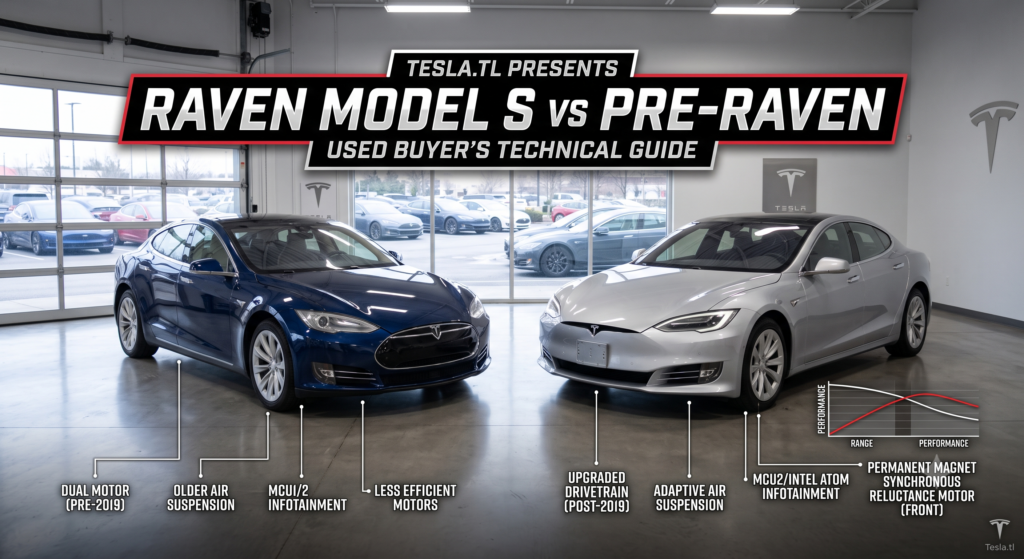
The Tesla Model S underwent its most significant mechanical transformation in 2019, when Tesla introduced an internal codename that would forever split the model’s history into two distinct eras: Raven and Pre-Raven. For buyers navigating the used Model S market in 2026, this is not merely a trivia distinction. It is the dividing line between a vehicle that represents Tesla’s early, experimental luxury sedan efforts and one that emerged as a mature, technologically sophisticated competitor to the Mercedes S-Class and BMW 7 Series. The Raven update addressed virtually every major weakness that had plagued the Model S since its 2012 debut, yet it arrived on a body shell that looked nearly identical to casual observers. This creates a dangerous trap for uninformed buyers: a 2018 Pre-Raven and a 2019 Raven may appear side-by-side on a dealership lot with similar mileage and only a modest price gap, but beneath their shared silhouettes lies a chasm of difference in efficiency, reliability, ride quality, and long-term viability.
This technical guide dissects exactly what separates the Raven from the Pre-Raven architecture, explains why the Raven’s permanent magnet front motor and adaptive suspension represent genuine engineering breakthroughs, identifies which Pre-Raven weaknesses persist and which the Raven finally resolved, and provides the pricing context necessary to determine whether the newer hardware justifies its premium on the used market.
What Is Raven? The 2019 Mechanical Revolution
The Raven update, introduced in mid-2019, was not a cosmetic refresh. Tesla deliberately avoided dramatic styling changes, choosing instead to overhaul the Model S from the powertrain outward. The name itself derived from the new permanent magnet reluctance front motor—internally codenamed “Raven”—that replaced the older induction front motor used in all dual-motor Pre-Raven vehicles. This was accompanied by an entirely new adaptive air suspension system with real-time damping control, revised rear motor hardware for improved efficiency, and incremental but meaningful upgrades to thermal management and regenerative braking calibration.
For Tesla, the Raven represented an admission that the Model S needed to evolve beyond its startup-era roots. The original platform, while revolutionary in 2012, had accumulated a decade of compromises: inefficient induction motors, an air suspension that leaked and sagged, door handles that failed with metronomic regularity, and a ride quality that was competent but never truly competitive with established luxury flagships. The Raven was Tesla’s answer to these criticisms—a Model S that finally drove like the $100,000 vehicle it was priced as.
Pre-Raven: The Pioneer’s Burden
The Pre-Raven Model S—encompassing all vehicles produced from 2012 through early 2019—is not without merit. These cars proved that electric vehicles could be desirable, fast, and practical. They established the Supercharger network as a viable long-distance travel solution. They introduced the world to over-the-air updates and the minimalist interior aesthetic that now defines the industry. But they also carried the burden of being first.
Pre-Raven vehicles used asynchronous induction motors front and rear in dual-motor configurations. While robust and capable of delivering thrilling acceleration, these motors are less efficient than permanent magnet designs, generating more waste heat and consuming more energy per mile. The original air suspension—sourced from early suppliers and calibrated for comfort rather than control—was prone to compressor failures, air strut leaks, and ride height sensor drift. The door handles, a signature design flourish, became infamous for their complexity and failure rate. The Media Control Unit (MCU1) in early cars suffered from eMMC memory degradation that eventually bricked the touchscreen.
By 2019, Tesla had addressed many of these issues incrementally. Later Pre-Raven cars had better door handles, improved MCU2 availability, and more reliable suspension components. But the fundamental architecture remained rooted in 2012 decisions. The Raven was the clean-sheet rethink that the platform needed.
Motors and Efficiency: The Heart of the Difference
The most consequential technical divergence between Raven and Pre-Raven lies in the front motor. Pre-Raven dual-motor vehicles used an induction motor at the front axle. Induction motors are simple, powerful, and excellent for delivering bursts of acceleration. However, they suffer from rotor losses—energy dissipated as heat in the rotor rather than converted to motion—particularly at highway cruising speeds where the motor spins continuously without the cooling benefit of aggressive airflow.
The Raven’spermanent magnet synchronous reluctance motor eliminates these rotor losses. Permanent magnets embedded in the rotor create magnetic fields without requiring continuous electrical excitation, dramatically improving efficiency during steady-state cruising. Tesla paired this with an updated silicon carbide inverter that reduced switching losses and improved thermal management. The result was a 10% to 15% improvement in real-world efficiency compared to equivalent Pre-Raven vehicles with the same battery pack.
For used buyers in 2026, this efficiency gain translates directly to range. A 2019 Raven Long Range with a 100 kWh battery might deliver 320 to 340 miles of real-world range in temperate conditions, while a 2018 Pre-Raven 100D with identical battery capacity typically manages 290 to 310 miles. Over years of ownership, this efficiency also reduces per-mile energy costs and slows battery degradation because the pack is less stressed to deliver the same distance. The Raven motor runs cooler, works less hard, and ages more gracefully.
The rear motor also received updates in the Raven, though less dramatically. It remained an induction design but with improved bearings, better thermal management, and refined software calibration that reduced noise and vibration during regenerative braking. The combined effect of both motor upgrades is a drivetrain that feels more refined, more efficient, and less strained during daily use.
Suspension: Adaptive Damping vs. Original Air Ride
If the motor upgrade is the Raven’s heart, the adaptive air suspension is its soul. The Pre-Raven air suspension was a binary system: you selected a ride height, and the suspension maintained it. There was no real-time adjustment to road conditions, no predictive damping based on speed or steering input, and no ability to stiffen the chassis for aggressive cornering while maintaining plushness on the highway. The system was also mechanically fragile, with air struts that leaked after 60,000 to 80,000 miles and compressors that labored audibly when raising the vehicle.
The Raven’s adaptive system, by contrast, uses continuously variable damping that adjusts each shock absorber hundreds of times per second based on road surface data, steering angle, brake pressure, and acceleration forces. It can soften the ride to glide over expansion joints, then instantly firm the dampers to eliminate body roll during a lane change. It lowers the vehicle automatically at highway speeds to improve aerodynamic efficiency, then raises it for driveway entries or speed bumps. The difference in ride quality is not subtle—it is transformative.
For used buyers, the suspension reliability gap is equally significant. The Raven’s air struts and compressors were redesigned with more durable materials and better sealing. While not immune to failure, they fail less frequently and less catastrophically than Pre-Raven units. A 2018 Pre-Raven with original air suspension at 70,000 miles is a ticking time bomb for a $3,000 to $5,000 repair bill. A 2019 Raven at the same mileage typically has more life remaining in its components, and when failures do occur, the redesigned parts are easier to service.
Range, Charging, and Thermal Management
The Raven’s efficiency improvements extended range without increasing battery size. A 2019 Raven Long Range achieved an EPA rating of 370 miles when new, compared to 335 miles for the 2018 Pre-Raven 100D. In 2026, after degradation, this gap persists: a well-maintained Raven typically shows 300 to 330 miles at 100% charge, while an equivalent Pre-Raven shows 270 to 300 miles.
The Raven also introduced more sophisticated battery preconditioning for DC fast charging. When navigating to a Supercharger, the Raven heats the battery pack to its optimal temperature en route, reducing charging times and minimizing thermal stress. Pre-Raven vehicles precondition less aggressively, meaning charging sessions take slightly longer and subject the battery to more heat cycles over time. For buyers who road-trip frequently, this marginal improvement compounds into meaningful time savings and better long-term battery health.
Interior, Noise, and Build Quality
While the Raven did not fundamentally redesign the Model S interior, it introduced refinements that addressed long-standing owner complaints. The Raven era saw improved door seal designs that reduced wind noise at highway speeds—a persistent weakness of the Pre-Raven cars, particularly early examples with single-pane glass. The MCU2 became standard, eliminating the eMMC failure risk and delivering a responsive touchscreen experience that Pre-Raven owners with MCU1 could only dream of.
Build quality during the Raven era reached its zenith for the original Model S platform. Panel gaps tightened further, interior materials showed better consistency, and the overall sense of solidity approached German luxury standards in a way that earlier cars never quite managed. For used buyers in 2026, a 2019 Raven feels noticeably more solid and quieter than a 2017 Pre-Raven, even when both have been maintained identically.
Don’t risk buying a used Model S with a failing Pre-Raven air suspension or an obsolete induction motor. At Tesla.tl, every listing identifies Raven vs Pre-Raven status, verifies suspension health, and confirms motor hardware so you know exactly which generation you are buying. Browse inspected Model S inventory and buy with confidence at https://tesla.tl/.
Known Issues: Pre-Raven vs. Raven
Pre-Raven Persistent Weaknesses:
- Door handles: High failure rate on all years; budget for replacement.
- MCU1 (2012–2017): eMMC degradation and yellow border; requires MCU2 retrofit.
- Air suspension: Strut leaks, compressor failures, and ride height sensor drift.
- Drive unit milling: Early induction motors can develop bearing noise.
- Battery degradation: Older NCA chemistry and less sophisticated thermal management.
Raven-Specific Weaknesses:
- Front motor rarity: The permanent magnet motor is reliable but expensive if damaged; fewer independent repair options exist compared to induction motors.
- Adaptive suspension complexity: While more durable, the electronic damping system is more complex to diagnose if failures occur.
- HW2.5 limitations: Early Raven vehicles shipped with HW2.5, which cannot run modern FSD Beta. Verify hardware before paying for software premiums.
Pricing Landscape in 2026
The used market in 2026 reflects the Raven’s superiority with a clear but not insurmountable premium.
- 2017–2018 Pre-Raven 100D: $28,000–$38,000
- 2019 Raven Long Range: $38,000–$48,000
- 2019 Raven Performance: $45,000–$55,000
The $10,000 to $15,000 gap between late Pre-Raven and early Raven examples is justified by the motor efficiency, suspension refinement, and reliability improvements. However, for buyers on tight budgets, a well-maintained 2018 Pre-Raven with recent air suspension service and an MCU2 upgrade can deliver 85% of the Raven experience at a significant discount.
Which Should You Buy?
Choose Pre-Raven if:
- Your budget is capped below $35,000.
- You are mechanically savvy and willing to address door handles and suspension proactively.
- You found a late Pre-Raven with MCU2 already installed and recent air suspension refresh.
- You view the Model S as a hobby or project rather than a trouble-free daily driver.
Choose Raven if:
- You want the most refined, efficient, and reliable Model S experience on the original platform.
- You prioritize ride quality and long-distance comfort.
- You plan to keep the vehicle for five or more years and want the longest possible software support.
- Your budget allows for the premium, which pays dividends in reduced maintenance and superior efficiency.
Final Verdict
The Raven update transformed the Model S from a brilliant but flawed pioneer into a mature luxury sedan that could genuinely compete with the best from Germany. The permanent magnet motor, adaptive suspension, and improved efficiency are not incremental upgrades—they are foundational improvements that affect every mile of ownership. For buyers in 2026, the Raven is the default recommendation unless budget constraints force a Pre-Raven compromise. And even then, the Pre-Raven can be a satisfying purchase if you enter with eyes open, budget for known weaknesses, and verify that critical upgrades like MCU2 have already been completed.
Ready to choose between a Raven and Pre-Raven Model S? Compare verified listings with motor specifications, suspension health reports, and battery diagnostics at Tesla.tl. Filter by generation, trim, and service history to find the Model S that matches your technical needs and your budget. Visit https://tesla.tl/ and drive the future today.
