Used Tesla Model S: Air Suspension Issues & Real Repair Costs
The Tesla Model S has always marketed itself as a technological flagship, and nowhere is that ambition more visible—or more fragile—than in its air suspension system. Unlike the conventional steel springs found on economy sedans or even the fixed coil springs of the Model 3, the Model S rides on a complex network of compressed air, rubber bellows, electronic valves, and ride-height sensors that promise a magic-carpet glide over broken pavement. When functioning correctly, the system is genuinely impressive. It can raise the vehicle for steep driveways, lower it at highway speeds to improve aerodynamic efficiency, and adjust damping rates in real time to balance comfort and control. But for used Model S buyers in 2026, the air suspension is also the single most expensive and failure-prone subsystem on the vehicle. It is the feature that transforms a serene luxury sedan into a clunking, sagging money pit, and it is the reason many experienced Tesla owners actively seek out the rare base-model Model S examples that shipped with conventional coil springs.
This guide examines the air suspension from every angle that matters to a prospective buyer. We explain exactly how the system works, which components fail and why, the specific symptoms that manifest across different model years, and—most critically—the real repair costs you will face when the inevitable breakdown occurs. By the end, you will know whether the air suspension’s comfort justifies its risk, how to inspect a system before purchase, and whether you should walk away from a seemingly perfect Model S simply because it rides on compressed air.
How the Model S Air Suspension Works
To understand why the Model S air suspension fails, you must first understand what you are actually buying. The system is not merely a set of inflatable bags replacing metal springs. It is an integrated electro-pneumatic network managed by the vehicle’s central computer, constantly adjusting to road conditions, speed, steering input, and driver-selected modes.
At the core of the system is an electric air compressor—often called the “pump”—mounted beneath the front trunk area. This compressor draws ambient air, filters it, and pressurizes a reservoir tank to approximately 150 psi. From this reservoir, solenoid valves distribute air to four air struts (also called air springs), one at each corner. Each strut contains a rubber bellows that expands or contracts to raise or lower the vehicle. Ride-height sensors attached to each control arm measure the distance between the wheel hub and the chassis, feeding data to the suspension control module thousands of times per second. When the system detects sagging—whether from passenger load, cargo weight, or air loss—it opens valves to add pressure. When the vehicle accelerates onto a highway, the system lowers the body to reduce drag and improve stability.
The Raven update introduced in 2019 added adaptive damping to this architecture. Dampers with electronically controlled valves adjust their stiffness in milliseconds, working in concert with the air springs to provide a more sophisticated ride than the binary “soft or firm” settings of earlier systems. This complexity is wonderful when new and deeply problematic after eight to ten years of thermal cycling, road salt exposure, and rubber degradation.
The Failure Points: What Breaks and Why
The Model S air suspension has multiple failure modes, and they rarely announce themselves politely. Understanding each component’s typical lifespan helps you anticipate costs rather than being blindsided by a dashboard warning at the worst possible moment.
Air Strut / Air Spring Leaks The rubber bellows within each air strut flex millions of times over the vehicle’s life. Each compression and rebound microscopically stresses the rubber, eventually creating pinhole leaks or larger ruptures. Cold weather accelerates this process by making the rubber less pliable. When a strut leaks, that corner of the vehicle slowly sinks overnight. The compressor runs longer and more frequently to compensate, eventually burning itself out from overwork. A single leaking front strut is the most common failure, followed by rear struts. By 2026, any Pre-Raven Model S with original struts and over 60,000 miles is living on borrowed time. Raven struts are more durable but not immortal; they typically begin showing issues between 70,000 and 100,000 miles depending on climate.
Compressor Failure The compressor is the heart of the system, and it is surprisingly fragile. Early Pre-Raven compressors were particularly prone to overheating and internal wear. When a strut leaks, the compressor works overtime, generating excess heat that degrades its piston seals and motor windings. Eventually, the compressor fails entirely, leaving the vehicle stuck at whatever height it last achieved—or dropped to its bump stops. A failed compressor also means the system cannot raise for speed bumps or steep driveways, transforming daily driving into a logistical obstacle course.
Ride Height Sensor Drift and Damage The four ride-height sensors are exposed to road spray, salt, gravel, and physical impacts from potholes. Over time, their internal potentiometers wear, producing erratic readings that confuse the suspension module. The car may attempt to level itself endlessly, oscillating up and down while parked, or it may throw error codes and default to a safe mode that locks the suspension at standard height. Physical damage to sensor linkages is common after curb strikes or off-road excursions that the low-slung Model S should never attempt.
Valve Block and Air Line Issues The valve block distributes air from the reservoir to each strut. Its solenoids can stick open or closed due to moisture contamination or debris. Air lines can chafe against chassis components, developing slow leaks that are maddeningly difficult to trace without smoke-testing equipment. In humid climates, moisture accumulation in the reservoir can freeze in winter, blocking air flow and triggering system faults.
Adaptive Damper Failures (Raven Only) The Raven’s electronically controlled dampers add another layer of complexity. While the dampers themselves are more durable than the air springs, their internal valves and external wiring harnesses can fail. When they do, the system loses its ability to adjust ride stiffness, defaulting to a compromised middle setting that is neither comfortable nor sporty.
Symptoms You Cannot Ignore
A failing Model S air suspension does not whisper its distress; it broadcasts it through multiple sensory channels. During your pre-purchase inspection and test drive, watch and listen for these specific warning signs.
Overnight Sagging The most definitive symptom is a corner or entire end of the vehicle that sits noticeably lower after being parked for eight hours. A healthy system maintains height for days. If the nose or tail dips overnight, air is escaping somewhere. Check all four corners with a tape measure before and after a test drive.
Compressor Noise and Duty Cycle A healthy compressor operates briefly—perhaps ten to twenty seconds—when the door is opened or the vehicle is started. If the compressor runs continuously during your drive, cycles loudly every few minutes while parked, or emits a strained whining sound, it is either compensating for a leak or approaching mechanical failure.
Suspension Fault Warnings The touchscreen may display “Air Suspension Needs Service,” “Suspension Height Adjustment Unavailable,” or specific codes indicating compressor overheat. Do not dismiss these as temporary glitches. They indicate that the system has detected a fault serious enough to log in the vehicle’s memory.
Uneven Ride Height Park the vehicle on perfectly flat ground and step back. The body should sit level side-to-side. If one corner is visibly lower, that strut is failing. If the front sits higher than the rear in “Standard” mode, the calibration is drifted or a sensor is lying.
Bouncy or Harsh Ride A leaking air spring does not always sag immediately. Sometimes it develops internal damage that allows the strut to bounce excessively over bumps rather than absorbing them. If the ride feels like a 1980s Cadillac with worn shocks—floating and wallowing—the air springs are likely compromised.
Real Repair Costs in 2026
This is where fantasy meets reality. The Model S air suspension is not a system you can cheaply patch with junkyard parts and a prayer. Tesla’s proprietary design, limited aftermarket support, and the system’s integration with vehicle software mean that repairs are expensive, often requiring specialized tools and diagnostic equipment.
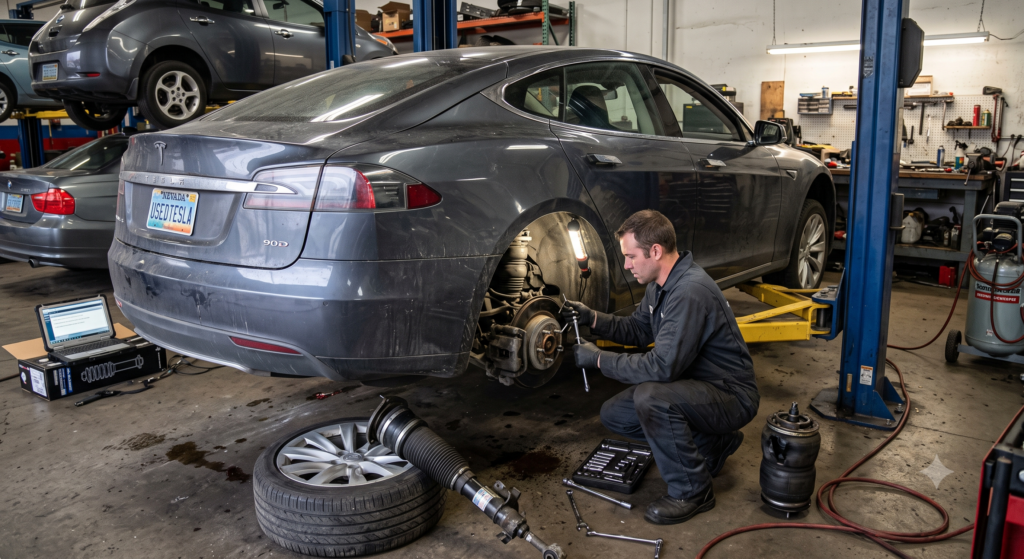
Air Strut Replacement (Per Corner) A single OEM Model S air strut from Tesla costs between $800 and $1,200 depending on whether it is a front or rear unit and whether it includes the adaptive damper (Raven). Independent shops can sometimes source quality remanufactured struts for $400 to $700, but quality varies wildly. Labor for replacing one strut typically runs $300 to $500 because the procedure requires disassembling suspension components, recalibrating ride-height sensors, and bleeding the system. Replacing all four struts at a Tesla Service Center can easily total $5,000 to $7,000. Using a reputable independent Tesla specialist might reduce this to $3,000 to $4,500, but it remains a major expense.
Compressor Replacement A new OEM compressor costs approximately $900 to $1,300. Labor adds another $400 to $600 because the unit is tucked beneath the front trunk and requires removal of the frunk tub and surrounding panels. Some owners opt for remanufactured compressors at $500 to $700, but these carry shorter warranties and may fail sooner. Total replacement cost: $1,300 to $2,200 depending on shop and parts choice.
Ride Height Sensor Replacement Each sensor costs $150 to $250 for the part, with labor at $100 to $200 per corner due to calibration requirements. While not catastrophic individually, sensor failures often occur in pairs or indicate underlying strut issues that caused the sensor to work overtime.
Valve Block and Air Line Repairs A replacement valve block costs $400 to $700, plus $200 to $400 in labor. Air line leaks are cheaper if accessible—perhaps $200 to $400 to replace a chafed section—but diagnosing the leak location can require smoke-testing equipment and hours of labor that add $300 to $500 to the bill.
Adaptive Damper Replacement (Raven) If the Raven’s electronic dampers fail, each unit costs $600 to $900, with labor similar to strut replacement. Because the damper and air spring are integrated on some configurations, you may face a combined replacement bill exceeding $1,500 per corner.
Total System Overhaul For a high-mileage Pre-Raven Model S with multiple failing components, a complete air suspension refresh—struts, compressor, valve block, sensors, and lines—can approach $8,000 to $12,000 at a Tesla Service Center. Even at an independent shop, expect $5,000 to $8,000 for a comprehensive rebuild. This is not hyperbole; it is the documented experience of owners who assumed the system would last longer than it did.
Don’t risk buying a used Model S with a failing air suspension that will cost thousands to repair. At Tesla.tl, every listing includes verified suspension health reports, compressor function tests, and ride-height sensor diagnostics so you know exactly what you are inheriting. Browse inspected Model S inventory and buy with confidence at https://tesla.tl/.
Pre-Raven vs. Raven: Does the Generation Matter?
Absolutely. The Pre-Raven (2012–2018) air suspension was Tesla’s first-generation design, and it shows. The struts use earlier rubber compounds that degrade faster in heat and cold. The compressors are less robust and more prone to overheating. The calibration software is less sophisticated, meaning the system works harder to maintain height. If you are considering a Pre-Raven Model S, assume the air suspension is either recently rebuilt or due for imminent failure. Budget accordingly or negotiate the purchase price to reflect a pending $5,000+ repair.
The Raven (2019+) introduced significantly improved air struts with more durable bellows, a redesigned compressor with better thermal management, and adaptive damping that reduces stress on the springs by smoothing out impacts. Raven suspensions fail less frequently and later in life, but they are more expensive to repair when they do fail because the adaptive dampers add parts cost and complexity. A 2019 Raven with 50,000 miles may have another 50,000 miles of healthy suspension ahead of it. A 2016 Pre-Raven with the same mileage is already on thin ice.
Should You Avoid Air Suspension Entirely?
For some buyers, the answer is yes. Tesla offered a coil spring suspension on base Model S configurations in certain years and regions. These vehicles ride slightly firmer and lack the adjustable height feature, but they eliminate the entire ecosystem of compressors, struts, and sensors that drain wallets. A used Model S with coil springs is mechanically simpler, cheaper to maintain, and often more reliable long-term. The trade-off is a ride that is less plush and the inability to raise the vehicle for steep driveways.
If you live in a region with poor road maintenance, extreme temperature swings, or high humidity, the coil spring option becomes even more attractive. The air suspension’s complexity is rewarding only if you genuinely value the adjustable ride and are financially prepared for its eventual demands.
Pre-Purchase Inspection Checklist
Before buying any used Model S with air suspension, perform or demand these checks:
- [ ] Measure ride height at all four corners after the vehicle has sat overnight on flat ground.
- [ ] Listen to the compressor during startup and door opening; it should run briefly and quietly.
- [ ] Cycle through all ride height settings (Very High, High, Standard, Low, Very Low) and verify smooth, prompt adjustment.
- [ ] Drive over speed bumps and listen for air leaks or compressor strain.
- [ ] Check for suspension fault codes in the vehicle’s service menu.
- [ ] Inspect the front trunk area for compressor noise, vibration, or signs of previous replacement.
- [ ] Ask for service records specifically mentioning suspension work, strut replacements, or compressor repairs.
- [ ] Verify that the vehicle does not sag after being parked for 30 minutes during your test drive.
Final Verdict
The Tesla Model S air suspension is a masterpiece of comfort engineering and a potential financial catastrophe. It transforms the driving experience when new but demands expensive tribute as it ages. For used buyers in 2026, the system should not be treated as a bonus feature but as a major variable in the total cost of ownership. A Pre-Raven with original air suspension is a ticking time bomb that can turn a $25,000 purchase into a $35,000 investment overnight. A Raven with verified recent suspension service is a safer bet but still carries risk.
If you choose to buy an air-suspended Model S, do so with a dedicated maintenance fund, a trusted independent Tesla specialist, and realistic expectations. If you prefer simplicity and predictability, hunt for the rare coil-spring examples or accept that the Model 3‘s fixed suspension may be the wiser choice for your sanity and your bank account.
Ready to find a used Model S with a healthy suspension—or a coil-spring alternative that skips the air entirely? Search Tesla.tl for listings with verified suspension diagnostics, compressor health checks, and documented service history. Filter by suspension type, model year, and budget to find the Model S that fits your life without emptying your wallet. Visit https://tesla.tl/ and drive with peace of mind today.
